

- Luxembourg's tax neutrality, treaty network of close to ninety countries and access to EU markets make it a natural entry point for capital from outside Europe.
- Luxembourg is the largest fund centre in Europe and the second largest in the world after the United States, with more than €5 trillion under management.
- Securitisation gives investors exposure to European real estate, private credit, infrastructure and private equity without holding the underlying assets directly.
- The jurisdiction's toolbox spans RAIFs, SIFs, SICARs and securitisation vehicles, so managers can match the structure to the strategy.
- CSSF oversight and established AML and KYC frameworks give global allocators real assurance without the cost or delay of heavier regulation.
For an investor based outside Europe, the continent's capital markets are both an opportunity and a problem. The opportunity is scale: deep pools of institutional capital, a mature alternative asset market and a private credit sector still taking share from bank lending. The problem is fragmentation. Europe is a patchwork of national regimes, and a single trusted entry point into it is hard to find.
For investors and asset managers from the United States, Asia and the Middle East, Luxembourg has become that entry point. Its role as a gateway to European capital markets rests on three things working together: legal certainty, tax neutrality and the structuring flexibility to fit almost any strategy. Understanding how they combine explains why so much cross-border capital passes through it.
Why Luxembourg works as a financial conduit
Luxembourg's financial system was built around cross-border efficiency rather than domestic scale, which is why it works so well for capital arriving from outside Europe.
The first advantage is access. Securitisation vehicles and alternative funds domiciled in Luxembourg can issue securities that comply with EU regulation, and asset-backed notes structured there can be distributed across Europe to professional investors without separate authorisation in each member state. For a manager selling into several European markets, that removes a layer of national process.
The second is tax neutrality. Cross-border capital is not penalised for moving through Luxembourg: payments to investors are typically deductible at the vehicle level, there is no withholding tax on interest, and investors benefit from a treaty network covering close to ninety countries. Tax falls where the investor is, which is what institutional allocators expect.
The third is flexibility. Compartmentalised securitisation vehicles and tax-transparent partnerships, such as the special limited partnership, let a manager build a structure around a particular investor group rather than forcing every investor onto the same terms.
The scale of the Luxembourg fund industry
Luxembourg is the largest centre for investment funds in Europe and the second largest in the world after the United States, with total assets under management of more than €5 trillion. That scale matters for a reason beyond prestige. Pension funds, insurers and sovereign wealth funds already hold Luxembourg vehicles across their portfolios, so a new structure arrives as something familiar rather than an unusual one-off that needs extensive internal review.
Scale also brings depth of service. Administrators, depositaries, auditors, lawyers and paying agents in Luxembourg handle cross-border structures every day, and the cost and speed of putting a transaction together reflect that.
Securitisation as a route to European assets
Securitisation is one of the more direct ways Luxembourg connects an investor to European assets it could not otherwise reach efficiently. Under the Luxembourg securitisation law, a securitisation vehicle can acquire exposure to real estate, private credit portfolios, infrastructure or private equity and issue securities backed by it. Investors subscribe to those securities, whether asset-backed notes or credit linked notes, rather than holding the underlying assets directly.
That conversion brings practical benefits. Illiquid assets become securities with liquidity options that direct private market ownership lacks, and settlement through Euroclear and Clearstream means the notes sit in institutional custody alongside the rest of a portfolio's fixed income holdings.
Luxembourg law also supports issuing securitised instruments on a distributed ledger. Tokenisation remains an early-stage part of the market rather than the default route to issuance, but where it is used it can improve secondary market transparency and open distribution to digital-native investors.
Luxembourg fund and securitisation structures compared
What sets Luxembourg apart from most competing jurisdictions is the breadth of its toolbox. A manager can pick the format that fits the strategy rather than adapting the strategy to whatever the jurisdiction happens to offer.
| RAIF | SIF | SICAR | Securitisation vehicle | |
|---|---|---|---|---|
| Regulation | Indirect, through an authorised AIFM | Directly regulated | Dedicated risk capital regime | Generally unregulated |
| Typical use | Private equity, private credit, real estate | Niche or higher-risk strategies for sophisticated investors | Private equity and venture capital | Notes backed by almost any asset class |
| Main strength | Speed to market and investment flexibility | Flexible investment rules | Tax and regulatory design for risk capital | Versatility, private placements and syndicated deals |
The securitisation vehicle is the most versatile of the four. It can issue debt or equity instruments backed by virtually any asset class, and it is particularly well suited to private placements of credit linked notes and to syndicated transactions where efficiency matters most. The choice between a vehicle and a fund usually turns on whether the strategy is a defined pool of assets or an actively managed portfolio, a distinction our comparison of credit linked notes and RAIFs explores. This range lets a manager scale from a straightforward securitisation to a complex, multi-strategy structure without leaving the jurisdiction.
Strategic advantages for asset managers
Beyond the structures, several jurisdiction-level advantages explain why managers keep choosing Luxembourg. Recognition comes first: global institutions know the frameworks, so a Luxembourg vehicle passes through investment committees with less friction than an unfamiliar structure would. Setup and operating costs remain lower than in London or New York, particularly for unregulated securitisation vehicles and RAIFs.
Investor protection is the counterweight to that flexibility. CSSF oversight, combined with well-established AML and KYC frameworks, gives allocators assurance without the cost or delay of heavier regulation. Luxembourg's position at the centre of Europe adds multilingual expertise, proximity to EU institutions and deep connections into the rest of the continent's financial markets.
Accessing Europe through Luxembourg: an example
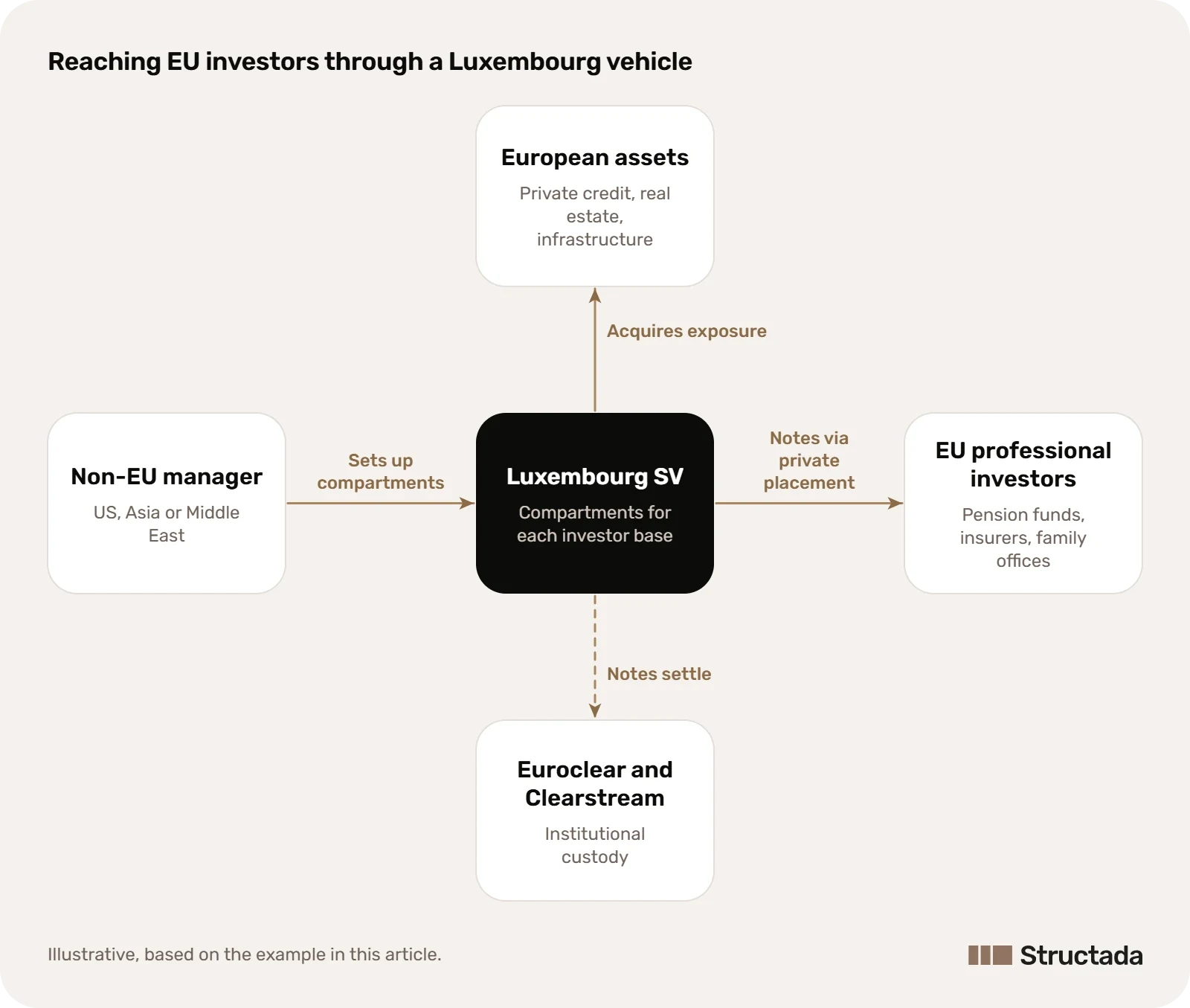
Consider a Middle Eastern asset manager building a €300 million private credit strategy aimed at European SMEs. Through Luxembourg, it could establish a securitisation vehicle with several compartments, each designed for a different investor base such as pension funds, family offices or insurers. Each compartment could issue credit linked notes with its own risk and return profile, while the treaty network keeps cross-border flows efficient for investors in different countries.
The notes could then be distributed across the EU under private placement exemptions, bringing the strategy to market considerably faster than a full UCITS or AIF structure would allow. The result is a structure that is cost-efficient to run, immediately recognisable to institutional allocators and usable as a route into European private credit from outside the region. Managers from the Gulf will find more on this route in our guide to securitising UAE and GCC assets in Luxembourg.
What this means for issuers
Luxembourg turns a fragmented continent into a market that can be reached through one trusted jurisdiction. For an issuer or manager outside Europe, that makes it the natural starting point, though the jurisdiction answers only the first question. The harder decisions are which vehicle fits the strategy, how compartments map to investor groups, and how the notes will settle and be held.
Those choices interlock, and the issuers who handle them well make them together, early, with the investor base in view. A securitisation vehicle chosen for speed can become a constraint if the strategy later needs fund-style management, and a fund chosen for familiarity can carry more cost than a defined pool of assets requires. Settling the structure against the strategy at the outset is what keeps Luxembourg working as a gateway rather than a detour.