

- A credit linked note is a debt security issued under Luxembourg's Securitisation Law and tied to a defined credit reference; a RAIF is a fund that pools investors' money into a diversified alternative strategy.
- A CLN programme can be brought to market with a lighter regulatory footprint, while a RAIF must always appoint an authorised AIFM before it can accept investors' money.
- RAIF investors must commit at least €100,000 or demonstrate professional expertise; CLN investors meet a broadly similar professional or qualified investor standard under securities law.
- A RAIF pays an annual subscription tax of around 0.01% on net assets, with exemptions for certain structures, while a CLN issued through a securitisation vehicle is treated as tax-neutral.
- CLNs are generally cheaper to run and potentially more liquid; RAIFs carry AIFM, depositary and compliance costs but can use the AIFMD marketing passport across the EU.
A credit linked note and a Reserved Alternative Investment Fund can both be established in Luxembourg. Both give professional investors exposure to credit or alternative assets, and both draw on the same jurisdiction's tax neutrality and legal certainty. Beyond that common ground, they are built to do different jobs.
The choice between a CLN and a RAIF comes down to whether an issuer needs a focused credit instrument or a genuine collective investment vehicle. Getting it wrong is costly in both directions: a fund carries regulatory and operating weight that a single credit exposure does not need, and a note lacks the reach and flexibility that a multi-strategy manager may require.
What is a credit linked note and what is a RAIF?
A credit linked note is a debt security issued under Luxembourg's Securitisation Law. Its return depends on the performance of a defined credit reference, such as a pool of loans or receivables, rather than on the issuer's general creditworthiness.
A Reserved Alternative Investment Fund is a fund structure created under the Law of 23 July 2016, designed to hold and manage a diversified pool of alternative assets on behalf of its investors. The RAIF is not itself directly supervised, but it must be managed by an authorised alternative investment fund manager, which brings it within the wider AIFMD framework indirectly. A CLN has no equivalent requirement, since it is a security rather than a collective investment scheme.
Purpose and structure
The two vehicles serve different purposes. A CLN exists to transfer a defined slice of credit risk from an issuer to investors, referencing a specific pool of loans, receivables or other credit exposures. A RAIF exists to pool investors' money into a diversified strategy, which might span private equity, real estate, infrastructure, private debt or several asset classes under one umbrella.
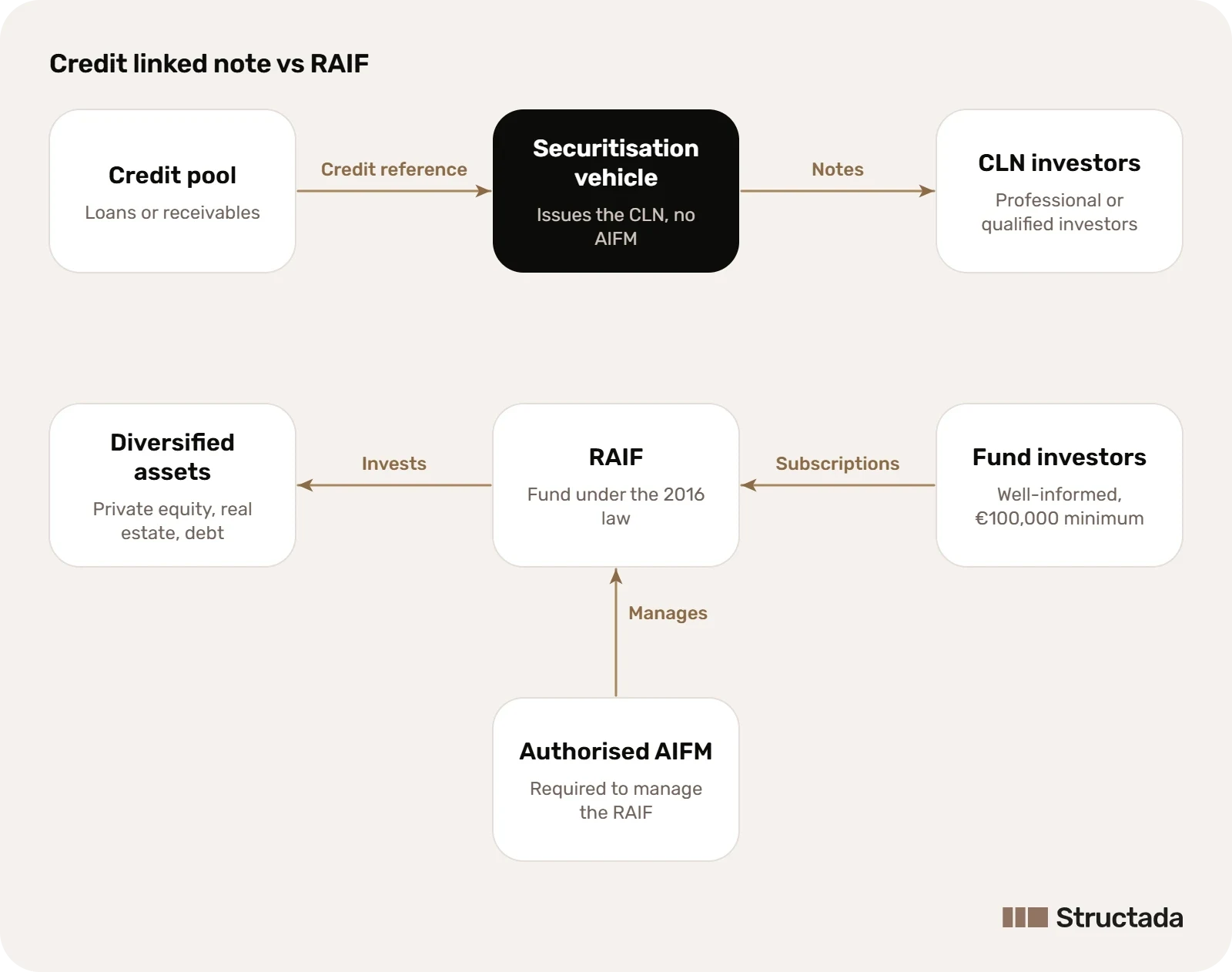
Their structures follow from that. A CLN uses a relatively simple securitisation structure, issued through a Luxembourg securitisation vehicle that can be divided into compartments if the sponsor wishes to run more than one transaction from the same legal entity. A RAIF offers considerably more variety. It can be a single fund or an umbrella with multiple sub-funds, each pursuing a different strategy, and it can take several legal forms, including a corporate vehicle or a common or special limited partnership. That flexibility suits a manager running several strategies at once, but it also means more structuring work than issuing a CLN.
Regulation and supervision
A CLN issued by private placement falls under the Securitisation Law without direct supervisory oversight, and moves under CSSF supervision only if the notes are issued to the public on a continuous basis. A RAIF is not directly supervised by the CSSF either, but it must appoint an authorised AIFM, and it is that manager's regulation which brings the RAIF within the European AIFMD framework.
In practice, a CLN programme can be brought to market with a lighter regulatory footprint than a RAIF, which always needs a regulated manager in place before it can accept investors' money. For an issuer with a single defined portfolio, that difference often settles the question on its own.
Who can invest in a CLN or a RAIF?
Both vehicles are built for professional and institutional investors rather than retail. RAIF investors must be well-informed investors, which under Luxembourg law means committing at least €100,000 or demonstrating professional expertise that qualifies them without meeting that threshold. CLN investors are typically professional or qualified investors under the relevant securities regime, a similar standard in substance, applied through securities law rather than fund law. Neither structure is open to a retail investor who meets neither test.
Risk, return and liquidity
A CLN concentrates an investor's risk on the performance of the reference assets named in its documentation. That can offer enhanced yield where the underlying credit carries more risk, but the return is tied closely to how that one defined pool performs. A RAIF spreads risk across whatever its mandate covers, which may mean broad diversification across strategies and asset classes, or a concentrated profile if the mandate is narrow. Neither is inherently safer. The real question is whether an investor wants risk concentrated in a specific, analysable pool or spread according to a manager's discretion.
Liquidity differs too. A CLN can carry an ISIN and settle through Euroclear or Clearstream, which gives it the potential to trade, although most privately placed CLNs are held to maturity. A RAIF is generally illiquid or at best semi-liquid, reflecting the private equity, real estate and infrastructure positions it typically holds, which cannot be sold quickly without affecting their value.
Tax treatment of CLNs and RAIFs
Both structures benefit from Luxembourg's tax neutrality, though the mechanics differ. A CLN issued through a securitisation vehicle is treated as tax-neutral under the Securitisation Law, so the vehicle is generally not taxed on the income it passes through to investors. A RAIF is exempt from corporate income tax and net wealth tax and instead pays a subscription tax of around 0.01% a year on its net assets, assessed quarterly. Exemptions are available for certain structures, such as RAIFs investing exclusively in risk capital under Luxembourg's Article 48 regime. In both cases the aim is to avoid taxing the vehicle itself, leaving tax to be settled at investor level in each investor's own jurisdiction.
Costs and distribution
A CLN is generally the cheaper structure to run. It needs no AIFM, and its ongoing administration is limited to the note administrator, trustee and any calculation agent the structure requires. A RAIF carries meaningfully higher running costs, including the AIFM's fees, fund administration, a depositary and the compliance infrastructure that comes with AIFMD.
Distribution is where the RAIF earns its keep. A CLN is typically placed privately with a defined group of professional or institutional investors, without a formal cross-border marketing passport. A RAIF, once its AIFM is authorised, can use the AIFMD passport to market to professional investors across the European Union without separate authorisation in each member state. For a manager seeking investors in several EU jurisdictions, that passport is a real advantage that a private placement does not replicate.
CLN vs RAIF compared
| Credit linked note | RAIF | |
|---|---|---|
| Legal nature | Debt security under the Securitisation Law | Fund under the Law of 23 July 2016 |
| Manager | No AIFM required | Authorised AIFM required |
| Investors | Professional or qualified investors | Well-informed investors, €100,000 minimum or professional expertise |
| Tax | Tax-neutral vehicle | Subscription tax of around 0.01% a year |
| Liquidity | Can settle through Euroclear or Clearstream | Generally illiquid or semi-liquid |
| Distribution | Private placement | AIFMD marketing passport across the EU |
What this means for issuers
The decision turns on what is being built. An issuer that wants to fund or transfer risk on a defined, identifiable pool of credit assets is usually better served by a CLN, which delivers that efficiently without the cost and complexity of a regulated fund. A manager pooling money into a diversified, actively managed strategy, prepared to work with an AIFM and wanting EU-wide reach, is usually better served by a RAIF.
Many managers will need both at different stages. A CLN can fund a defined book today and build the track record that later justifies a fund, a path we discuss in credit linked notes vs private credit funds. The sound approach is to choose the vehicle for the strategy as it stands, and to revisit the choice as the strategy grows.