

- Tokenised private credit is lending in which the loans, or investors' claims on them, are recorded and transferred as tokens on a distributed ledger.
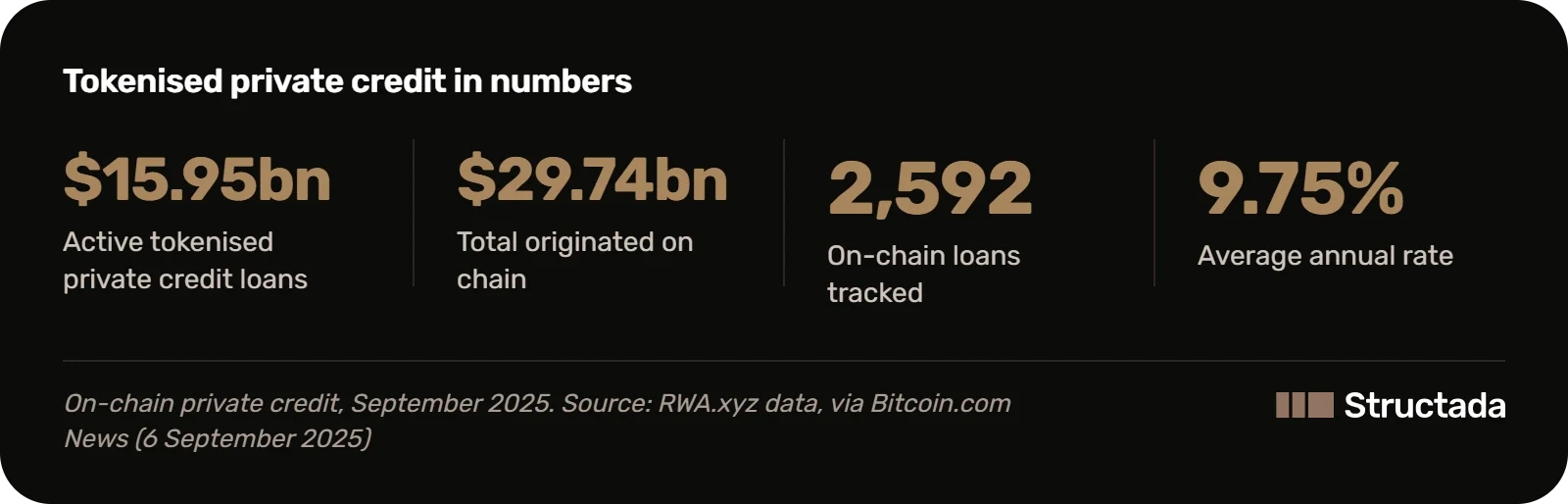
- RWA.xyz data reported in September 2025 showed about $16 billion of active tokenised private credit loans and nearly $30 billion originated in total, with one platform, Figure, holding most of the active book.
- Tokenisation can make records clearer, transfers faster and asset data more visible, and it can help prevent the same receivable being financed twice.
- It does not change the credit. Tokenised loans default like any other loans, and several platforms have recorded losses.
- The most robust structures put the loans in a legally ring-fenced vehicle, such as a securitisation compartment, and record the investors' notes on the ledger.
Private credit has grown into one of the largest asset classes in finance with very little help from technology. Loans are still documented in long agreements, tracked in spreadsheets and reported monthly. Tokenisation promises to change that by putting the record of who owns what, and sometimes the loans themselves, on a shared ledger. It is one of the fastest-growing parts of the digital asset market, and one of the most misunderstood.
What is tokenised private credit?
Tokenised private credit is private lending where the loans, or investors' claims on a pool of loans, are represented as tokens on a distributed ledger. The token records ownership and can be transferred between eligible holders. The underlying credit is the same: a loan to a business or a consumer, a receivable, or a pool of either.
There are two broad models. In the first, a lending platform originates loans and records them on a ledger, and investors buy tokens representing those loans or a share of a pool. In the second, a fund or vehicle holds the loans in the conventional way and issues tokenised shares or notes to investors. Apollo's tokenised credit fund, launched with Securitize in January 2025, is an example of the second.
How large is the market?
Figures compiled by RWA.xyz and reported by Bitcoin.com News in September 2025 showed $15.95 billion of active tokenised private credit loans, with $29.74 billion originated in total across 2,592 loans and an average annual rate of 9.75%. Figure, a lending platform focused on home equity loans, accounted for $11.64 billion of the active book. Later industry estimates based on RWA.xyz data put the active book above $18 billion by early 2026, making private credit the largest category of tokenised real-world assets.
That is still small against a private credit market measured in trillions, but it is growing faster than any other tokenised asset class apart from government bonds.
What tokenisation improves
The clearest gain is in the record. A ledger gives every party the same view of which assets exist, who owns them and whether they are pledged. That addresses one of private credit's oldest frauds: the same receivable or loan being financed twice by different lenders. A shared register that marks an asset as encumbered when it is pledged makes that much harder.
Tokenisation can also speed up transfers, allow smaller investment sizes, and give investors near real-time data on the underlying loans rather than monthly reports.
What it does not change
A token is only as good as the credit behind it. The same RWA.xyz data showed defaults on several platforms, including $47 million at Maple and $117 million at PACT. Weak underwriting, poor servicing and fraud by a borrower work the same way on a ledger as off it.
There are legal questions too. Investors need to know what the token gives them: a claim on specific loans, a share of a pool, or a promise from a platform. If the platform fails, what matters is whether the loans were legally separated from its own assets.
Where securitisation fits
This is where tokenisation and securitisation meet. The strongest structures put the loans in a bankruptcy-remote vehicle, such as a Luxembourg securitisation vehicle compartment, and then record the investors' notes on the ledger. The ring-fencing comes from securitisation law; the efficiency comes from the ledger.
Luxembourg's Blockchain Laws allow exactly that, as our guide to tokenised securitisation in Luxembourg explains. For investors, it means a tokenised note with the same legal protections as a conventional one. For lenders, it means a route to investors who want both the yield of private credit and the transparency a ledger can give. Our guide to securitised credit covers the conventional side of the structure.