- The headline arrangement fee for a credit linked note (CLN) is often only part of the real cost, with paying agent, administration, clearing, listing, data vendor, audit and legal fees following once the engagement letter is signed.
- A low upfront quote is sometimes used to secure the mandate, with third-party costs passed through at cost or with a margin, and ongoing fees charged per note, per payment or per change.
- The true cost of a CLN is the total paid over its life, upfront and ongoing, including what happens on amendments, new tranches and early redemption.
- Before signing, issuers should ask for a complete fee schedule covering every party, every recurring charge and every event-driven fee, and confirm which items are fixed and which are estimates.
- Structada quotes one price for upfront fees and one price for ongoing fees, fixed at the outset.
The first quote for a credit linked note often looks attractive: a modest arrangement fee, a short timetable and an assurance that the notes will be live within weeks. The engagement letter is signed, and then the invoices begin to arrive.
There is the paying agent's acceptance fee and its annual fee, the corporate services provider's set-up and administration charges, and a compartment fee. The common depositary, the listing agent and the auditor each bill separately. There are charges for loading the notes onto Bloomberg and other data platforms, and legal fees for documents that turned out to sit outside the original scope. Each line is reasonable on its own. Together they can multiply the cost the issuer believed it had agreed.
The hidden costs of CLN issuance are rarely concealed in any deliberate sense. They sit in the gaps between the parties to a transaction, and in the way fee quotes are framed. This guide explains where those costs arise, why the headline number can mislead and what an issuer should ask before committing.
Why upfront CLN fees can mislead
A credit linked note involves many parties: the arranger, the issuing vehicle and its corporate services provider, a paying agent, a common depositary, sometimes a trustee, a calculation agent, auditors, lawyers and, if the notes are listed, a listing agent and an exchange. Each has its own fees, and only some of them are controlled by the firm quoting the deal.
That fragmentation leaves room for a familiar pattern. A low headline fee covers the arranger's own work and excludes third-party costs. Those pass-through costs are added later, sometimes at cost and sometimes with a margin. Ongoing fees are quoted per item, so the annual bill depends on the number of payments, investors or changes. Event fees then apply to anything outside the original scope, such as a new tranche, an amendment or an early redemption.
By the time the full picture emerges, the issuer has usually signed the engagement letter, paid the first instalment and given its investors a timetable. Walking away at that stage is expensive, which is why the structure of a quote matters as much as its size.
Set-up costs
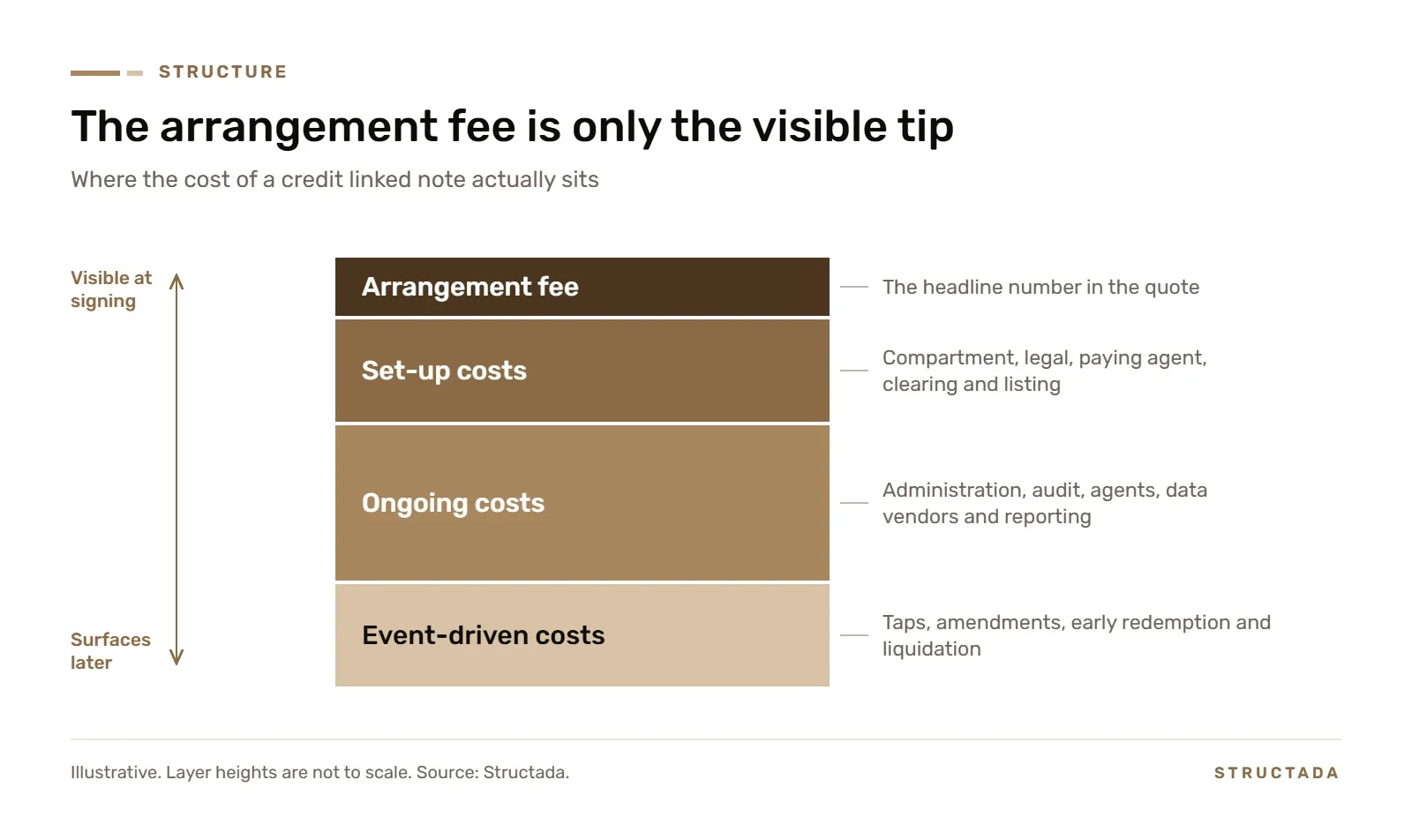
The set-up phase carries the largest number of separate charges. Creating the compartment on a Luxembourg securitisation vehicle, including board approvals, has its own fee. Legal fees for drafting the note terms, the issue memorandum and the supporting agreements are often quoted as estimates and billed by the hour, which leaves the issuer carrying the risk of overrun.
The paying agent typically charges a one-off acceptance fee to take on the issue and complete its onboarding. The common depositary charges for holding the global note and for making the notes eligible in Euroclear and Clearstream. Allocation of the ISIN and related codes is usually handled by the paying agent and charged on. Where the notes are listed, listing agent and exchange fees follow, and each service provider may charge for KYC and onboarding of the issuer and related parties.
Ongoing costs over the life of the notes
Once the notes are live, the vehicle or compartment must be run. Corporate services, accounting, directors and a registered office are charged annually, and the compartment bears its share of the annual audit. The paying agent levies an annual fee, often supplemented by a charge for each coupon or principal payment, so a note paying monthly can cost considerably more to service than one paying annually.
Further charges attach to calculation and valuation, where payments must be calculated or net asset or indicative values provided, and to data vendors, which charge for setting up and maintaining the notes on Bloomberg and other market data platforms and for supplying pricing to investors' custodians. Listed notes incur annual exchange fees. Regulatory and tax reporting, including FATCA and CRS reporting, statistical returns to the central bank and tax filings, adds a further layer, as do trustee fees where there is a trustee.
Event-driven costs
The final category is the least visible at the outset because it depends on what happens during the life of the deal. Each new tranche or tap issue may carry its own fee, often with fresh legal costs. Amendments to the terms can require board approvals, legal work and action by the paying agent. Early redemption or restructuring triggers unwinding fees, and liquidating the compartment at the end of the deal has its own closing costs. Some providers also charge for investor transfers, onboarding new investors or producing additional reporting.
Why total cost matters more than the headline fee
A CLN may run for three, five or more years. Over that period, ongoing and event-driven fees can exceed the upfront fee several times over, and two quotes with the same arrangement fee can produce very different total costs depending on how the rest is structured.
A proper comparison models the full life of the notes. It starts with upfront costs, including every third-party fee, and adds the annual costs for each year the notes are expected to be outstanding. Per-payment charges should be multiplied by the actual payment schedule. A realistic allowance for events, such as one or two taps or an amendment, belongs in the model, as do exit costs on maturity or early redemption. The relevant figure is the total paid over the life of the notes, measured against the amount issued.
Questions to ask before signing an engagement letter
Most of these costs can be surfaced with direct questions, asked before the mandate is signed rather than after. The most useful are:
- Does the fee include all third-party costs, including paying agent, common depositary, administration, audit, listing, data vendors and legal?
- Which costs are fixed and which are estimates, and who pays if legal fees exceed the estimate?
- Are any third-party costs passed through with a margin?
- Are any ongoing costs charged per payment, per investor or per transaction?
- What does a new tranche, amendment or early redemption cost?
- Are fees payable if the deal does not close, and can the full fee schedule be attached to the engagement letter?
A firm that is confident in its pricing should be able to answer each of these in writing. Our guide to the role of an arranger covers what else to look for in the firm that leads the transaction.
How Structada prices CLN issuance
Structada quotes one price for upfront fees and one price for ongoing fees, fixed at the outset. The upfront price covers setting up the compartment and issuing the notes, including the service providers needed to make them live. The ongoing price covers running the notes for their life. Both are agreed before the engagement letter is signed.
What this means for issuers
The cost of a CLN is the sum of every fee paid to every party over the life of the notes, whatever the arrangement fee suggests. The protection against surprises is to ask for the whole picture before committing: every party, every recurring charge, every event fee, and which of them are fixed.
Issuers who compare total cost rather than headline fees make better decisions and avoid renegotiating halfway through a transaction. Our guide on how to issue a credit linked note sets out each stage of the process in which these costs arise.
Frequently Asked Questions
What does it cost to issue a credit linked note?
Costs include set-up fees for the compartment and notes, legal, paying agent, clearing, administration, audit, listing and data vendor fees, plus ongoing annual costs. The total depends on how each is priced and how long the notes run.
What are pass-through costs?
Fees charged by third parties, such as paying agents or auditors, that the arranger passes on to the issuer, sometimes with a margin.
Why are ongoing fees important?
They are paid every year the notes are outstanding and can exceed the upfront fee over the life of the deal.
What should an engagement letter include?
A full fee schedule covering upfront, ongoing and event-driven costs, stating which are fixed and which are estimates, and what is payable if the deal does not close.
Do issuers pay for Bloomberg listings?
Issuers or their arrangers may pay for setting up and maintaining the notes on Bloomberg and other data platforms, which is often charged separately.
How does Structada charge for CLN issuance?
Structada quotes one upfront price and one ongoing price, both fixed at the outset.