

- A credit linked note is a debt security whose interest and principal depend on the credit performance of a named borrower, loan or portfolio.
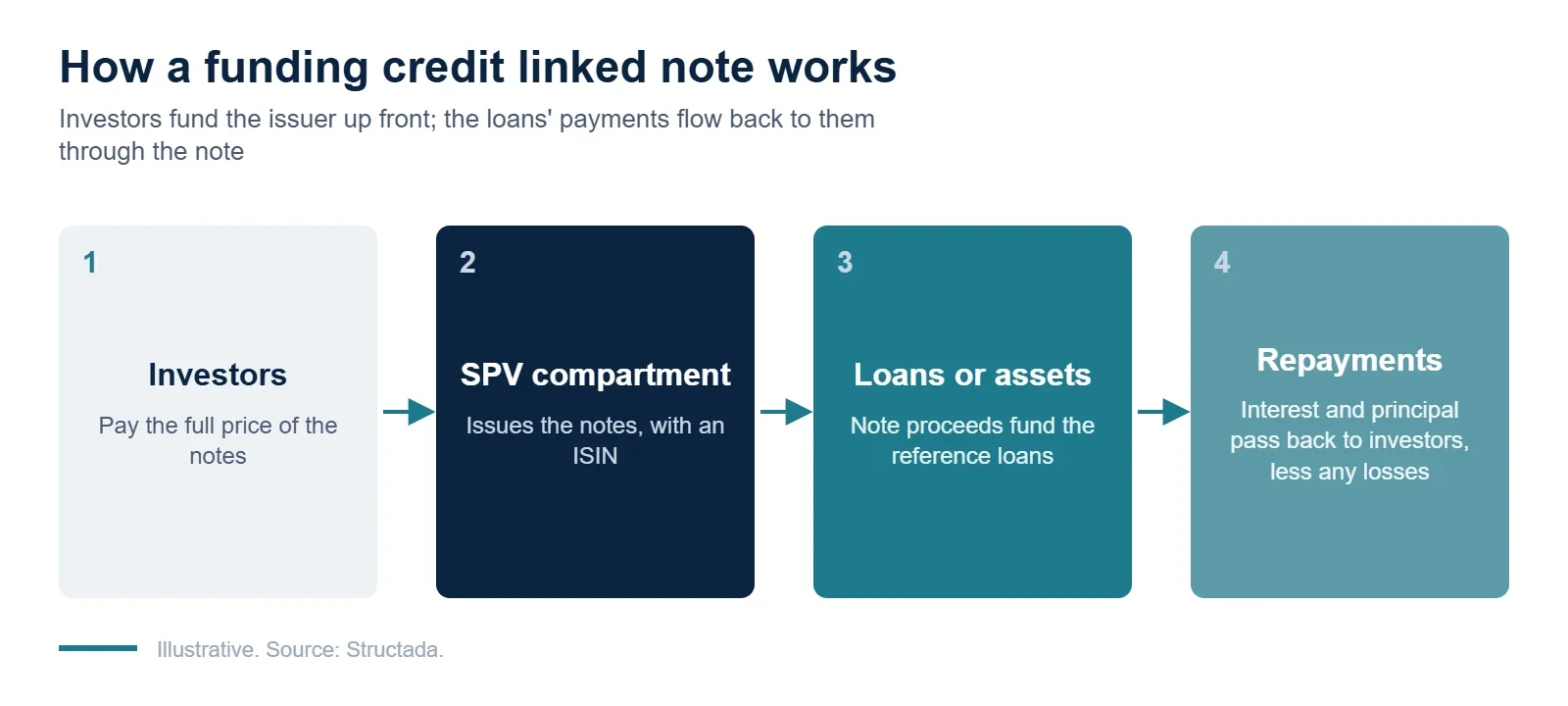
- The investor pays the full amount up front, so the issuer is funded and the investor carries the credit risk.
- Issuers use CLNs for two main purposes: banks use them to transfer credit risk on loans they keep, and lenders and asset owners use them to raise funding against a loan book or a single deal.
- If a defined credit event occurs, such as non-payment or insolvency of the reference borrower, investors are repaid less than face value.
- Most CLNs today are issued from a compartment of a securitisation vehicle, carry an ISIN and settle through Euroclear and Clearstream, so any professional investor can buy them through their custodian.
A credit linked note, or CLN, is a bond whose repayment depends on someone else's credit. The investor buys the note and receives regular interest. If the borrower, loan or portfolio the note refers to performs, the investor gets their money back at maturity. If it does not, the investor takes the loss.
That simple idea does two useful jobs for issuers. It moves credit risk from one balance sheet to another, and it turns a loan, or a book of loans, into a security that investors can buy, hold and settle like any other bond.
How a credit linked note works
Every CLN has the same moving parts.
- The issuer. Usually a special purpose vehicle, often a ring-fenced compartment of a Luxembourg securitisation vehicle. Banks also issue CLNs directly from their note programmes.
- The reference credit. The borrower, loan or portfolio whose performance drives the note. It can be a single company, a pool of SME loans, a property loan or a lender's whole book.
- The investors. Professional investors who pay the full price of the note at the start. Because they pay up front, the CLN is a funded instrument: the issuer holds the cash and does not have to chase investors for it if losses arise.
- The payments. Coupons come from the interest on the reference loans, or from a protection premium plus the return on collateral. Principal is repaid at maturity, reduced by any losses.
In plain terms, the note passes the economics of the reference credit through to the investor, wrapped in a security with an ISIN that settles through Euroclear and Clearstream.
The two main types of CLN
| Risk-transfer CLN | Funding CLN | |
|---|---|---|
| Typical issuer | A bank, through an SPV or its own programme | A lender, manager or asset owner, through an SPV compartment |
| Why it is issued | To pass on the credit risk of loans the bank keeps | To raise capital to fund loans or assets |
| What happens to the loans | They stay on the bank's balance sheet | The note proceeds fund them, directly or through a loan to the originator |
| Where the cash goes | Held as collateral against losses | Lent out to the borrower or originator |
| Common use | Significant risk transfer and capital relief | Private credit, specialty lending and real estate |
Risk-transfer CLNs grew out of the bank credit derivatives market in the 1990s and remain a core tool for capital relief. Funding CLNs are the faster-growing side for non-bank issuers: a specialty lender, a credit fund or a property company uses the note to bring in capital from investors who want exposure to its loans. Our history of credit linked notes traces how the market moved from one to the other.
What is a credit event?
The note's terms define the events that trigger losses for investors. In a risk-transfer CLN these usually follow standard credit derivative definitions:
- Failure to pay interest or principal when due.
- Bankruptcy or insolvency of the reference borrower.
- Restructuring of the debt on worse terms for lenders.
In a funding CLN the link is more direct. Investors are paid from what the underlying loans actually pay. If a borrower defaults and the loan recovers 70 per cent, the loss passes through to noteholders under the agreed order of payments.
Why issuers use credit linked notes
For a lender or asset owner, a CLN solves a practical problem: how to reach a wide base of investors without building a fund or relying on a single bank.
- Access to capital. Family offices, private banks, wealth managers and asset managers can buy a note through their existing custodian. Few of them would sign a bilateral loan agreement. Our comparison of credit linked notes and bilateral loans sets out the difference.
- Speed. A compartment on an existing platform can be set up in weeks, with service providers already in place. See how long a Luxembourg securitisation takes.
- Control. The issuer keeps its origination and servicing, and the note terms are written around its assets, not a lender's standard covenants.
- Ring-fencing. Each compartment is legally separate, so investors in one deal are not exposed to another.
- No fund regime. A securitisation compartment is generally outside the alternative investment fund rules, avoiding the cost and timetable of an AIFM and depositary.
The risks investors weigh
Investors will look hard at the same points every issuer should be ready to answer:
- Credit risk of the reference loans, and how losses are absorbed.
- Counterparty risk where the structure depends on a bank, a swap provider or the originator.
- Liquidity. CLNs are rarely traded actively, so most investors hold to maturity.
- Structure and documentation. Clear terms, credible service providers and regular reporting do much of the work of winning investor confidence.
What this means for issuers
A credit linked note turns credit into a security. For a bank, that means shedding risk while keeping the client relationship. For a lender or asset owner, it means funding growth from investors who would never lend to it directly.
The decisions that matter come early: the reference assets, the vehicle and jurisdiction, the paying agent and clearing set-up, and the investors the note is built for. For a fuller guide to structures, parties and documentation, read What Is a Credit Linked Note? Everything You Need to Know, and for a worked example see How Do Credit Linked Notes Work?
Frequently Asked Questions
What is a credit linked note in simple terms?
A bond whose interest and principal depend on whether a named borrower, loan or portfolio repays. If the credit performs, investors are repaid in full; if not, they take the loss.
Is a credit linked note a derivative?
It is a debt security that can contain a credit derivative. In a risk-transfer CLN the note embeds a credit default swap. In a funding CLN the note is linked directly to the cash flows of the underlying loans.
Who issues credit linked notes?
Banks, and special purpose vehicles used by lenders, credit managers and asset owners, often through a compartment of a Luxembourg securitisation vehicle.
What is the difference between a CLN and a credit default swap?
A credit default swap is an unfunded contract: the protection seller pays only if a credit event happens. A CLN is funded: the investor pays up front, so the issuer already holds the money.
Who buys credit linked notes?
Professional investors, including family offices, private banks, wealth managers, asset managers and insurers.
How long does it take to issue a credit linked note?
On an existing securitisation platform, a new compartment and note can often be ready in a matter of weeks. A standalone vehicle takes longer.