

- A credit linked note (CLN) is a debt security issued by a securitisation vehicle whose coupons and principal depend on the performance of a defined reference credit, such as a loan, a pool of receivables or a portfolio of rental income.
- In a real estate example, a property company can fund the expansion of its portfolio through notes linked to its assets and tenants, without selling equity or bringing in a joint venture partner.
- Structured appropriately, a CLN preserves ownership and control and can be shaped around the company's asset base, cash flow timing and desired maturity.
- Compared with equity, bank loans, mezzanine debt, REIT formation or joint ventures, a CLN avoids dilution, rigid covenant packages and shared control, though it brings its own documentation and reporting obligations.
- Investors gain real estate-backed returns through a security with an ISIN, held in custody, without the operational demands of owning property directly.
Credit linked notes are often explained in the abstract: a reference credit, a coupon, a loss on default. The mechanics become far clearer when they are followed through a single transaction, from the assets at the bottom of the structure to the investor at the top.
Real estate offers a useful illustration. A property company that wants to grow its portfolio usually faces a narrow set of options: sell equity, borrow from a bank, add mezzanine debt or share control with a joint venture partner. Each can work, and each carries a trade-off the company would prefer to avoid. A credit linked note offers another route, funding the company's growth through investors who take on a defined slice of credit risk in exchange for a coupon.
This guide explains how credit linked notes work, walks through that real estate example and compares the result with the alternatives.
What is a credit linked note?
A credit linked note is a structured debt security whose payments are linked to the credit performance of a defined reference asset or portfolio. Investors receive a regular coupon for bearing that credit risk, and their principal is returned at maturity provided the reference credit performs. If it does not, they may lose part or all of their principal according to the terms of the note.
What distinguishes a CLN from an ordinary bond is the source of repayment. A bond is repaid from the issuer's general creditworthiness. A credit linked note is repaid from the performance of a specific credit exposure, which might be a loan, a pool of receivables, a guarantor or, in real estate, the tenants and properties that generate rental income.
How a credit linked note works
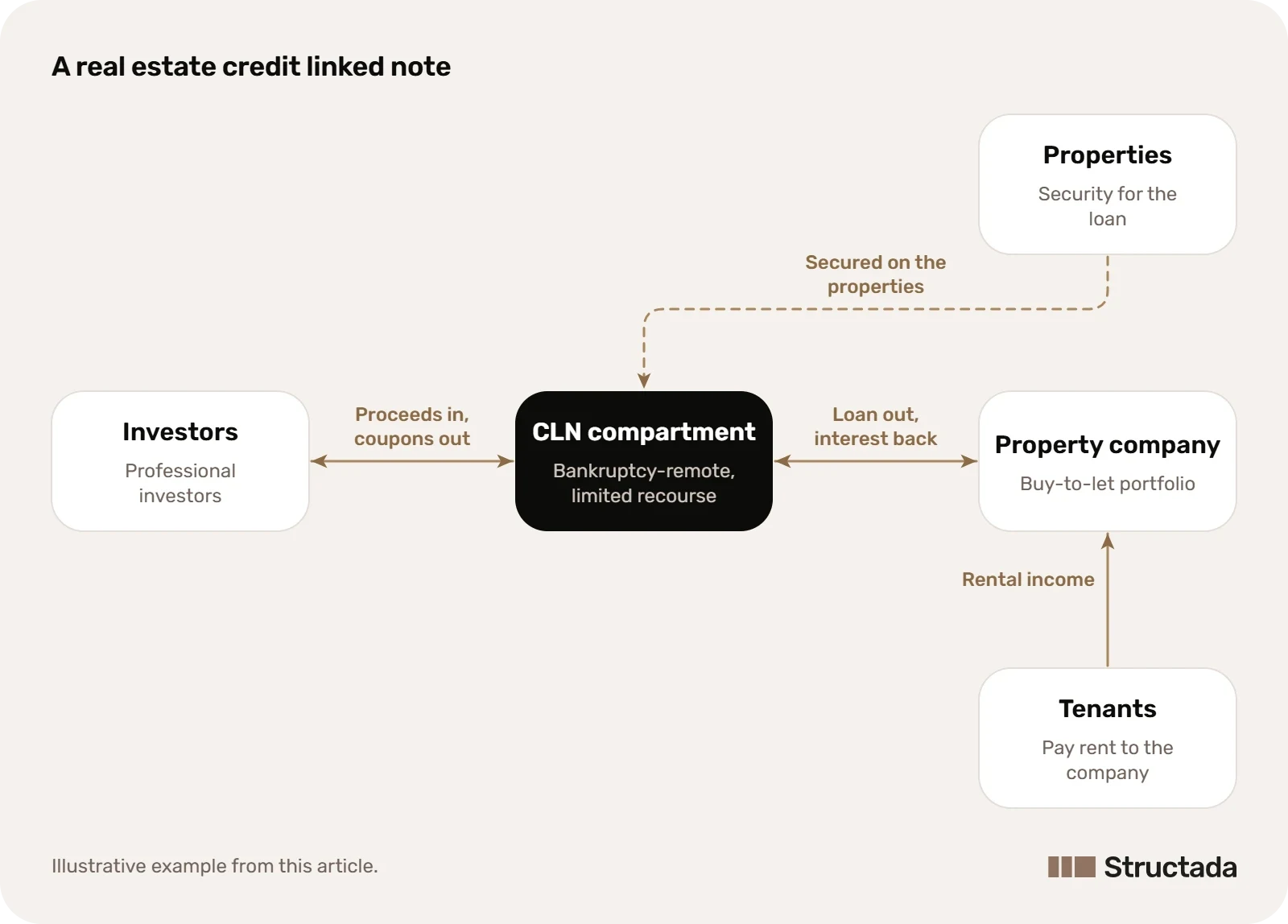
Every CLN has the same basic architecture. A securitisation vehicle, often a compartment of a Luxembourg securitisation vehicle, issues notes to investors. The proceeds are used to fund a loan or acquire an exposure to the reference credit. As that credit pays interest and principal, the cash flows back through the vehicle, which pays noteholders their coupons and, at maturity, their principal, after fees and costs.
The vehicle is bankruptcy-remote and its recourse is limited to the assets of the relevant compartment, so investors are exposed to the reference credit they chose and to nothing else. The notes carry an ISIN and settle through the international clearing systems, so investors hold them in the same custody accounts as any other bond.
Bank-issued CLNs often embed a credit default swap, with the bank buying protection on a reference entity. In private credit, the more common form is funded directly: the note proceeds finance a specific loan or pool of assets, and the investor's return depends on that loan or pool performing.
A real estate example: funding a portfolio expansion
Consider a property company that owns five buy-to-let properties and wants to expand the portfolio, but lacks the liquidity to pursue new acquisitions. It needs funding that does not dilute its ownership, does not expose it to risks it cannot manage and does not undermine the profitability of the properties it already holds.
Through a CLN, a compartment of a securitisation vehicle issues notes to professional investors and uses the proceeds to fund the company's acquisitions, typically as a loan secured on the properties. The rental income from the tenants services that loan. The vehicle passes interest through to noteholders as coupons, and principal is repaid as the loan amortises or is refinanced at maturity.
The investors' return is therefore linked to the credit of the property company, its tenants and the security over the properties. Where the tenants are well covenanted and the income stable, the credit risk being transferred is correspondingly lower, and the coupon can be priced accordingly.
Benefits of a credit linked note for a property company
The first benefit is ownership. Selling equity or bringing in a joint venture partner means sharing future profits and, often, control. Funding through notes leaves the company's shareholders and strategy unchanged.
The second is cost. A CLN typically carries a lower cost than equity, particularly when the credit risk being transferred sits with lower-risk third parties such as well-covenanted tenants. The third is flexibility. The note can be shaped around the company's asset base, the timing of its rental cash flows and its desired maturity, instead of forcing it into standard bank terms. Structured appropriately, the arrangement can also limit the impact on the company's own balance sheet, although the accounting treatment depends on the specific structure and should be confirmed with the company's auditors.
Speed matters too. A CLN can typically be executed faster than more regulation-heavy routes such as forming a REIT or establishing a full standalone securitisation, particularly where an existing platform compartment is used.
For investors, the appeal is access. They gain exposure to real estate-backed cash flows and risk-adjusted returns through a security, without the operational demands of owning, letting and maintaining property directly. That lowers the barrier for investors who want the exposure but have no wish to manage buildings.
Credit linked notes vs other funding routes
| Funding route | Main advantage | Main trade-off |
|---|---|---|
| Selling equity | Fast access to funding | Ownership dilution and shared future profits |
| Bank loan | Familiar and widely available | Collateral demands, relatively high interest and restrictive covenants |
| Mezzanine debt | Fills a gap above senior debt | Expensive, and may convert to equity in some conditions |
| REIT formation | Access to public markets | Significant compliance obligations and limits on retained earnings |
| Joint venture | Shares capital and risk | Shared control and a need for aligned strategy |
| Credit linked note | Funding without dilution or shared control | Documentation, reporting and investor disclosure obligations |
For a company with stable income and credible tenants, a CLN avoids dilution, rigid covenant packages and operational interference from a new partner. It brings its own discipline in exchange: clear documentation, regular reporting to noteholders and a structure that investors can understand. Our comparison of credit linked notes and bilateral loans looks at that trade-off in more depth.
What this means for issuers
For a property company with stable rental income and credible tenants, a credit linked note is a practical way to fund growth without surrendering the control that makes the business worth running. Investors gain diversified exposure to real estate credit in a form they can hold through their custodians, and the company secures funding on terms shaped around its own assets.
The structure rewards preparation. Clean data on properties, tenants and rental history, a clear view of the security package and an early decision on the vehicle and settlement arrangements make the difference between a note that places smoothly and one that stalls. Our guides to how to issue a credit linked note and to UAE real estate credit linked notes take the process further.