

- UAE LLC structures limit how far investor protections such as board rights, veto rights or preferential distributions can be written into a company's constitution, which discourages foreign investors.
- DIFC and ADGM Qualified Investor Funds both require a $500,000 minimum investment, and setting up and running a REIT or private fund for the first year commonly costs more than $250,000 to $500,000.
- A credit linked note issued by an offshore or European vehicle offers a globally distributable, transparent and institutional-grade route to UAE real estate exposure, without the cost of a regulated fund.
- The proceeds of the notes are lent to the UAE project company under a loan agreement, secured where feasible by a charge over the underlying asset.
- Investors gain exposure to the economics of a UAE development without lending directly into the UAE legal system, and the structure can be made Shariah-compliant.
The UAE real estate market is drawing money from every direction, with developers, landowners and sponsors competing to fund residential, hospitality and mixed-use projects. Investor appetite is rarely the constraint. The harder task, particularly for anyone unfamiliar with the local legal environment, is building a structure that international investors will actually commit to.
The two obvious routes both have drawbacks. A standard UAE LLC is difficult to present to global investors, and a local REIT or regulated fund is often too expensive and too slow for a single project or a mid-sized portfolio. Credit linked notes have become a practical middle path between the two, and demand for this kind of structure in UAE real estate finance has been growing quickly.
Why UAE LLC structures deter foreign investors
Funding a project through a UAE LLC can be restrictive, and foreign investors tend to hesitate for a consistent set of reasons. Ownership rules, despite recent liberalisation, still create uncertainty for some. Transparency around profit distribution and governance is limited, exit options narrow sharply once money has been committed, and there is no well-tested withholding tax regime to give comfort on the tax position.
Governance is often the real sticking point. A developer may wish to offer investors board representation, veto rights over major decisions or preferential distributions, but the Department of Economic Development limits how far a company's Articles of Association can depart from the standard LLC framework. Compared with jurisdictions with more flexible corporate law, such as the Cayman Islands or Luxembourg, a UAE LLC leaves little room to negotiate or codify investor protections, particularly for lenders and noteholders who hold no shares. That inflexibility can undermine investor confidence even where the underlying asset is fundamentally sound.
DIFC and ADGM funds and REITs
The DIFC and ADGM both offer regulated fund structures for real estate, including REITs and Qualified Investor Funds. They provide strong protections, but they are out of reach for many sponsors and developers.
In the DIFC, Exempt Funds are available to professional clients only and carry lighter regulation than a fully regulated fund. Qualified Investor Funds require a minimum investment of $500,000 and are typically used for real estate portfolios. DIFC REITs, whether public or private, are regulated by the DFSA and require a trustee, a fund manager and detailed ongoing reporting. ADGM offers a Qualified Investor Fund on similar terms, with the same $500,000 minimum for professional clients, while ADGM REITs are regulated by the FSRA and require a listing on a recognised exchange, full NAV audits and strict distribution requirements. Who qualifies as a professional investor differs between the regimes, as our guide to professional investors under the CMA, DFSA and FSRA explains.
The cost reflects the protection. Launching a REIT or private fund in either centre typically involves fund manager licensing, custodian and administrator appointments, audit and legal fees, and regulatory capital alongside ongoing compliance. Total setup and first-year operating costs commonly exceed $250,000 to $500,000, before licensing costs and capital requirements are counted. That makes these structures suitable mainly for large or pooled portfolios. For a project-level financing, they are usually more structure than the transaction needs, a trade-off we examine more broadly in securitisation SPV vs private fund.
What a credit linked note offers
A credit linked note is a debt instrument whose returns are linked to the performance, or credit risk, of an underlying asset or entity. Structured correctly, it gives investors a wrapper for UAE real estate exposure with three qualities that local structures struggle to provide.
The first is distribution. Issued through a European or offshore vehicle, in a jurisdiction such as Luxembourg, Guernsey or Jersey, a credit linked note can be placed with professional investors through private banks, wealth managers and investment platforms. With an ISIN and settlement through the international clearing systems, it fits the way those investors already hold securities.
The second is enforceability. Documentation is standardised, investor protections are built into the terms from the outset, and security over the underlying asset, by way of a pledge or mortgage, can be incorporated directly. The third is familiarity: private banks, family offices and institutional allocators already use credit linked notes routinely across credit, infrastructure and real estate.
How a UAE real estate CLN works
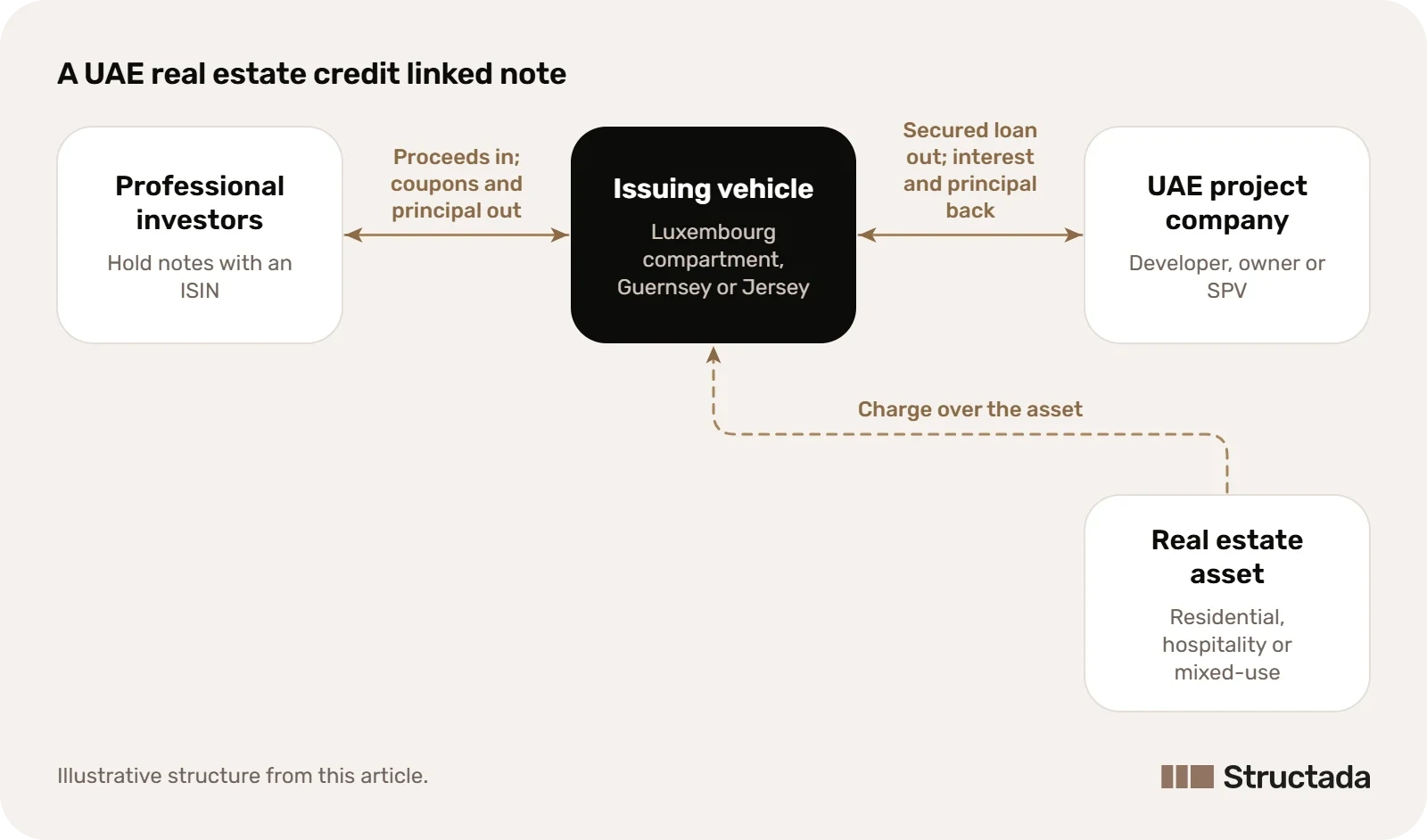
A developer, asset owner or SPV holding a UAE real estate project funds it through a credit linked note issue. The notes are issued by a vehicle in a jurisdiction such as Luxembourg, Guernsey or Jersey, often a compartment of a Luxembourg securitisation vehicle, and the proceeds are lent to the UAE project company. The loan is documented in a loan agreement and secured, where feasible, by a charge over the asset itself. Investors are paid from the interest and principal the project company pays on that loan.
The effect is to give investors exposure to the economics of the development without lending directly into the UAE legal system, which is often the core concern for an international investor. The vehicle holds the loan and the security, and the noteholders hold a familiar instrument governed by a familiar law. Taking and perfecting that security locally is a discipline of its own, covered in our guide to how to perfect security in the UAE.
The capital stack in UAE real estate
The capital stack used in developed markets, with senior debt, mezzanine and equity tranches carrying clear enforcement rights and priority, is less well defined in UAE law and practice. Investors are right to be cautious. Enforcement can be uncertain, intercreditor agreements have little local precedent, and priority in an insolvency is difficult to predict.
A credit linked note addresses this by putting the issuing vehicle in control of the terms of its loan to the UAE company. The loan can be structured to mirror senior or mezzanine risk and return, with covenants, security and ranking set out in the documents, without investors having to navigate UAE legal complexity directly. For sponsors working across the region, the same approach extends to other assets, as set out in our guide to securitising UAE and GCC assets in Luxembourg.
Shariah-compliant structures
Many investors in UAE real estate require Shariah-compliant exposure, and a credit linked note can accommodate them. Rather than an interest-bearing loan, the vehicle's financing of the project can be structured around Murabaha, Ijara or Wakala contracts, with the notes' returns linked to those arrangements. Our guide to what is Shariah-compliant investing covers the principles involved.
What this means for issuers
The difficulty in UAE real estate finance lies less in finding investors than in finding a structure both sides will accept. A local vehicle is often too rigid for international investors, and a regulated fund is often too expensive for a single project. A credit linked note sits between the two, offering institutional documentation, enforceable security and access to the wealth channel at a cost proportionate to the transaction.
The judgement lies in the detail. The jurisdiction of the issuing vehicle, the terms of the loan to the project company, the security package and its perfection, and the eligibility of the target investors all interact, and they are best settled together before the first term sheet is circulated. Developers who treat the structure as an afterthought tend to find investors asking the questions it should already have answered.