- A private fund pools investors' capital and invests it under a policy, which in the EU usually makes it an alternative investment fund (AIF), with an authorised or registered manager, a depositary, reporting and marketing rules.
- A securitisation vehicle issues notes linked to defined assets. Securitisation special purpose entities are excluded from the EU AIFM Directive, so they avoid most fund-level regulation.
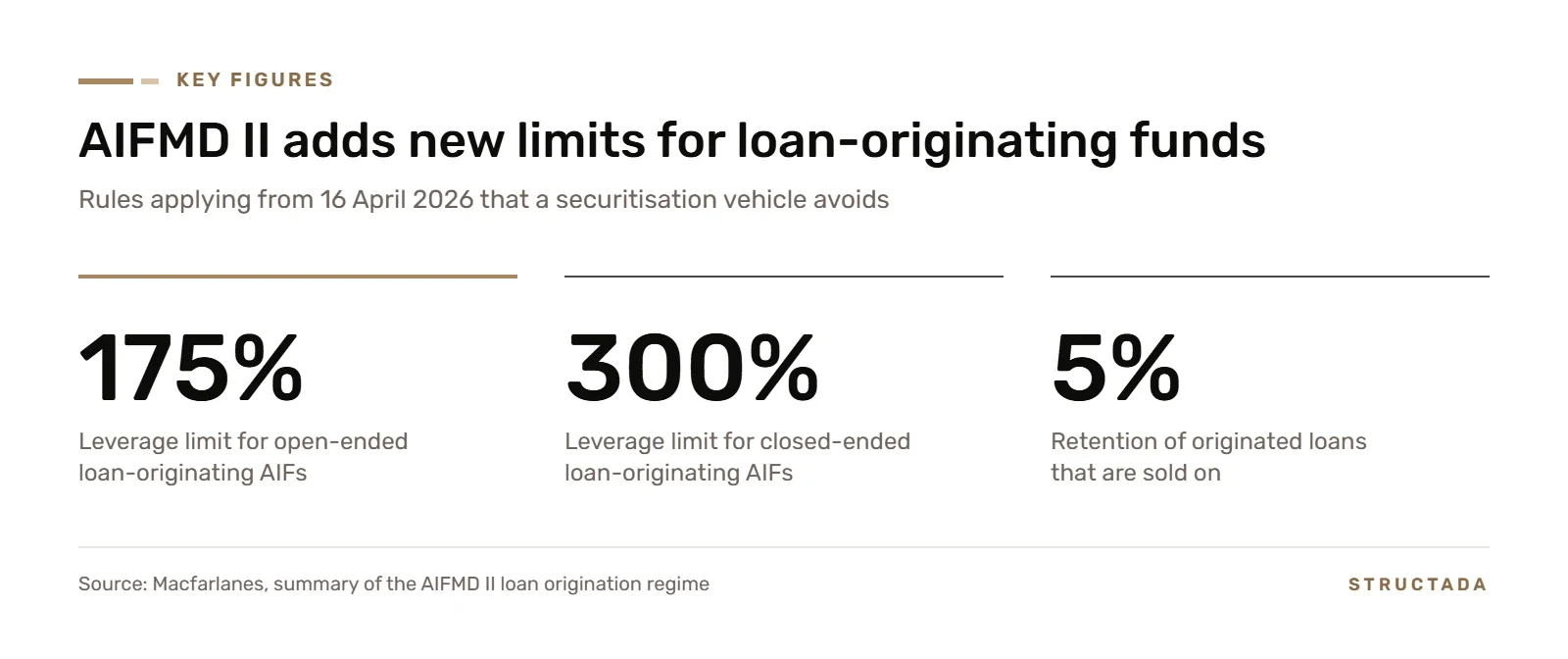
- AIFMD II, applying from 16 April 2026, adds a regime for loan-originating funds, including leverage caps, a 5% retention on loans sold on and a 20% limit on exposure to some single borrowers.
- For lenders, managers and asset owners financing specific assets, a compartment on an existing securitisation platform can be faster and cheaper than launching a fund.
- The exclusion depends on substance. A vehicle that behaves like a fund, pooling capital for a broad discretionary strategy, can be treated as one, so the structure must be designed honestly.
A credit manager with a strong track record plans to fund a €50 million portfolio with money from family offices and private banks. The first instinct is often to launch a fund. Then the requirements arrive: an AIFM, a depositary, a fund administrator, an offering memorandum, regulatory reporting, marketing notifications in each country and, increasingly, the new loan origination rules. The fund may take months to launch and absorb a large share of the first year's fees.
There is often another route. Where the money is going into a defined portfolio of loans or assets, a securitisation vehicle can issue notes linked to those assets. The investor holds a security with an ISIN in an ordinary custody account, and the manager obtains funding without building a fund.
The choice between a securitisation SPV and a private fund is therefore less about preference than about what the structure is actually doing. Each carries a different regulatory load, and the right answer depends on whether investors are buying exposure to defined assets or to a manager's discretion.
What makes a fund a fund
In the EU, an AIF is a collective investment undertaking that gathers capital from a number of investors to invest it in line with a defined investment policy for their benefit. Classification is functional: regulators look at what a vehicle does, whatever it is called. As this AIFMD overview notes, an entity must meet all elements of the definition to be an AIF.
Once a vehicle is an AIF, its manager must be authorised or registered under the AIFM Directive, and a substantial set of obligations follows.
Regulatory drag in a private fund
The heaviest burden falls on the manager. A full-scope AIFM needs capital, risk and liquidity management, remuneration policies, and valuation and compliance functions. Smaller managers below the thresholds can register instead, but they lose the marketing passport. A full-scope AIF must also appoint a depositary to hold assets and oversee cash flows, and report regularly to its regulator on leverage, liquidity, exposures and risk.
Distribution adds its own friction. EU-wide marketing requires a passport, while non-EU managers depend on country-by-country private placement regimes. Selling to retail investors brings PRIIPs key information documents and further protections.
Credit funds now face an additional layer. Under AIFMD II, from 16 April 2026 loan-originating AIFs face leverage limits of 175% for open-ended funds and 300% for closed-ended funds, must retain 5% of loans they originate and sell on, and cannot pursue originate-to-distribute as their only strategy, as Macfarlanes summarises. Exposure to a single borrower that is a financial undertaking is capped at 20% of capital.
For a large, diversified, discretionary credit fund, this is the right framework. For a specialist lender funding its own book, or a manager financing a defined portfolio, it can be considerably more than the transaction needs.
How a securitisation vehicle differs
A securitisation vehicle acquires or finances assets and issues notes whose returns depend on them. Securitisation special purpose entities are excluded from the AIFM Directive, and they are governed by the EU Securitisation Regulation where they meet its definition of securitisation, meaning tranched credit risk.
The practical consequences are significant. No AIFM is required for the vehicle itself, although a third party may manage the assets. There is no depositary: assets are held by the vehicle, with a trustee or agent acting for noteholders where needed. Investors hold a debt security settled through Euroclear and Clearstream, which many private banks and wealth managers find easier to onboard than fund units.
In Luxembourg, each transaction can sit in its own ring-fenced compartment on an existing securitisation vehicle, and the vehicle needs a CSSF licence only if it issues to the public on a continuous basis.
Securitisation SPV vs private fund at a glance
| Private fund (AIF) | Securitisation SPV | |
|---|---|---|
| Investor holds | Fund units, shares or partnership interests | Notes with an ISIN |
| Manager | Authorised or registered AIFM | Not required for the vehicle; asset manager optional |
| Depositary | Required for full-scope AIFs | Not required |
| Regulatory reporting | Regular AIFMD reporting | Securitisation Regulation reporting where it applies; otherwise investor reporting |
| Loan origination rules | AIFMD II leverage, retention and concentration rules | Not applicable; securitisation risk retention may apply |
| Time to launch | Often several months | Weeks on an existing platform |
| Best for | Diversified, discretionary, multi-investor strategies | Defined assets, specific loan books, repeat deals |
| Custody and distribution | Fund dealing and transfer agency | Standard securities custody |
When a securitisation vehicle could be treated as a fund
The exclusion has limits, and they should be respected rather than tested. A vehicle that gathers money from many investors to pursue a broad, discretionary strategy, with returns that look like equity, may be treated as a fund whatever it is called. Regulators scrutinise structures that mimic funds without the oversight, and mischaracterisation can lead to enforcement or forced restructuring.
Luxembourg's 2022 reforms allow a securitisation vehicle to actively manage portfolios of debt instruments and receivables, but only where its financing instruments are not offered to the public. Issuers should take advice on where the line falls for their structure.
The signs that a structure suits securitisation are reasonably clear. The assets are defined, or chosen against clear eligibility criteria; investors take credit risk on those assets, often in tranches; returns come from the assets' cash flows; and the vehicle has limited discretion and a narrow purpose. A blind pool with wide investment discretion, several strategies or asset classes in one vehicle, or investors expecting fund-style governance, valuation and redemption rights all point towards a fund.
Tax treatment of funds and securitisation vehicles
Both routes can be tax neutral. Luxembourg funds such as a RAIF or SCSp are typically exempt or transparent. A Luxembourg securitisation vehicle is taxable in principle, but payments to investors are deductible, so its taxable profit is usually small. Our guide to alternatives to setting up a fund compares the options in more detail, and our comparison of credit linked notes and private credit funds looks at the investor's perspective.
Choosing between a securitisation SPV and a fund
For a specialist lender funding its own loan book, a securitisation compartment or credit linked note usually fits best. A manager financing a defined portfolio with a small number of investors can also use notes from a compartment and avoid most fund-level overhead. A manager building a diversified, discretionary credit strategy with many investors is usually better served by a regulated fund. And a sponsor testing a strategy can use notes to build a track record first, with a fund to follow once the strategy has scale.
What this means for issuers
Funds and securitisation vehicles solve different problems. A fund is built for pooled, discretionary investment and carries the regulation that goes with it. A securitisation vehicle is built for financing defined assets and carries much less.
For many lenders and managers financing specific assets, issuing notes from a compartment on an existing platform avoids months of set-up and much of the running cost of a fund. The condition is that the structure is a genuine securitisation, and that judgement should be made at the outset, on the substance of the assets and the discretion involved, rather than defended after the fact. Our guide on how to issue a credit linked note shows the steps.
Frequently Asked Questions
Is a securitisation vehicle an AIF?
Securitisation special purpose entities are excluded from the AIFM Directive. A vehicle that behaves like a fund, however, may be treated as one.
What is regulatory drag?
The cost, time and operational burden of regulation, such as authorised managers, depositaries, reporting and marketing rules, that a structure must carry.
What does AIFMD II change for credit funds?
From 16 April 2026, loan-originating AIFs face leverage limits, a 5% retention requirement on loans sold on, concentration limits and restrictions on originate-to-distribute strategies.
Can a securitisation vehicle be actively managed?
In Luxembourg, a securitisation vehicle can actively manage portfolios of debt instruments and receivables, provided its financing instruments are not issued to the public.
Which is faster to launch, a fund or a securitisation compartment?
A compartment on an existing platform can usually be launched in weeks, while a regulated fund often takes several months.
Can investors hold securitisation notes in a normal custody account?
Yes. Notes with an ISIN that settle through Euroclear and Clearstream can be held in standard custody accounts.