

- A regulated fund suits large, diversified and long-term credit strategies, but it brings a manager licence or third-party AIFM, a depositary, an administrator and months of set-up.
- Five alternatives can bring a credit strategy to investors faster: a white-label fund, a separately managed account, a securitisation compartment issuing notes, an actively managed certificate and a club or co-investment vehicle.
- The right route turns on three questions: who the investors are, how many of them there are, and whether the strategy is a single deal, a loan book or a managed portfolio.
- Securitisation compartments and certificates turn a strategy into a security with an ISIN, which wealth managers and private banks can buy and hold through their custodian.
- Many managers start with a note or certificate to build a track record, then launch a fund once scale and investor demand justify the fixed cost.
Every manager or lender with a credit strategy reaches the same fork. Investors are willing to back it, and the obvious answer is to set up a fund. Then the quotes arrive: legal fees, a manager licence or a third-party AIFM, a depositary, a fund administrator, an auditor, a board, and a timetable measured in months.
For a large, diversified, long-term programme, that cost is worth paying. For a first strategy, a single loan book or a pool of demand from wealth investors, it often is not. The overhead of a fund is largely fixed, and it falls hardest on the strategies that can least afford it.
There are several alternatives to setting up a fund, and most of them are faster and cheaper. Each one changes who can invest, how the assets are held and what the documents look like, so the choice of wrapper deserves as much thought as the strategy itself.
The regulated fund as a baseline
A regulated fund, such as a Luxembourg RAIF or SCSp managed by an authorised AIFM, or a Cayman fund, pools investors' money and invests it at the manager's discretion. Its strengths are real. Institutions know the wrapper, it can invest across many assets, and it has room to scale over a long life.
Its weaknesses are cost, time and fixed overhead. The fund needs a licensed manager, either the sponsor's own or a third party, together with a depositary and an administrator. Those costs are much the same whether the fund gathers fifty million or five hundred million, which is why the economics work best at size. Our comparison of credit linked notes and RAIFs sets out the detail for Luxembourg.
White-label fund platforms
A white-label or platform fund lets a manager launch a sub-fund under an existing umbrella, using the platform's AIFM, depositary and administrator. The manager runs or advises on the portfolio, and the platform carries the regulatory load.
This route suits emerging managers who need a fund wrapper for institutional investors but do not want to build their own regulatory infrastructure. Set-up is faster than for a standalone fund, though it still takes months. The fees are ongoing, and the manager accepts the platform's governance, which means giving up some control over service providers, terms and timing.
Separately managed accounts
In a separately managed account, or mandate, a single investor appoints the manager to run a portfolio held in the investor's own name or vehicle. No pooled fund is created, and the investor keeps direct ownership of the assets.
Managed accounts work well for one or two large institutions or family offices, each with enough capital to justify its own arrangement. The limitation is that every account is negotiated separately and the investor dictates much of the structure. The route does not extend to a wide base of smaller investors, although the same discipline can be delivered through a note, as our guide to an SMA as a credit linked note explains.
Securitisation compartments issuing notes
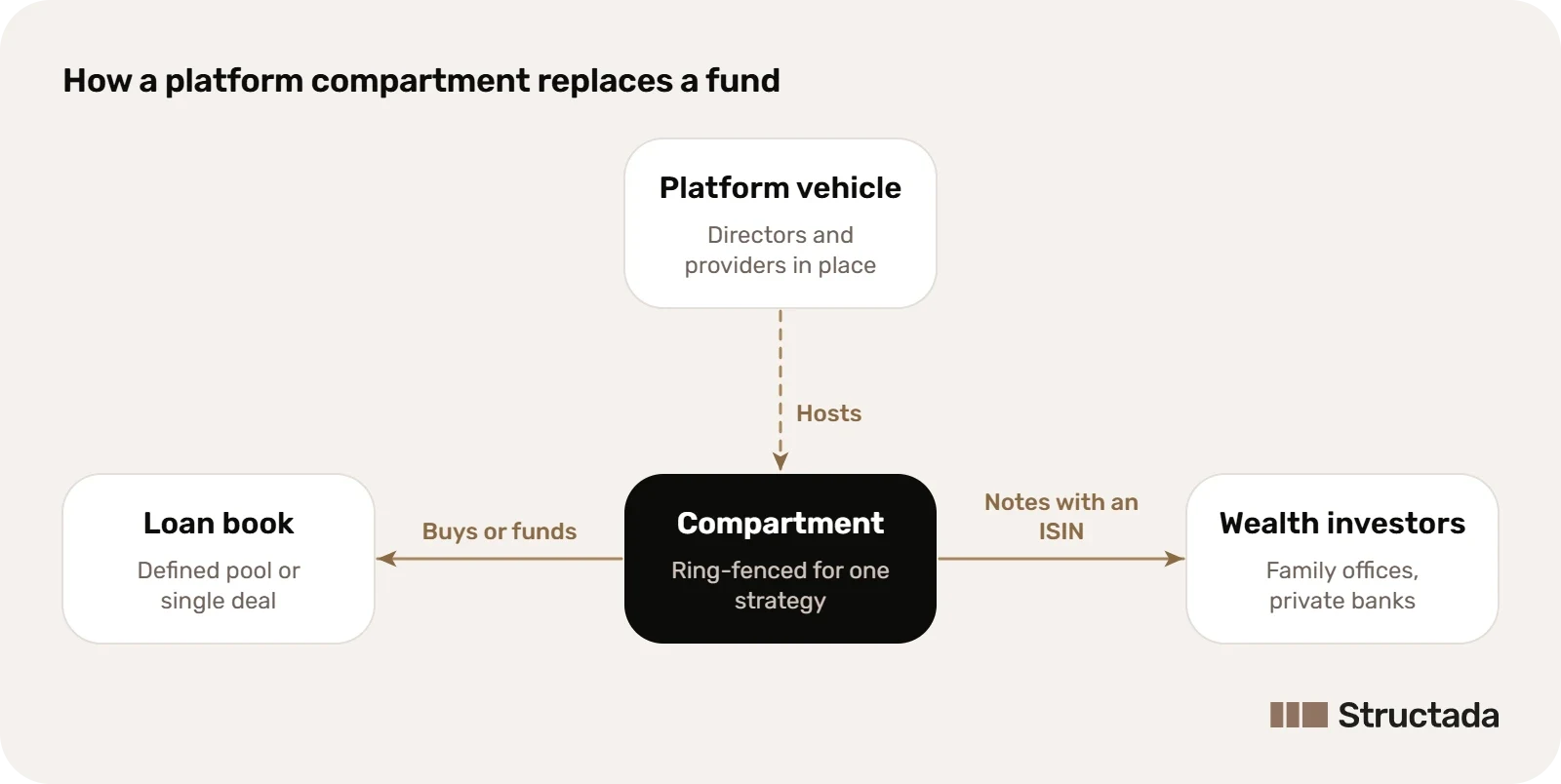
A securitisation vehicle, such as a Luxembourg securitisation vehicle, can create a ring-fenced compartment for a single strategy. The compartment buys or funds the loans and issues notes, often credit linked notes, to investors. The notes carry an ISIN and settle through Euroclear and Clearstream, so investors hold them in a custody account like any other bond.
This is the natural route for lenders and managers funding a loan book, a single deal or a defined pool of assets, particularly where the investors sit in the wealth channel: family offices, private banks, wealth managers and asset managers. The structure is designed for illiquid assets, and segregation by compartment means each strategy stands on its own.
The trade-off is that the structure is built around defined assets, so it suits a broad, discretionary multi-asset strategy less well. On an existing platform, a compartment can usually be launched in weeks, with the vehicle, directors and service providers already in place and their running costs shared. Our guides to Luxembourg securitisation costs and to credit linked notes and private credit funds cover the economics in more depth.
Actively managed certificates
An actively managed certificate wraps a portfolio that a named manager runs at their discretion into a single listed or unlisted security. The manager can rebalance within agreed rules, and investors hold the certificate as they would any other note.
Certificates appeal to managers running discretionary portfolios of bonds, loans or listed instruments who want to reach private banks and advisers without the cost of a fund. They work best for liquid or semi-liquid portfolios, and the issuer's structure and regulatory position need checking for each strategy. Investors also take the credit risk of the issuer as well as that of the underlying portfolio, a point that sophisticated buyers will examine closely.
Club deals and co-investment vehicles
For a single transaction, a small group of investors can co-invest through a simple holding company or partnership, often alongside the manager. It is the lightest of the routes and, for a one-off deal with a handful of known investors, frequently the quickest.
Its weakness shows up on the second deal. Each new transaction needs a new vehicle, and the resulting interests are not held in a form that most custodians and wealth platforms can book. What is cheap for one deal becomes expensive and untidy across a series.
Fund vs alternatives compared
Set side by side, the routes differ most in launch time, regulatory set-up and the investors they can reach.
| Route | Typical time to launch | Regulatory set-up | Investor reach | Best for |
|---|---|---|---|---|
| Regulated fund | Several months | AIFM, depositary, administrator | Institutions and qualified investors | Large, diversified, long-term programmes |
| White-label fund | Months | Platform's AIFM and service providers | Institutions and qualified investors | Emerging managers needing a fund wrapper |
| Managed account | Weeks to months | Investment management agreement | One investor per account | One or two large investors |
| Securitisation compartment | Weeks on a platform | Securitisation law; no fund regime in most cases | Professional investors via custodians | Loan books, single deals, defined pools |
| Actively managed certificate | Weeks | Issuer's programme | Private banks and advisers | Discretionary portfolios |
| Club or co-investment vehicle | Weeks | Company or partnership | A few known investors | One-off deals |
How to choose the right route
Three questions narrow the choice quickly. The first is who the investors are. Institutions that insist on a fund point towards a standalone fund or a white-label platform, while family offices, private banks and wealth managers are comfortable buying notes and certificates through their custodian. Our guide to accessing the wealth channel explains why the custody point matters so much.
The second is how many investors there are. One large investor suits a managed account. A broad group of smaller investors needs a security they can all hold on the same terms. The third is the shape of the strategy. A defined loan book or deal fits a securitisation compartment, and a discretionary portfolio fits a fund or a certificate.
Many managers use these routes in sequence. They begin with a note or certificate to fund the first assets and build a record, then add a fund once scale and investor demand justify the fixed cost.
What this means for issuers
A fund is one way to bring a credit strategy to investors, and for many strategies it is the wrong first step. Where the assets form a defined pool and the investors sit in the wealth channel, a compartment issuing notes reaches the same buyers in a fraction of the time, with costs that scale with the transaction rather than ahead of it.
The decision belongs at the very start. The wrapper determines the documents, the regulatory perimeter, the running costs and who is able to buy, and changing it later means doing much of the work twice. Managers who settle it before the first term sheet tend to reach investors sooner and spend less doing so.