- A separately managed account gives one investor a dedicated portfolio run to its own rules, but in private credit it usually means the investor holding the loans directly or setting up its own vehicle.
- Wrapping the mandate in a credit linked note puts the portfolio in a dedicated securitisation compartment and gives the investor a single note, with an ISIN, held at its own custodian.
- The note's return follows the portfolio, and the investment guidelines, eligibility criteria and reporting are written into the note terms.
- The manager or lender originates and services the assets for the compartment, while the vehicle handles administration, payments and accounts.
- The structure can grow with the relationship: the investor can top up through further issues, and other investors can be added in their own compartments.
Large investors often want a lending strategy on their own terms. A family office may admire a manager's loan book but want its own concentration limits, its own reporting and no exposure to the manager's other investors. The established answer is a separately managed account, or SMA, and structuring that SMA as a credit linked note is an efficient way to deliver that mandate in private credit.
The difficulty lies in the plumbing. In listed markets, an SMA is straightforward: the manager trades securities in the investor's custody account and the custodian does the rest. A private credit SMA usually means the investor holding loans in its own name, or forming and running its own vehicle to do so. Many investors, particularly family offices and the clients of private banks, have neither the appetite nor the infrastructure for that.
A credit linked note resolves the problem by wrapping the entire mandate in a single security. The investor keeps the control that made the SMA attractive, and the operational burden moves to a vehicle built to carry it.
What is a separately managed account?
A separately managed account is a portfolio run by a manager for one investor, under an investment management agreement or mandate. The investor sets the rules: what can be bought, in what proportions, with how much leverage and with what frequency of reporting. There is no pooling. Each account belongs to one investor, and its performance reflects only the assets in it.
SMAs are popular with large institutions and family offices because they offer control, transparency and fees negotiated for the investor alone. They also avoid the compromises inherent in a pooled vehicle, where liquidity terms, investment limits and reporting are set for the average investor rather than any particular one. Our article on alternatives to setting up a fund compares SMAs with the other routes open to managers.
Why structure an SMA as a credit linked note?
Private loans resist the custody model on which conventional SMAs depend. They are not held at a custodian in the same way as listed bonds; they must be documented, serviced and administered; and payments have to be collected from borrowers and passed on. Someone has to own the loans, and in a direct SMA that someone is the investor.
A credit linked note moves that work into a vehicle designed for it. The investor holds one security, a single note with an ISIN, in its existing custody account, settled through Euroclear or Clearstream like any other bond. Behind the note sits a dedicated compartment that holds only that investor's assets, legally ring-fenced from every other transaction on the platform. The investor's rules, from eligibility criteria to limits and reporting, are written into the note terms. And the investor need not form a company, open bank accounts or run loan administration.
The effect is to separate ownership of the economic exposure from ownership of the operational machinery. The investor owns the first; the vehicle carries the second.
How an SMA credit linked note works
The structure follows a clear sequence from mandate to cash flow.
- The investor and manager agree the mandate.
- A securitisation vehicle creates a dedicated compartment.
- The compartment issues a note to the investor.
- Subscription proceeds fund eligible assets.
- Collections flow back to the investor.
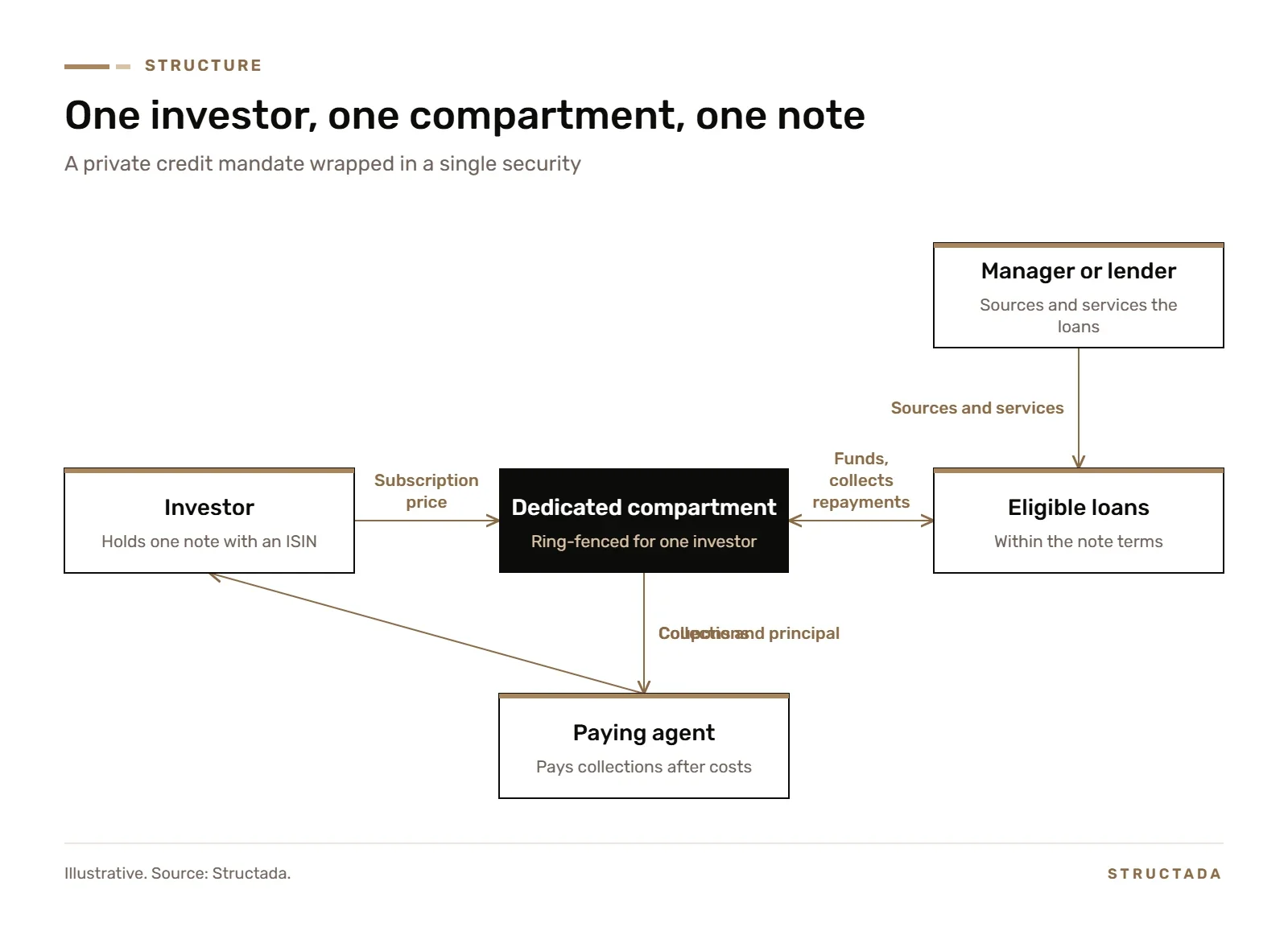
The mandate sets the strategy, eligibility criteria, concentration limits, target size, reporting and fees, in much the way an investment management agreement would. A Luxembourg securitisation vehicle then creates a compartment dedicated to that mandate, and the compartment issues a note to the investor in return for the subscription price. The note's return is linked to the performance of the portfolio in the compartment.
The compartment uses the proceeds to acquire or fund loans that meet the eligibility criteria, sourced and serviced by the manager or lender. Interest and repayments are collected by the compartment and paid to the investor through the paying agent, after costs. The investor sees a bond paying coupons and principal; underneath, a private credit portfolio is being run to its specification.
What goes into the note terms
In a conventional SMA, the investment management agreement is the governing document. In an SMA structured as a note, the note terms do that job, and they need to be drafted with the same care.
The eligibility criteria define the loans or assets the compartment can hold, by borrower, sector, geography, size, tenor and security. Concentration limits cap exposure to any single borrower, sector or country. Reinvestment provisions decide whether repayments can be recycled into new assets, and for how long, which shapes whether the portfolio behaves like a revolving mandate or an amortising one.
The return mechanism sets out how interest and principal on the note follow the portfolio after fees and expenses. Reporting provisions specify what the investor receives and how often, typically asset tapes, payment data, arrears and valuations. Finally, the terms govern top-ups and exit: how the investor can add capital through further issues, and how and when the note is redeemed.
SMA vs credit linked note vs private credit fund
| Conventional SMA | SMA as a credit linked note | Private credit fund | |
|---|---|---|---|
| Investors | One | One per compartment | Many, pooled |
| What the investor holds | Loans or a vehicle it owns | A single note with an ISIN | Fund units or interests |
| Custody | Investor's own arrangements | Existing custodian, via Euroclear or Clearstream | Fund administrator and depositary |
| Investor's rules | Investment management agreement | Note terms | Fund documents, shared with others |
| Investor's set-up work | Significant | Minimal | Minimal |
| Time to launch | Weeks to months | Weeks on a platform | Months |
The note sits between the two familiar options. It offers the dedicated portfolio and negotiated terms of an SMA with the operational simplicity of a fund interest, and it reaches the market in weeks where an existing platform is used. Our comparison of credit linked notes and private credit funds explores the pooled alternative in more depth.
Regulatory and structuring considerations
The first question is regulatory. Whether a single-investor, actively managed structure falls inside or outside the fund rules depends on how it is set up and run. The 2022 reform of Luxembourg's securitisation law broadened what vehicles can do with actively managed debt portfolios, but the analysis should be confirmed for each mandate rather than assumed.
The manager's role needs equal precision. Its appointment, whether as servicer, adviser or portfolio manager, and its fees should be documented clearly at compartment level. Some investors also expect the manager to retain a share of the risk, through a junior tranche or a co-investment, and that alignment is best agreed at the outset. Lastly, private loans need an agreed approach to valuation and arrears reporting from the first day, since disputes over either are far harder to resolve once the portfolio is under strain.
What this means for issuers
For a lender or manager, an SMA structured as a credit linked note is a way to say yes to a large investor's request for a dedicated portfolio without asking it to build infrastructure. The investor gains control and transparency. The manager gains a repeatable format, in which each new mandate becomes another compartment on the same platform, documented on familiar terms.
The discipline lies in the drafting. The note terms carry the whole mandate, and every question an investment management agreement would answer must be answered there. Managers who treat the terms as the mandate itself, and settle the regulatory analysis before the first loan is funded, will find the structure scales with the relationship. Our guide on how to issue a credit linked note sets out the process.
Frequently Asked Questions
Can a separately managed account be structured as a note?
Yes. A dedicated compartment of a securitisation vehicle can hold the portfolio and issue a note to the investor, whose return follows the portfolio.
What are the advantages of wrapping an SMA in a credit linked note?
The investor holds one security with an ISIN at its existing custodian, the assets are ring-fenced in their own compartment, the investor's rules are written into the note terms, and the investor does not need to set up its own vehicle.
Who manages the portfolio in an SMA note?
The manager or lender sources and services the assets within the eligibility criteria set by the note terms, while the vehicle handles administration, payments and accounts.
Can the investor add capital later?
Yes. Further notes can usually be issued from the same compartment to increase the investment, subject to the terms agreed at the start.
Is an SMA note a fund?
It is a debt security issued by a securitisation compartment rather than a fund. Whether the fund rules apply depends on how the structure is set up and managed, and should be confirmed for each case.