- A DIFC VCC, or Variable Capital Company, is a DIFC company whose share capital always equals its net asset value, so shares can be issued and redeemed at NAV without formal capital increases or reductions.
- The DIFC Variable Capital Company Regulations 2026 came into force on 9 February 2026.
- A VCC can be standalone or an umbrella with either segregated cells, which are ring-fenced compartments within one company, or incorporated cells, which are separate companies. It cannot mix both types.
- The VCC is designed for proprietary investment, such as family offices, holding structures and asset portfolios. It is not a regulated fund, but any regulated financial services or fund activity still needs DFSA authorisation.
- Where outside investors are to fund a defined portfolio of loans or assets, a securitisation compartment is usually the better tool: the VCC holds and organises investments, while a compartment is built to issue notes to third parties.
The DIFC has long offered companies, foundations and special purpose vehicles for holding assets. What it lacked was a single, flexible vehicle that could hold several portfolios under one roof, let owners add and withdraw capital freely and ring-fence each portfolio from the others. Families and investment groups in Dubai often ended up with a stack of holding companies, each with its own board, accounts and filings.
In February 2026 the DIFC filled that gap with the Variable Capital Company. The DIFC VCC draws on Singapore's VCC, introduced in 2020, and on the cell company models pioneered in Guernsey, but it is built for the DIFC's own common law system and for the UAE's growing family office and investment holding market.
The interest for structured finance lies at the edges: what the VCC can safely do, where it stops and how it sits alongside the vehicles that issue notes to outside investors.
What is a DIFC VCC?
A Variable Capital Company is a private company incorporated under DIFC Companies Law, as modified by the Variable Capital Company Regulations 2026, which came into force on 9 February 2026. Its defining feature is that its share capital is always equal to its net asset value.
In an ordinary company, adding or returning capital usually means formal capital increases, reductions or share buybacks, each with its own procedure. In a VCC, shares are simply issued when owners contribute and cancelled when they redeem, at the prevailing NAV. Distributions can also be paid out of capital as well as profits, as long as NAV remains positive, according to Fichte & Co. For a family or group whose investments are constantly being topped up and drawn down, that removes a good deal of corporate housekeeping.
How a DIFC VCC is structured
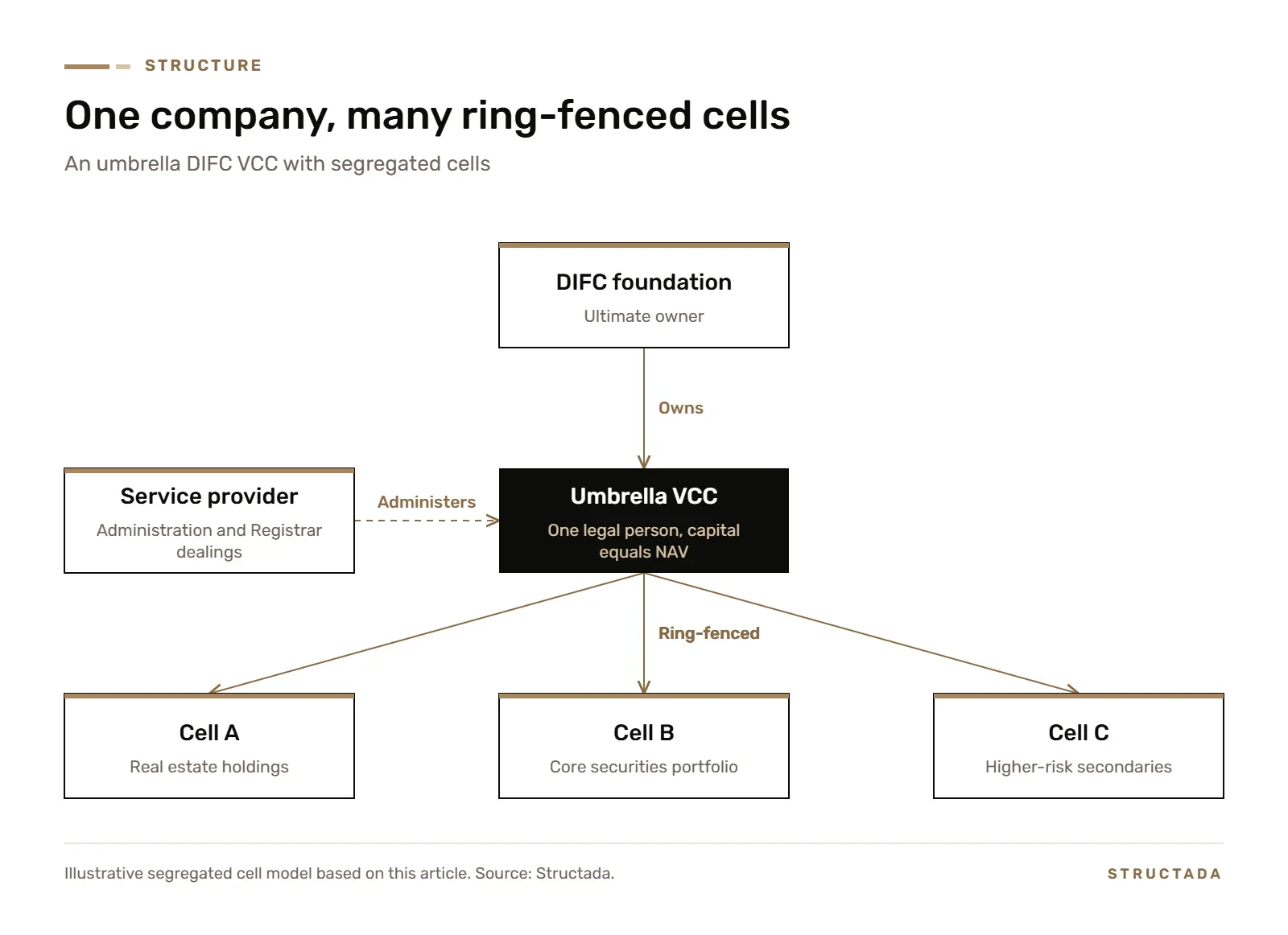
A VCC can take one of three forms. The simplest is a standalone VCC: a single company with variable capital and no cells. The second is an umbrella VCC with segregated cells, in which one legal entity is divided into ring-fenced cells, each with its own assets and liabilities, while the VCC remains the only legal person and acts on behalf of each cell. The third is an umbrella VCC with incorporated cells, where each cell is a separate company with its own legal personality, assets and liabilities. Incorporated cells are not subsidiaries of the VCC.
An umbrella VCC must choose one model and cannot have both segregated and incorporated cells. It can, however, convert from one model to the other with the necessary approvals, which gives some room to adjust as a structure grows.
Ring-fencing between cells
The value of a cell structure depends on how well the walls hold. The creditors of a segregated cell can claim only against that cell's assets, and have no recourse to other cells or to the VCC's general assets. Incorporated cells carry their own liabilities as separate companies. Directors must keep assets properly segregated, record which cell each asset belongs to and make clear which cell the VCC is acting for in each transaction. Failure to do so can expose officers to liability.
The choice between the two models follows the same logic as Guernsey's protected and incorporated cell companies, and the Jersey PCC. Segregated cells are simpler and cheaper to run, while incorporated cells give stronger separation that is easier to rely on outside the DIFC, where a foreign court may be unfamiliar with cell legislation. The DIFC also has its own incorporated cell company regime, which is worth comparing before a structure is chosen.
Setting up a DIFC VCC
There are three routes in. A VCC can be incorporated new in the DIFC. An existing DIFC private company can convert into a VCC, and back again if needed. A foreign company can continue into the DIFC as a VCC, which suits an offshore holding company migrating its domicile to Dubai.
Most VCCs must appoint a corporate service provider to handle administration, compliance and dealings with the DIFC Registrar. VCCs controlled by DIFC registered persons, DFSA authorised firms, government entities or listed companies are exempt from that requirement.
What a DIFC VCC can and cannot do
The VCC is a holding vehicle. It can hold investments of almost any kind, including securities, private companies, real estate holdings and intellectual property. It can separate different portfolios, strategies or family branches into cells, issue and redeem shares at NAV as owners contribute or withdraw, and consolidate several existing holding companies or SPVs into one structure.
Its limits are equally clear. A VCC cannot carry on an operating business or employ staff, and it cannot carry on regulated financial services, or establish a fund, without DFSA authorisation. Forming a VCC gives no exemption from DFSA rules: if the VCC, or the firm running it, carries on regulated activity in or from the DIFC, authorisation is still required.
In practice the uses cluster around family offices, which hold investments in cells by asset class, risk profile or family branch, often with a DIFC foundation as ultimate owner. Investment groups use it to bring scattered holding companies under one umbrella, to separate real estate projects, to isolate higher-risk secondaries or complex positions from core holdings, and to set aside a cell for charitable or impact allocations.
How a DIFC VCC is taxed
A DIFC VCC is subject to UAE corporate tax. It may benefit from the 0% rate as a Qualifying Free Zone Person on qualifying income; otherwise, the standard 9% rate applies to taxable income above AED 375,000. According to Ocorian, incorporated cells may form a tax group with the parent, and a VCC held by a family foundation may, in some circumstances, be treated as transparent. The position depends on the facts and should be confirmed with tax advisers before the structure is set.
DIFC VCC vs other cell and compartment structures
| DIFC VCC | Singapore VCC | Guernsey PCC or ICC | Luxembourg securitisation vehicle | |
|---|---|---|---|---|
| Main purpose | Proprietary investment and holding | Investment funds | Insurance, funds, investment structures | Issuing notes backed by assets |
| Regulation | Not a regulated fund; DFSA rules apply to regulated activity | Managed by a MAS-licensed fund manager | GFSC consent to create cell companies and cells | Unregulated unless issuing continuously to the public |
| Segregation | Segregated or incorporated cells | Sub-funds | Protected or incorporated cells | Statutory compartments |
| Capital | Variable, equal to NAV | Variable | Fixed or variable, depending on structure | Financed mainly by notes |
| Typical investors | The owner, family or group | Fund investors | Varies | Third-party noteholders |
The comparison with a Luxembourg securitisation vehicle is the one that matters most for issuers. The VCC is designed to hold and organise an owner's own investments. Taking money from third parties to invest on their behalf can amount to operating a fund or carrying on regulated activity, which would need DFSA authorisation. Where professional investors are to fund a defined portfolio of loans or assets, a securitisation compartment is built for that job: it issues notes with an ISIN, cleared through Euroclear and Clearstream, to investors who take credit risk on the assets. Our guide to securitisation SPVs vs private fund structures explains why that route avoids most fund-level regulation.
What this means for issuers
The DIFC VCC gives UAE-based families, groups and investment holders a flexible vehicle that combines variable capital with ring-fenced cells, under a common law framework and with access to UAE tax regimes. It is a structuring and holding tool, and it should be judged as one. Used to tidy a sprawl of holding companies or to separate family interests, it is likely to prove valuable.
Issuers looking to fund loan books or assets from outside investors will usually still turn to a securitisation vehicle. The two can work together, though. A family office or group might use a DIFC VCC to hold its investments, including notes issued by a securitisation compartment, with each strategy in its own cell. In that sense the VCC may become a natural home for the very investors who buy structured notes.
Frequently Asked Questions
What does VCC stand for?
Variable Capital Company, a company whose share capital always equals its net asset value.
When did the DIFC introduce the VCC?
The DIFC Variable Capital Company Regulations 2026 came into force on 9 February 2026.
Is a DIFC VCC a regulated fund?
No. It is a corporate vehicle for proprietary investment. Regulated financial services or fund activity still requires DFSA authorisation.
What is the difference between segregated and incorporated cells?
Segregated cells are ring-fenced compartments within one company. Incorporated cells are separate companies with their own legal personality.
Can an existing company become a DIFC VCC?
Yes. A DIFC private company can convert into a VCC, and a foreign company can continue into the DIFC as a VCC.
Is a DIFC VCC subject to UAE corporate tax?
Yes, although it may qualify for the 0% rate as a Qualifying Free Zone Person on qualifying income. Otherwise, the 9% rate applies above AED 375,000.