- A DIFC incorporated cell company (ICC) is a company that can create incorporated cells, each of which is a separate company with its own legal personality, assets and liabilities.
- The DIFC Incorporated Cell Company Regulations came into force on 1 May 2019, under the DIFC Companies Law.
- A DIFC ICC is a regulated structure: it can be used only for insurance business or fund business, and its incorporation, its cells and changes to its directors need the DFSA's written consent.
- The ICC and its cells are not parent and subsidiaries. The ICC cannot own shares in its cells, and cells cannot own shares in the ICC or each other.
- It differs from the DIFC Variable Capital Company introduced in 2026, which can also use incorporated cells but is designed for proprietary investment rather than regulated insurance and fund business.
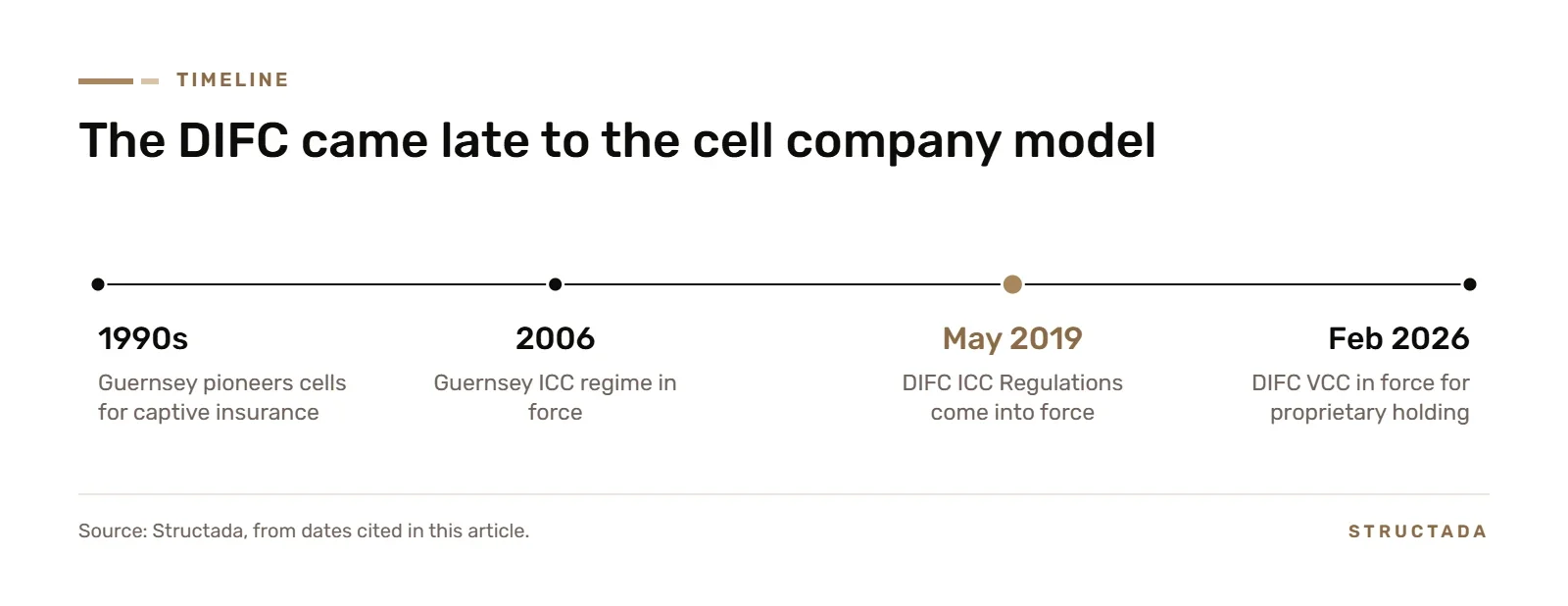
Cell companies solve a problem that every multi-portfolio business eventually meets: how to hold several pools of assets under one roof without letting a loss in one pool reach the others. Guernsey pioneered the answer in the 1990s for captive insurance, and the model has since spread to Jersey, Malta, the Cayman Islands and beyond.
In 2019 the Dubai International Financial Centre added its own version, the DIFC incorporated cell company, or DIFC ICC. The aim was to help the DIFC compete for captive insurers, reinsurance structures and funds that wanted ring-fenced cells within a common law jurisdiction in the Gulf.
The DIFC ICC is a narrower tool than its offshore counterparts. It is regulated from formation onwards and limited to two kinds of business. Understanding those limits matters as much as understanding the structure itself, particularly for issuers and lenders deciding which Gulf vehicle belongs in a transaction.
What is a DIFC ICC?
A DIFC ICC is a company incorporated under the DIFC Companies Law that can establish incorporated cells. Each cell is itself a company, with its own articles of association, shareholders, assets and liabilities. The regime sits in the DIFC Incorporated Cell Company Regulations, which came into force on 1 May 2019.
The point of distinction is legal personality. In a protected cell company, the cells are ring-fenced parts of a single legal entity, and their separation depends on statute. In an ICC, every cell is a legal person in its own right, so the separation between cells rests on separate incorporation as well as on the regulations. A court with no cell company legislation of its own should still recognise a separate company, which is why incorporated cells are generally regarded as the more robust form. Our guide to Guernsey ICCs explains the same distinction in the Guernsey context.
How a DIFC ICC works
The ICC sits at the top of the structure and provides the shared framework, board oversight and administration. Beneath it, each incorporated cell is a separate company with its own name, shareholders, assets and liabilities. The relationship between them is deliberately unusual: the ICC and its cells are not parent and subsidiaries. The ICC may not own shares in its cells, a cell may not own shares in the ICC, and cells may not own shares in one another.
The regulations also impose a degree of transparency through naming. The ICC's name must end with "Incorporated Cell Company" or "ICC". Each cell's name must end with "Incorporated Cell" or "IC", preceded by "Open-ended" or "Closed-ended", so that a counterparty can see from the name alone what kind of entity it is dealing with. Every cell is also designed to have a limited life: its articles must provide for it to be wound up on a specified event or after a specified period.
Permitted uses of a DIFC ICC
The defining constraint of the DIFC ICC is that it can be used only for insurance business or fund business. In practice, that means captive insurance, where a business insures its own risks through a cell, other insurance arrangements, and funds in which each cell operates as a separate fund.
Further rules shape how those uses work. The ICC itself must be closed-ended, and insurance cells must be closed-ended too. Fund cells can be open-ended or closed-ended, and open-ended cells must give shareholders the right to redeem their shares at net asset value. An ICC formed for fund business cannot itself be a fund or a fund manager, nor provide services to funds other than its own cells. When the regime launched, using ICCs for fund business also required changes to the DIFC's collective investment law, so sponsors should confirm the current position before building a fund structure around one.
DFSA regulation of the ICC
The Dubai Financial Services Authority is involved at every significant step in the life of a DIFC ICC. An application to the DIFC Registrar to incorporate an ICC, or to convert an existing company into one, must include the DFSA's written consent, and the DFSA can attach conditions. The application fee to incorporate or convert an ICC is US$1,000, according to the regulations.
That oversight continues after formation. Changes to the directors of the ICC or of any cell need prior DFSA approval. A cell can transfer to another ICC, but only with board and shareholder approvals, creditor consent or court sanction, a solvency declaration and DFSA consent. A cell can also apply to become a standalone company, again with DFSA consent. Where things go wrong, the DFSA can direct receivership or winding up, and can apply to court for orders over individual cells or the ICC itself.
For a captive insurer or a regulated fund platform, that supervision is part of the value. For a sponsor wanting to move quickly, it is a cost to be planned around.
Insolvency and winding up
Because each cell is a separate company, a cell's insolvency is handled as the insolvency of that company, and its creditors look only to its assets. That is the practical payoff of incorporated cells: a failed cell is wound up as a company in its own right, and the other cells continue untouched.
The ICC itself is treated differently. It cannot be wound up until all its cells have been transferred to another ICC, converted into standalone companies or wound up.
DIFC ICC vs DIFC VCC vs Guernsey ICC
| DIFC ICC | DIFC VCC | Guernsey ICC | |
|---|---|---|---|
| In force | 1 May 2019 | 9 February 2026 | Since 2006 |
| Permitted uses | Insurance and fund business only | Proprietary investment and holding | Insurance, funds, investment and other structures |
| Regulator involvement | DFSA consent to form, to directors and to transfers | No separate authorisation unless conducting regulated activity | GFSC consent to create the ICC and cells |
| Cells | Incorporated cells only | Segregated or incorporated cells, not both | Incorporated cells |
| Capital | Standard company capital, with NAV redemption for open-ended cells | Share capital always equal to NAV | Standard company capital |
The DIFC VCC is the more flexible tool for families and groups holding their own investments. The DIFC ICC is the specialist, regulated tool for insurance and funds. Guernsey's ICC has a longer track record and wider permitted uses, and sits alongside the island's protected cell company.
Where the DIFC ICC fits in structured finance
For note issuers and specialist lenders, the DIFC ICC is unlikely to be the issuing vehicle, because its uses are confined to insurance and fund business. Issuers placing notes with investors against defined assets will usually look to a securitisation vehicle designed for that purpose, such as a compartment of a Luxembourg securitisation vehicle, whose notes can be cleared and settled through the international systems.
The ICC can still matter around a transaction. A captive insurer in a DIFC ICC cell may provide credit insurance on a loan portfolio, or an insurance-linked structure may hold collateral in a cell. Our guide to securitisation SPVs vs private fund structures explains how the fund and note routes differ, and Gulf issuers working with regional assets will find the considerations in securitising UAE and GCC assets through Luxembourg relevant.
What this means for issuers
The DIFC ICC gives insurers and fund sponsors in the Gulf a common law cell structure in which each cell is its own company, supervised by the DFSA. It offers strong separation between cells and the flexibility to move or spin out cells over time, at the cost of regulatory consent at each key step.
For anyone else, the question is fit. Proprietary holding structures are now better served by the DIFC VCC, and note issuance to third-party investors belongs in a purpose-built securitisation compartment. The ICC earns its place where insurance or fund business is the point of the structure, and the sensible course is to settle that question at the outset, before the DFSA application is drafted.
Frequently Asked Questions
What does ICC stand for?
Incorporated cell company, a company that can create cells, each of which is a separate company.
When did the DIFC introduce ICCs?
The DIFC Incorporated Cell Company Regulations came into force on 1 May 2019.
What can a DIFC ICC be used for?
Only insurance business or fund business, such as captive insurance or funds with separate cells.
Does a DIFC ICC need DFSA approval?
Yes. The DFSA's written consent is needed to incorporate or convert an ICC, and for changes to directors and transfers of cells.
What is the difference between a DIFC ICC and a DIFC VCC?
An ICC is a regulated structure for insurance and fund business, with incorporated cells only. A VCC is designed for proprietary investment, has share capital equal to NAV and can use segregated or incorporated cells.
Is an incorporated cell a subsidiary of the ICC?
No. The ICC and its cells are not in a parent-subsidiary relationship, and the ICC cannot own shares in its cells.