- Fund finance is lending to investment funds rather than to operating companies. Its main forms are subscription lines, NAV facilities and hybrid facilities.
- A subscription line is secured on investors' uncalled capital commitments and is used mainly to bridge capital calls early in a fund's life.
- A NAV loan is secured on the fund's portfolio of investments and is used later in a fund's life, for follow-on investments, refinancing, acquisitions or distributions.
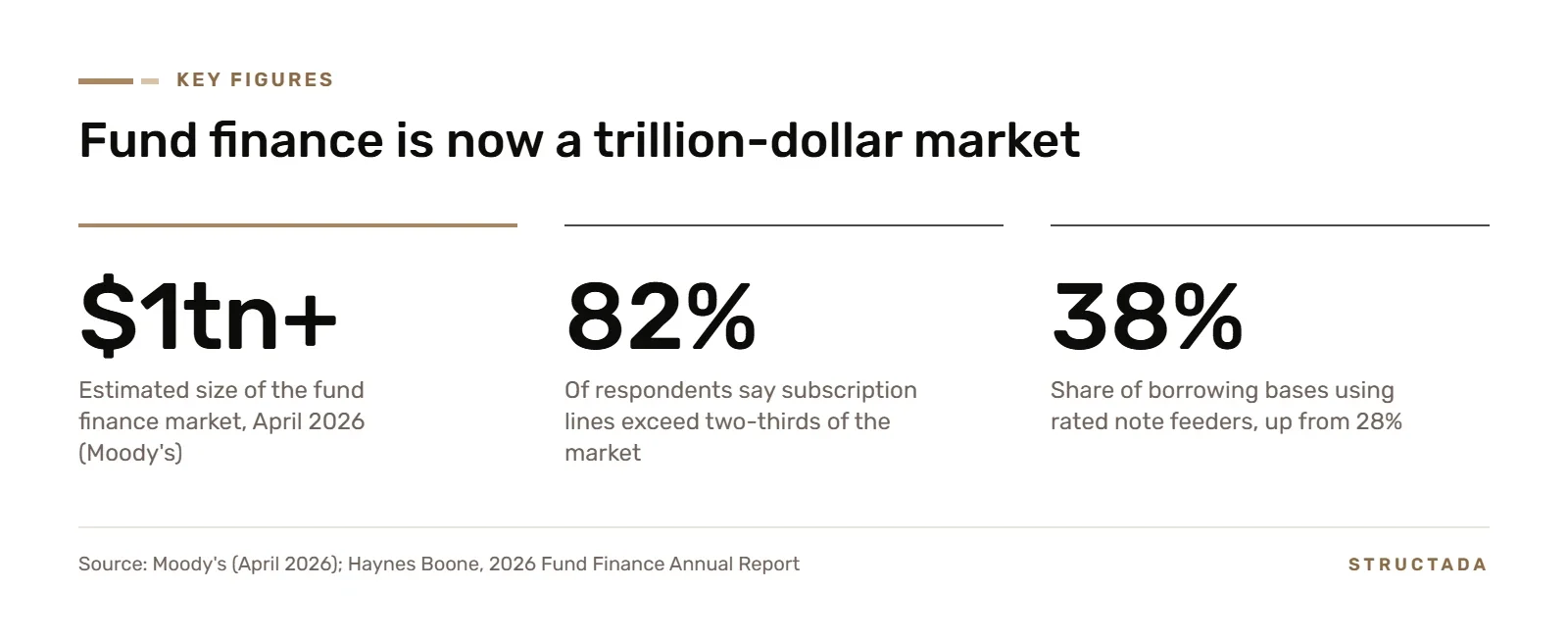
- The market has grown rapidly with private markets. Moody's estimated it at over $1 trillion in 2026, and most Haynes Boone survey respondents put it between $1.25 and $1.75 trillion.
- Fund finance can improve returns and flexibility, but it adds leverage at fund level, so investors increasingly ask how and why it is used.
A private equity fund that has agreed to buy a company can issue a capital call and wait for its investors to fund it, or it can draw on a credit line, close at once and call capital later in a single, larger batch. Most funds now take the second route. Years later, the same fund may be fully invested, with a portfolio company needing more capital and no uncalled commitments left. It can sell an asset at a poor moment, or borrow against the value of the whole portfolio. Increasingly, it borrows.
Those two loans are the two halves of fund finance: subscription lines at the start of a fund's life and NAV lending later on. Together they have turned fund-level borrowing from an occasional convenience into a standard part of how private markets operate.
That shift brings real benefits in speed and flexibility. It also adds a layer of leverage that sits above the portfolio companies, and investors and lenders are paying closer attention to how it is used.
What is fund finance?
Fund finance means lending to private funds, including private equity, private credit, real estate and infrastructure funds, or to their managers and investors. The lender looks to the fund's assets or its investors' commitments for repayment, rather than to the cash flows of an operating company.
The market has grown alongside private markets. Moody's estimated it at more than $1 trillion in April 2026, and in the Haynes Boone 2026 Fund Finance Annual Report, more than half of respondents put it between $1.25 and $1.75 trillion. Subscription lines remain the largest part, with more than 82% of respondents saying they represent over two-thirds of the market.
Subscription lines vs NAV facilities
Fund finance divides according to what the lender relies on, and that in turn follows the stage of a fund's life.
| Subscription line | NAV facility | Hybrid facility | |
|---|---|---|---|
| Secured on | Investors' uncalled capital commitments | The fund's portfolio of investments | Both commitments and portfolio |
| When used | Early in the fund's life | Mid to late life, once largely invested | Through the middle of the fund's life |
| Typical uses | Bridging capital calls, fast closings | Follow-on investments, refinancing, acquisitions, distributions | Flexible funding as the fund moves from commitments to assets |
| Credit focus | Investors' creditworthiness | Portfolio value, diversification and cash flows | A mix of both |
| Typical tenor | Short, revolving | Several years, often term loans | Varies |
Early in a fund's life, its main asset is the legal obligation of its investors to fund capital calls. Later, that obligation has largely been used up and the value sits in the portfolio. Hybrid facilities bridge the gap, drawing on whichever form of collateral the fund holds at the time.
How subscription lines work
A subscription line, also called a capital call facility, is a revolving loan to a fund secured on its right to call capital from its investors, the limited partners. The lender advances a percentage of the uncalled commitments of eligible investors, with higher advance rates for stronger investors, so the credit analysis is largely an analysis of the investor base.
The fund assigns its right to call capital and pledges the account into which that capital is paid, and it repays the line from capital calls, usually within months. The benefits are operational: faster execution, fewer and more predictable capital calls, and smoother cash management for both fund and investors.
Subscription lines also affect reported performance. Because investors' money is called later, a fund's internal rate of return can look higher than it would without the line, which is one reason investors now ask funds to disclose how they use them.
How NAV lending works
A NAV loan is made to a fund, or to a holding vehicle beneath it, and secured on the net asset value of its investments. It is used once most commitments have been called and the fund holds a portfolio.
Because the collateral is a portfolio of private and illiquid assets, NAV loans are usually made at modest loan-to-value ratios. Security typically takes the form of pledges over the holding vehicle's shares, the fund's bank accounts and the distributions from portfolio companies, as Proskauer's NAV survey describes. Repayment comes from distributions and exits, often through a cash sweep that diverts a share of proceeds to the lender. The holding vehicle structure also makes a share pledge central to the security package.
Follow-on investments and support for portfolio companies were the main uses of primary NAV facilities in the 2025 survey, while secondaries funds used NAV loans mainly to finance portfolio acquisitions. Proskauer found most primary facilities in the $100 million to $250 million range, with secondaries facilities often larger, and buyout funds the largest group of borrowers. Our guide to credit secondaries covers the related market for selling positions rather than borrowing against them.
Who lends to funds
Banks dominate subscription lines and remain active in NAV lending. Specialist NAV lenders and private credit funds have grown quickly in NAV and hybrid lending.
Insurers have become significant participants, often through rated structures. Use of rated note feeders, which give insurers rated exposure to funds, rose from 28% to 38% of respondents' borrowing bases in a year, according to Haynes Boone. Moody's has also noted banks packaging NAV loan exposures into asset-backed securities, bringing fund finance closer to the securitisation market.
The risks of NAV lending
The case for fund finance rests on speed, flexibility, liquidity and efficiency: closing without waiting for capital calls, supporting portfolio companies after the investment period, making distributions before exits and reducing the number of calls on investors. The risks are of a different kind, and they fall mainly on NAV lending.
The first is leverage on leverage. A NAV loan adds borrowing at fund level on top of debt already sitting inside the portfolio companies, and a loan secured on a small number of assets is exposed if one of them fails. Valuation is a further concern, since private asset values can lag the market, so a loan-to-value ratio may understate the real risk in a downturn. Investors have also become more vocal: limited partners may object to NAV loans used to fund distributions, which can look like returning their own money with borrowed funds, and they increasingly adjust reported returns for the effect of subscription lines.
Fund finance and note issuance
Fund finance and securitisation are converging. Rated note feeders already package fund exposure into notes for insurers, and lenders are exploring securitisations of subscription and NAV loans. For lenders and managers in the space, notes issued from a securitisation compartment can fund a fund-finance portfolio or give wealth investors exposure to it, without the regulatory weight of a new fund. Our guides to securitisation SPVs vs private funds and alternatives to setting up a fund explain the options. Where a facility has several lenders, a collateral agent usually holds the security for all of them.
What this means for issuers
For fund managers, fund finance is now a standard tool across a fund's life: subscription lines for speed early on, NAV and hybrid facilities for flexibility later. Used with discipline, it improves execution and liquidity. Used aggressively, it adds leverage that investors did not expect when they committed, and the reputational cost of that can outlast the facility.
For lenders and other providers of finance, the asset class offers secured exposure to diversified private portfolios, and it is increasingly funded through notes and structured vehicles as well as bank balance sheets. The managers and lenders who fare best treat fund-level leverage as a matter for transparent policy agreed with investors, and the funding structure behind it as a decision that deserves the same care as the loans themselves.
Frequently Asked Questions
What is fund finance?
Lending to private investment funds, secured on investors' uncalled commitments, the fund's portfolio or both.
What is a subscription line?
A revolving credit facility secured on investors' uncalled capital commitments, used to bridge capital calls.
What is NAV lending?
Lending to a fund secured on the net asset value of its portfolio, used once the fund is largely invested.
What is a hybrid facility?
A facility secured on both uncalled commitments and the fund's portfolio, used during the transition between the two.
How big is the fund finance market?
Moody's estimated it at more than $1 trillion in 2026, and many market participants put it between $1.25 and $1.75 trillion.
Why are investors cautious about NAV loans?
Because they add leverage at fund level, can be concentrated on a few assets, and are sometimes used to fund distributions before exits.