- Credit secondaries are transactions in which investors buy existing private credit exposure, such as interests in private credit funds or portfolios of loans, from current holders.
- There are two main types: LP-led deals, where a fund investor sells its stake, and GP-led deals, where a manager moves loans into a continuation vehicle backed by new capital.
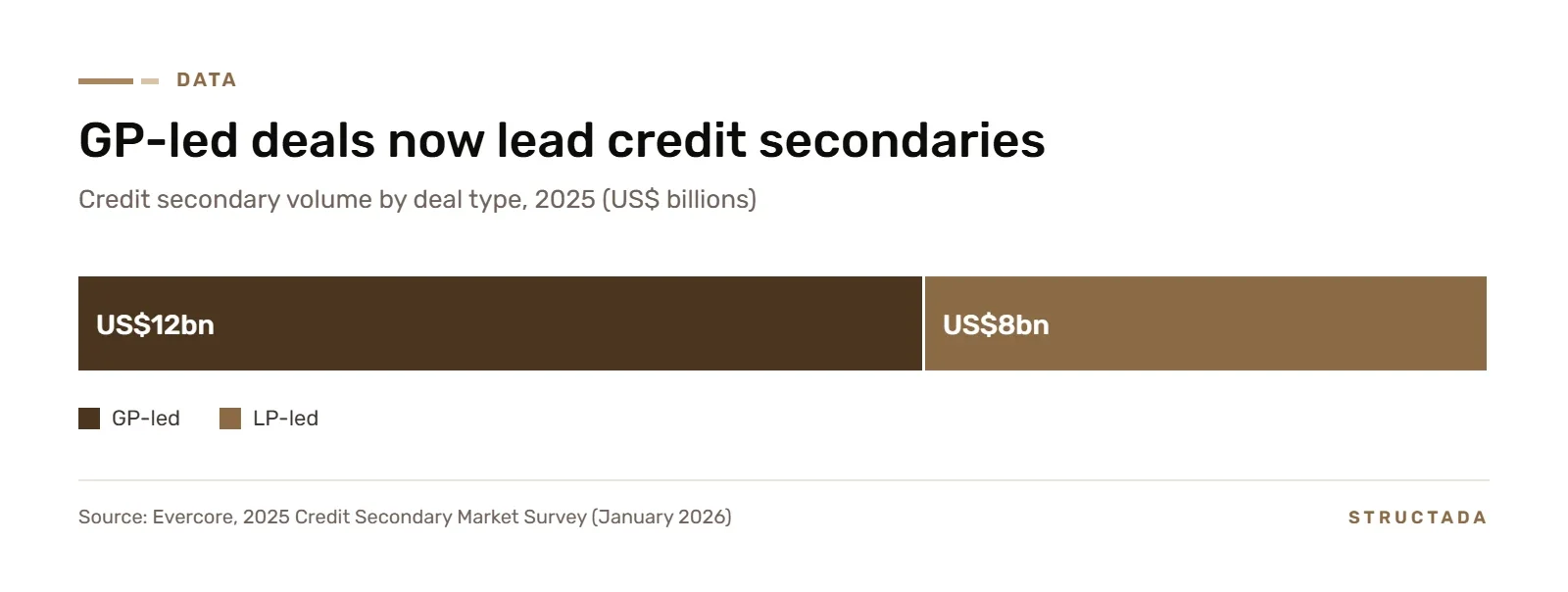
- The market roughly doubled in 2025. Evercore puts credit secondary volume at US$20 billion, up 83% from US$10.9 billion in 2024, with GP-led deals making up around 60%.
- Pricing has been close to par. Evercore estimates GP-led credit secondaries averaged 98% of net asset value in 2025, with first-lien portfolios in the mid-to-high 90s.
- Liquidity is the main driver. Investors want to rebalance or free up cash, and managers want to extend good loans and give their investors an exit.
A pension fund committed US$50 million to a direct lending fund five years ago. The loans are performing and the fund is paying interest. But the pension fund has changed its allocation targets, the fund has three more years to run, and it wants its money back now.
Five years ago its options would have been limited. Today it can sell its stake to a specialist buyer in a matter of weeks, often at close to the value the manager reports. That is the credit secondaries market at work, and its growth is changing how investors think about the illiquidity of private credit.
For anyone who originates, manages or holds private loans, the secondary market matters well beyond the deals themselves. It sets a visible price for seasoned credit, and it rewards structures that make exposure easy to transfer.
What are credit secondaries?
Credit secondaries are the sale of existing private credit exposure from one investor to another. The asset changes hands, but no new loan is made. The exposure being sold may be a limited partner's interest in a private credit fund, a portfolio of loans sold by a manager, bank or specialist lender, or single loans and strips of them, much like the whole loan market for individual assets.
Private equity secondaries have existed for decades. Credit secondaries are younger, but they have grown with the private credit market itself, and many of the same buyers now operate across both.
How credit secondaries work
The market divides into two kinds of transaction. In an LP-led deal, an investor in a private credit fund sells its interest to a secondary buyer. The fund and its loans stay the same, and only the investor changes. The manager usually has to consent to the transfer. Sellers are motivated by portfolio rebalancing, liquidity needs and a wish to reduce exposure to a single manager, according to the Evercore 2025 Credit Secondary Market Survey.
In a GP-led deal, the manager moves some or all of a fund's loans into a new vehicle, often called a continuation vehicle. Existing investors can choose to sell for cash or roll into the new vehicle, and new secondary investors provide the capital to buy out those who leave. These transactions let managers keep holding loans they like beyond the original fund's life, reset terms and give investors a genuine choice.
GP-led deals have moved from the margins to the centre of the market. Jefferies notes that continuation vehicles have become mainstream in credit, and that their use by blue-chip private credit managers has encouraged wider adoption.
The size of the credit secondaries market
Evercore puts credit secondary volume at US$20 billion in 2025, up 83% from US$10.9 billion in 2024. GP-led deals accounted for US$12 billion, up 202%, while LP-led deals reached US$8 billion, up 15%. The shift towards manager-led transactions is the defining feature of the past year.
Capital is following. Evercore estimates dedicated dry powder for credit secondaries at about US$37 billion at the end of 2025, around three-quarters of it targeting senior and unitranche loans. About 60% of surveyed buyers expect 2026 volume to exceed US$20 billion, and Jefferies has suggested private credit secondaries could reach more than US$40 billion a year by 2027.
How credit secondaries are priced
Credit secondaries are priced as a percentage of the net asset value (NAV) reported by the manager. Because performing loans pay contractual interest and have defined maturities, they are easier to value than private equity, and discounts are usually narrower. Evercore estimates that GP-led credit secondaries averaged 98% of NAV in 2025, with some first-lien portfolios trading at par or better.
| Factor | Effect on price |
|---|---|
| Senior secured, first-lien loans | Higher price, often mid-to-high 90s of NAV |
| Junior, mezzanine or opportunistic credit | Lower price, wider discounts |
| Portfolio diversification | More diversified portfolios price higher |
| Remaining term and cash yield | Shorter, high-yielding portfolios are attractive |
| Credit quality and non-accruals | Problem loans push prices down |
| Unfunded commitments and fund leverage | Can reduce what a buyer will pay |
The pattern is consistent: the more predictable the cash flows, the closer to par. Where a loan sits in the borrower's capital stack remains one of the main drivers of price, which is why so much dedicated capital is aimed at senior and unitranche exposure.
Who buys credit secondaries
The buyer base has widened considerably. Dedicated credit secondaries funds, from established managers and new entrants, remain the core. Insurers and pension funds buy for seasoned, income-producing loans that match their liabilities. Sovereign wealth funds and family offices take positions alongside them. Evergreen and semi-liquid funds have become important buyers too, using secondaries to deploy capital quickly into existing portfolios rather than waiting for new loans to be originated.
What these buyers share is a preference for certainty. A secondary purchase offers seasoned loans with known performance, faster deployment than a primary fund commitment and often a modest discount to NAV.
Why the market has grown
Several forces have converged. Private credit is now larger and older, and many funds launched in recent years hold seasoned portfolios that are ready to trade. Distributions have slowed, so investors receive cash back later than expected and look to secondaries for liquidity. Managers facing a harder fundraising environment use continuation vehicles to extend good assets while returning cash to investors who want it. And more capital has arrived, as dedicated credit secondary funds and new buyers have entered the market.
None of these pressures looks temporary, which suggests secondaries will become a permanent part of private credit's infrastructure rather than a cyclical outlet.
Secondaries, notes and liquidity
Fund interests are cumbersome to transfer. Each sale needs manager consent, investor checks and its own legal documentation. Loan exposure held through notes can be simpler. Notes issued by a securitisation vehicle carry an ISIN, settle through clearing systems and can be transferred between eligible investors without restructuring the vehicle. Our comparison of credit linked notes vs private credit funds explains the differences.
Secondaries also sit alongside other liquidity tools. Some managers and investors borrow against portfolios instead of selling them, as described in our guide to fund finance and NAV lending.
What this means for issuers
The growth of credit secondaries shows that private credit is becoming a more liquid asset class, and investors commit more readily when they can see a way out. That changes the questions lenders and managers should ask at the start of a transaction, long before anyone wants to sell.
Transferability is a design choice. The vehicle, the documents and the format in which investors hold their exposure all affect how easily a position can be sold later, and at what price. Exposure that is clearly documented, held in a settled security and backed by well-ranked loans will find buyers close to its reported value. Exposure that needs consents, fresh legal work and investor-by-investor negotiation will not, however well the underlying loans perform.
Frequently Asked Questions
What are credit secondaries?
Transactions in which investors buy existing private credit exposure, such as fund interests or loan portfolios, from current holders.
What is the difference between LP-led and GP-led credit secondaries?
In an LP-led deal, a fund investor sells its stake. In a GP-led deal, the manager moves loans into a continuation vehicle and existing investors choose to sell or roll over.
How big is the credit secondaries market?
Evercore estimates volume reached US$20 billion in 2025, up 83% from US$10.9 billion in 2024.
How are credit secondaries priced?
As a percentage of reported NAV. Evercore estimates GP-led deals averaged 98% of NAV in 2025, with senior secured portfolios pricing highest.
What is a continuation vehicle?
A new vehicle, set up by a manager, that buys assets from an existing fund so they can be held for longer, with new capital buying out investors who want to exit.
Why do investors sell private credit fund interests?
Mainly for liquidity, to rebalance portfolios or to reduce exposure to a particular manager.