- A whole loan is an entire loan held or bought as a single asset, with all of its cash flows, rights and risks, rather than a share of it or a slice of a securitised pool.
- Lenders sell whole loans to free up capital and funding to originate more, while buyers such as banks, insurers and private credit funds gain direct exposure to the loans.
- Forward flow arrangements extend the idea: an investor agrees to buy new loans from an originator on an ongoing basis, as long as they meet agreed eligibility criteria.
- Large forward flow deals include Klarna's reported US$26 billion multi-year agreement with Nelnet, according to law firm Weil.
- Whole loans can be held directly, or placed into a securitisation vehicle that issues notes to investors, giving them the loan exposure in a format they can hold and settle.
A specialist consumer lender writes £10 million of loans a month. Its funding line is nearly full, and every new loan consumes capital it does not have. A pension fund manager, meanwhile, wants exposure to exactly this kind of short-dated, higher-yielding consumer credit, but has no means of originating it.
The answer is one of the oldest transactions in credit markets. The lender sells the loans, whole, to the fund. The lender keeps the customer relationship and usually continues to service the loans. The fund takes the cash flows and the risk. Each side gets what it lacks.
The whole loan market has grown into one of the main channels through which non-bank lenders fund themselves, and its mechanics, from eligibility criteria to true sale and servicing, shape how much of that growth investors can safely absorb.
What is a whole loan?
A whole loan is a loan held in its entirety by one owner. The holder has the full principal, all interest payments and all the lender's rights under the loan agreement, including the right to enforce security.
The term exists to distinguish outright ownership from the other ways of holding credit. In a participation, an investor buys a share of a loan, often without any direct relationship with the borrower. In a securitised credit structure, loans are pooled and investors buy notes or tranches backed by the pool. In a syndicated loan, the loan is shared among several lenders from the outset.
Usage varies by market. In US mortgage markets, whole loans are mortgages traded as individual loans rather than as mortgage-backed securities. In commercial real estate, a whole loan can also mean a single loan covering both senior and mezzanine risk, before it is split into senior and junior notes.
How a whole loan sale works
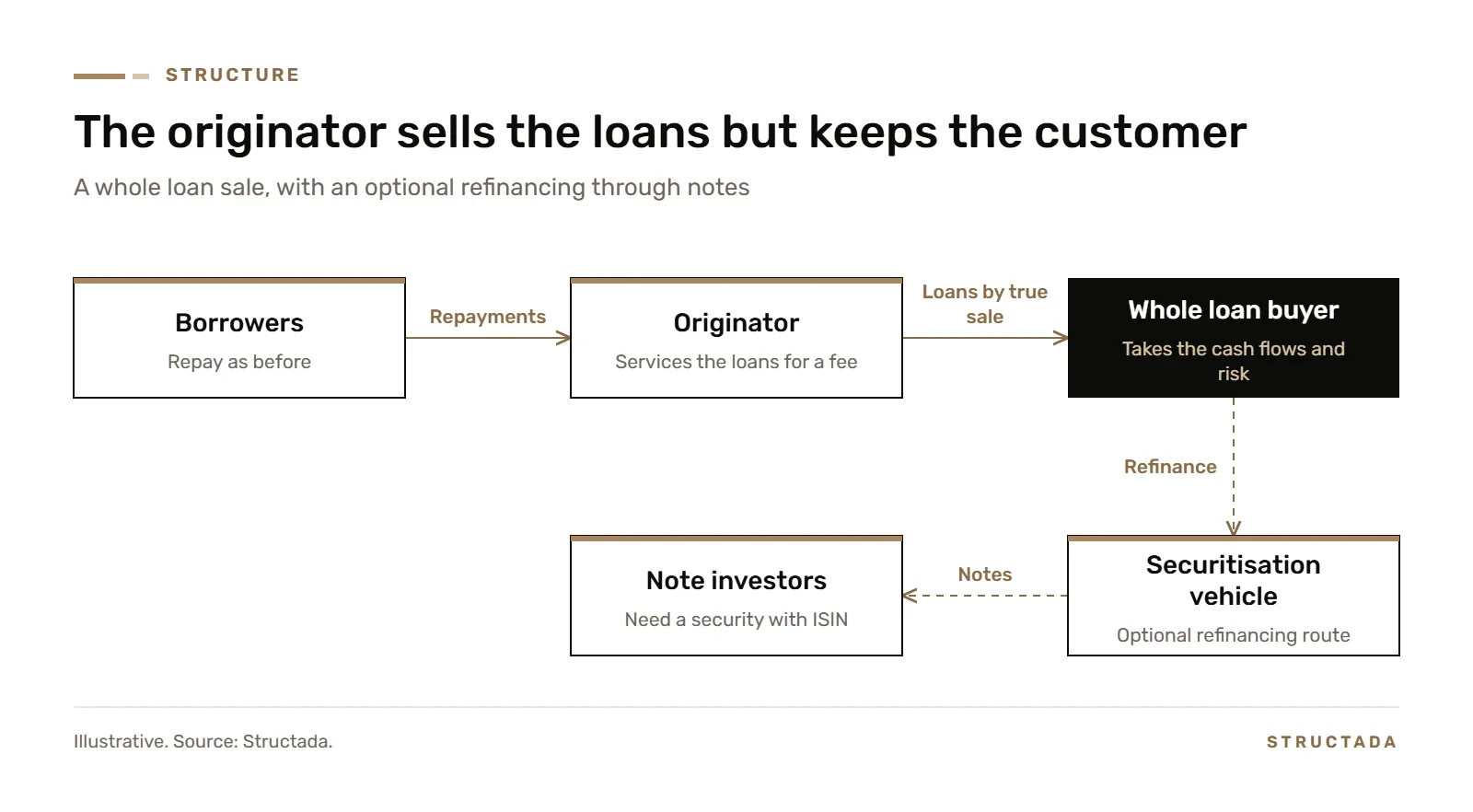
A whole loan sale begins with origination. The lender writes loans under its own credit policy, and those that meet the buyer's eligibility criteria, such as loan size, borrower profile, term and credit score, are identified for sale. The loans are then transferred to the buyer, usually by true sale, at a price agreed by reference to their yield and expected losses.
After the sale, the originator usually keeps servicing the loans for a fee, collecting payments and managing arrears. Collections are passed to the buyer net of that fee. To the borrower, nothing appears to change; the economic owner of the loan, and the party bearing its credit risk, has changed entirely.
That separation of ownership from servicing is the heart of the market. It allows an originator to keep its customers, its brand and its operating platform while handing the balance sheet burden to someone better placed to carry it.
Forward flow arrangements
A forward flow arrangement turns a one-off sale into a programme. The buyer commits to purchase new loans from the originator over a period, often several years, as long as they meet agreed criteria.
According to Weil, these agreements commonly share a set of features. Eligibility criteria give the buyer a specific risk profile, and the originator must repurchase loans that turn out not to meet them. The originator continues to service the loans. Interests are aligned, often through deferred consideration or additional servicing fees where the originator retains no direct risk. Some agreements also include minimum volumes or rights of first refusal over new products.
Weil cites Klarna's US$26 billion multi-year US deal with Nelnet, and KKR's agreement to buy future consumer credit receivables from UK card lender NewDay, as examples of how large the market has become. For a growing originator, a well-structured forward flow agreement can provide funding certainty that a revolving warehouse line rarely matches.
Whole loans vs securitisation
Whole loan sales and securitisation solve the same funding problem in different ways.
| Whole loan sale | Securitisation | |
|---|---|---|
| What the investor holds | The loans themselves | Notes backed by a pool of loans |
| Tranching | None: the buyer takes all the risk | Senior, mezzanine and junior tranches |
| Number of investors | Usually one buyer per loan pool | Several investors across tranches |
| Format | Loan transfer and servicing agreement | Securities with an ISIN, settled in clearing systems |
| Typical buyers | Banks, insurers, private credit funds | Wider range, including wealth and institutional investors |
The two often work together. A buyer may acquire whole loans and later finance or refinance them through a securitisation, using the senior tranches to fund the purchase while keeping the junior risk. Our guide to how securitisation works explains the process.
Why originators sell whole loans
The first reason is funding. A sale turns loans into cash that can fund new lending, which matters most to lenders whose growth outpaces their committed facilities. The second is capital: moving loans off balance sheet frees capital, which is particularly valuable for a growing lender. Originators also tend to keep servicing fees and the customer relationship, so a sale need not mean giving up the franchise. Regular sales bring a further, less obvious benefit, an independent view of what the loans are worth, which supports the lender's valuation and its conversations with every other funder.
For banks, selling whole loans is one way to manage capital. Another is to keep the loans and transfer only the risk, as described in our guide to synthetic risk transfer. For portfolios of distressed loans, see our article on NPL securitisation.
What buyers look for
A whole loan buyer is underwriting the originator as much as the loans. Origination quality comes first: underwriting standards, data and a track record that shows how earlier vintages performed. Servicing comes next, since the buyer depends on the servicer's ability to collect and manage arrears, and usually wants a backup servicer in place if it fails.
The legal transfer must be clean. A true sale protects the loans if the originator becomes insolvent, and without it the buyer may find itself an unsecured creditor of the lender it meant to fund. Buyers also expect loan-level data, regular performance reports and audit rights, together with clear repurchase obligations if loans breach eligibility criteria or warranties. Weaknesses in any of these areas show up in price, or in the buyer walking away.
Whole loans and notes
Many investors who want loan exposure cannot hold whole loans directly. Their mandates, custodians or regulators require a security with an ISIN that can be booked and settled. A securitisation vehicle bridges the gap: it can buy whole loans, or a term loan to a lender, and issue credit linked notes that pass the loan cash flows to investors. Our guide to how non-bank lenders use credit linked notes explains the structure.
What this means for issuers
Whole loan sales and forward flow arrangements let specialist lenders keep originating without being constrained by their own balance sheet. The market rewards preparation. Originators with clean loan-level data, a servicing platform that stands up to scrutiny and eligibility criteria that are precise rather than aspirational attract better pricing and longer commitments.
The format of the sale is a separate decision from the sale itself. Where the natural buyer can hold loans directly, a whole loan sale is the simplest route. Where investors need a security, the same loans can be placed in a securitisation vehicle and funded through notes. Lenders who build their data and documentation to serve both routes from the outset keep their options open as their investor base widens.
Frequently Asked Questions
What is a whole loan?
An entire loan owned by one holder, with all its cash flows and rights, rather than a share of a loan or a securitised tranche.
What is a whole loan sale?
The transfer of entire loans from an originator to a buyer, usually by true sale, with the originator often continuing to service them.
What is a forward flow arrangement?
An agreement under which an investor buys new loans from an originator on an ongoing basis, as long as they meet agreed eligibility criteria.
Who buys whole loans?
Banks, insurers, asset managers and private credit funds seeking direct exposure to loan portfolios.
How is a whole loan different from a securitisation?
A whole loan buyer takes all the risk of the loans directly, while securitisation investors buy notes in tranches backed by a pool of loans.
Who services a whole loan after it is sold?
Usually the originator, which collects payments and manages arrears for a fee under a servicing agreement.