- A term loan is a loan of a fixed amount, drawn at the start or over a short availability period, and repaid over a set term, usually between one and seven years.
- Repayment can be amortising, with regular instalments of principal, or bullet, with most or all of the principal repaid at maturity.
- In leveraged and corporate finance, Term Loan A is an amortising loan usually held by banks, while Term Loan B has minimal amortisation, a longer term and is sold to institutional investors such as CLOs.
- Term loans are usually senior and secured, with covenants, security and a set of events of default that protect the lender.
- In private credit, term loans are often funded through notes, so the lender can finance a loan book with capital from investors rather than its own balance sheet.
A company agrees to buy a competitor for £15 million. Its cash flow is steady, but the cash is not on the balance sheet. It has no use for a facility it can draw and repay at will. It needs a single sum at completion, which it will repay from the profits of the combined business over the next five years.
That is the job of a term loan. It is the most basic instrument in corporate lending, and it sits at the heart of most acquisition financings, real estate transactions and private credit portfolios. Its simplicity is deceptive. The repayment profile, the ranking, the covenants and the way the loan is funded determine who carries the risk, and who is left holding it if the business underperforms.
For lenders, and for the investors who increasingly stand behind them, understanding how a term loan is built is the starting point for understanding almost every other private credit structure.
What is a term loan?
A term loan is a loan of a fixed amount for a fixed period. The borrower draws the money in one go, or in a few tranches during a short availability period, and repays it according to an agreed schedule. Once repaid, the money cannot be drawn again.
That is the main difference from a revolving credit facility. A revolver works much like an overdraft: the borrower can draw, repay and redraw up to a limit, and it is used to fund working capital. Term loans fund long-term needs such as acquisitions, capital expenditure and refinancings, where the borrower knows how much it needs and when, and where repayment can be matched to the cash flow the investment is expected to produce.
How a term loan works
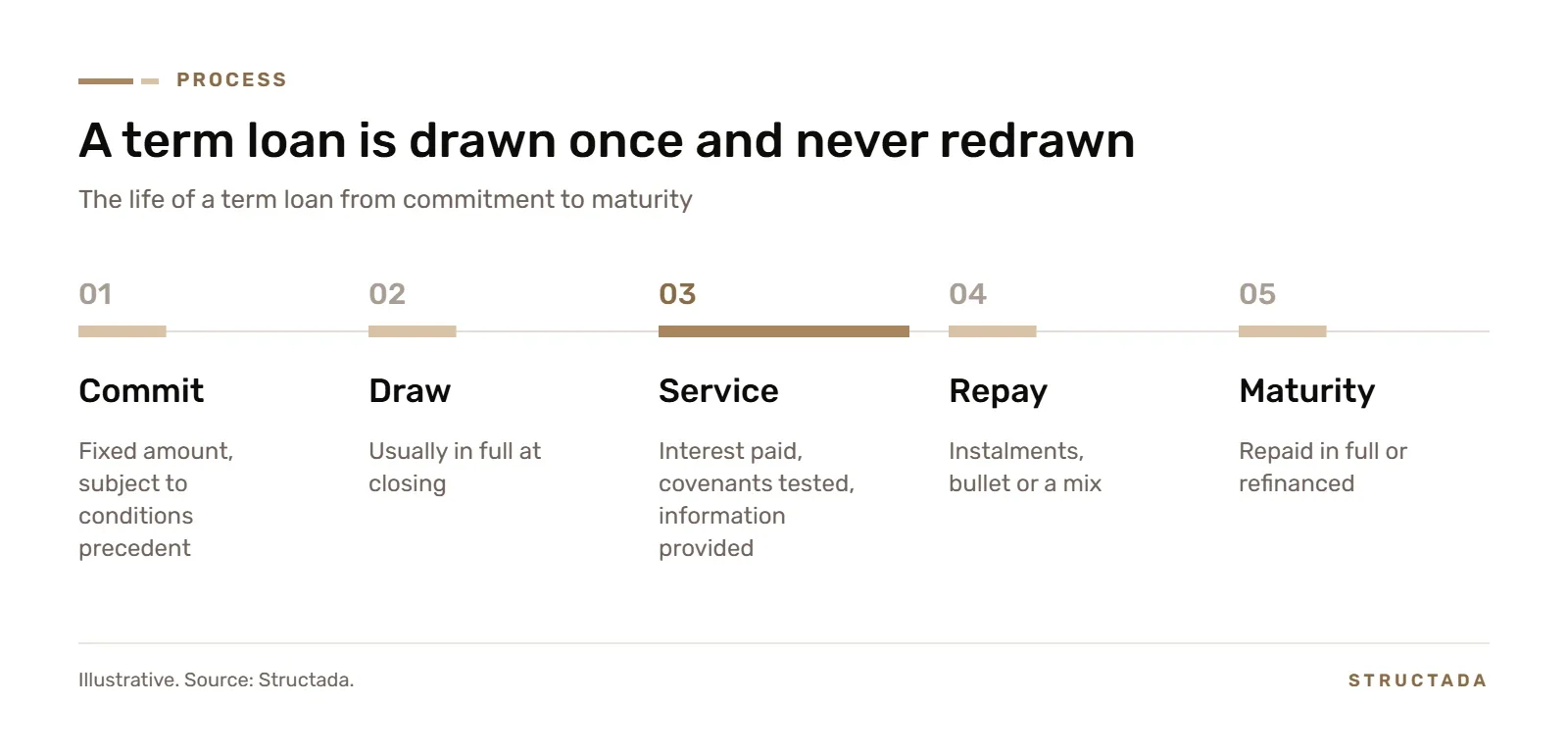
The life of a term loan follows a familiar sequence. The lender first commits to lend a fixed amount, subject to conditions precedent such as security, legal opinions and due diligence. Once those are satisfied, the borrower draws the loan, usually in full at closing.
Interest is then paid periodically, usually monthly or quarterly, either at a fixed rate or at a floating rate such as SONIA, SOFR or EURIBOR plus a margin. Throughout the term the borrower provides financial information and must comply with its covenants, which give the lender early warning if performance deteriorates. Principal is repaid in instalments, at maturity or through a mix of the two, and at maturity the loan is repaid in full or refinanced.
Most of the negotiation between lender and borrower concentrates on two of those stages: how the principal comes back, and what happens if the borrower fails to perform along the way.
Amortising vs bullet repayment
The repayment profile shapes both the borrower's cash flow and the lender's risk.
| Amortising | Bullet | |
|---|---|---|
| Principal repayment | Regular instalments over the term | All or most at maturity |
| Cash flow burden | Higher during the term | Lower during the term |
| Refinancing risk | Lower | Higher, as a large sum falls due at once |
| Typical use | Bank loans, equipment and asset finance | Institutional loans, real estate, acquisition finance |
An amortising loan reduces the lender's exposure every quarter, which is why banks favour it. A bullet loan leaves the borrower more cash to run and grow the business, but concentrates risk at maturity, when the borrower must either have the money or find someone willing to refinance it. Many loans sit between the two, with modest instalments during the term and a larger balloon payment at maturity. Lenders may also require a cash sweep, under which a share of excess cash flow goes towards early repayment.
Term Loan A vs Term Loan B
In leveraged and syndicated lending, term loans are often split into tranches aimed at different lenders. Term Loan A, or TLA, usually amortises substantially over around five to six years and is held by banks, often alongside a revolving facility. It typically carries maintenance covenants and a lower margin.
Term Loan B, or TLB, usually has minimal amortisation, often around 1% a year, with a bullet at maturity after around seven years. It is sold to institutional investors, particularly collateralised loan obligations (CLOs) and loan funds, and is often covenant-lite. The Federal Reserve has described how institutional term loans, funded mainly by non-banks, grew to dominate the US syndicated term loan market.
The split reflects who is lending. Banks prefer shorter, amortising exposure they can monitor closely. Institutional investors accept longer, bullet exposure in return for a higher margin and a loan they can buy and sell.
Term loans in private credit
Private credit lenders also lend mainly through term loans, though the shapes differ. The commonest is the senior secured term loan, with first-ranking security over the borrower's assets and shares. Unitranche loans combine senior and junior debt into one loan at a single blended rate, simplifying the capital structure for the borrower; our guide to the unitranche loan as a credit linked note explains how they can be packaged for investors. Delayed draw term loans let a borrower draw further amounts for acquisitions or capital expenditure within an agreed period, and asset-backed term loans, secured on a pool of receivables or other assets, are widely used by specialist lenders.
Private credit term loans are usually held by a small number of lenders, carry maintenance covenants and are priced at a margin above bank loans in return for speed, flexibility and certainty of execution. Where they sit in the borrower's capital stack determines how much of that margin is compensation for genuine risk.
What protects the lender
A term lender's protection rests on four elements working together. The first is security: typically a share pledge over the borrower and security over its bank accounts, receivables and other assets, often held by a collateral agent on behalf of several lenders.
The second is covenants. Financial covenants, such as leverage and interest cover, measure performance, while undertakings restrict new debt, disposals and distributions. Our guide to loan covenants explains how they work. The third is the events of default, including non-payment, covenant breaches, insolvency and change of control, which allow the lender to accelerate the loan and enforce its security. The fourth is prepayment terms: call protection or prepayment fees that compensate the lender if the loan is repaid early and the expected income is lost.
Security without covenants leaves the lender waiting for a payment default before it can act. Covenants without security give it a seat at the table but little leverage once there. The strongest loans combine both.
How term loans are funded
Banks fund term loans from deposits and their own capital. Non-bank lenders need another source, typically funds, bilateral facilities from larger lenders or notes.
Notes are increasingly common. A lender can place a term loan, or a portfolio of them, into a securitisation vehicle, which issues credit linked notes to investors. The note repayments follow the loan repayments, so the investor takes the credit risk of the underlying loans while the lender keeps the relationship with the borrower. Our comparison of credit linked notes vs bilateral loans sets out the trade-offs.
Other markets use their own formats. In Germany, for example, a Schuldschein is a term loan documented under German law and distributed to investors much like a bond.
What this means for issuers
The term loan is the building block of corporate and private credit lending, and its terms travel with it. When a specialist lender funds a book of term loans through notes, investors are buying the repayment profile, the security package and the covenant protection negotiated at origination. Weak documentation at the loan level cannot be repaired later in the structure.
The lenders who fund most efficiently treat the two as one exercise. They originate loans on terms that investors will recognise, with clean security, consistent covenants and reporting that can flow through to noteholders, and they settle the funding structure before the book grows, rather than retrofitting it once the balance sheet is full.
Frequently Asked Questions
What is a term loan?
A loan of a fixed amount, repaid over a set period according to an agreed schedule, which cannot be redrawn once repaid.
How is a term loan different from a revolving credit facility?
A term loan is drawn once and repaid, while a revolving facility can be drawn, repaid and redrawn up to a limit.
What is the difference between Term Loan A and Term Loan B?
Term Loan A amortises substantially and is usually held by banks. Term Loan B has minimal amortisation, a longer term and is sold to institutional investors such as CLOs.
What is a bullet repayment?
A repayment structure in which all or most of the principal is repaid in a single payment at maturity.
Are term loans secured?
Most corporate and private credit term loans are senior secured, with security over the borrower's shares and assets.
How long is a term loan?
Usually between one and seven years, depending on the purpose, the borrower and the lender.