

- A unitranche loan combines senior and subordinated debt into a single facility with one blended interest rate, one set of covenants and one set of documents.
- A credit linked note (CLN) passes the credit performance of a reference asset, such as a loan, to the investors who hold the note, in exchange for a coupon.
- Structuring a unitranche loan as a CLN lets a lender fund or transfer the risk of the loan through notes, while the borrower keeps a single facility with one lender of record.
- The note's coupon, maturity and loss terms must mirror the loan closely, or the lender is left holding mismatches it did not intend to keep.
- Success depends on sound credit analysis of the underlying loan, clear documentation and genuine investor appetite for single-name private credit exposure.
Unitranche lending has become one of the defining products of private credit. A borrower that once needed a senior bank facility and a separate mezzanine lender, with an intercreditor agreement between them, can now take a single loan at a single blended rate from one lender. The appeal for the borrower is obvious: one set of documents, one relationship and one negotiation.
The difficulty sits with the lender. A unitranche loan concentrates the whole of the borrower's debt risk on one balance sheet, and specialist lenders rarely have the depth of funding to hold many such positions to maturity. Structuring a unitranche loan as a credit linked note is one way to resolve that tension. The lender keeps the simplicity the borrower values, while the note carries the funding and the credit risk out to investors who want it.
This guide explains how the structure works, where its value lies and what has to be got right for it to hold together.
What is a unitranche loan?
A unitranche loan is a hybrid debt facility that blends senior and subordinated debt into one instrument with a blended interest rate and unified terms. Instead of separate agreements between senior and junior lenders, the borrower deals with a single lender under a single set of covenants.
The economics are easiest to see through an illustration. A $100 million unitranche loan might carry a blended rate of 8%, reflecting a mix of senior-style pricing around 6% and subordinated pricing around 12%. The borrower pays one rate and reports against one covenant package, and the lender takes the full spectrum of risk from the first pound of security value to the last. Where that sits in the borrower's capital stack explains both the pricing and the appetite of the investors who will eventually look at it.
What is a credit linked note?
A credit linked note is a debt security whose returns are linked to the credit performance of a reference asset or portfolio, such as a single loan or a pool of loans. Investors receive a coupon for bearing the risk of default on that reference asset. If a default occurs, they may lose part or all of their principal, and that loss protects the party that would otherwise have borne it.
In practice the notes are usually issued by a securitisation vehicle, often a compartment of a Luxembourg securitisation vehicle, which holds the loan or the exposure to it and pays investors from what the loan produces. Our guide to how credit linked notes work covers the general mechanics in more detail.
How to structure a unitranche loan as a credit linked note
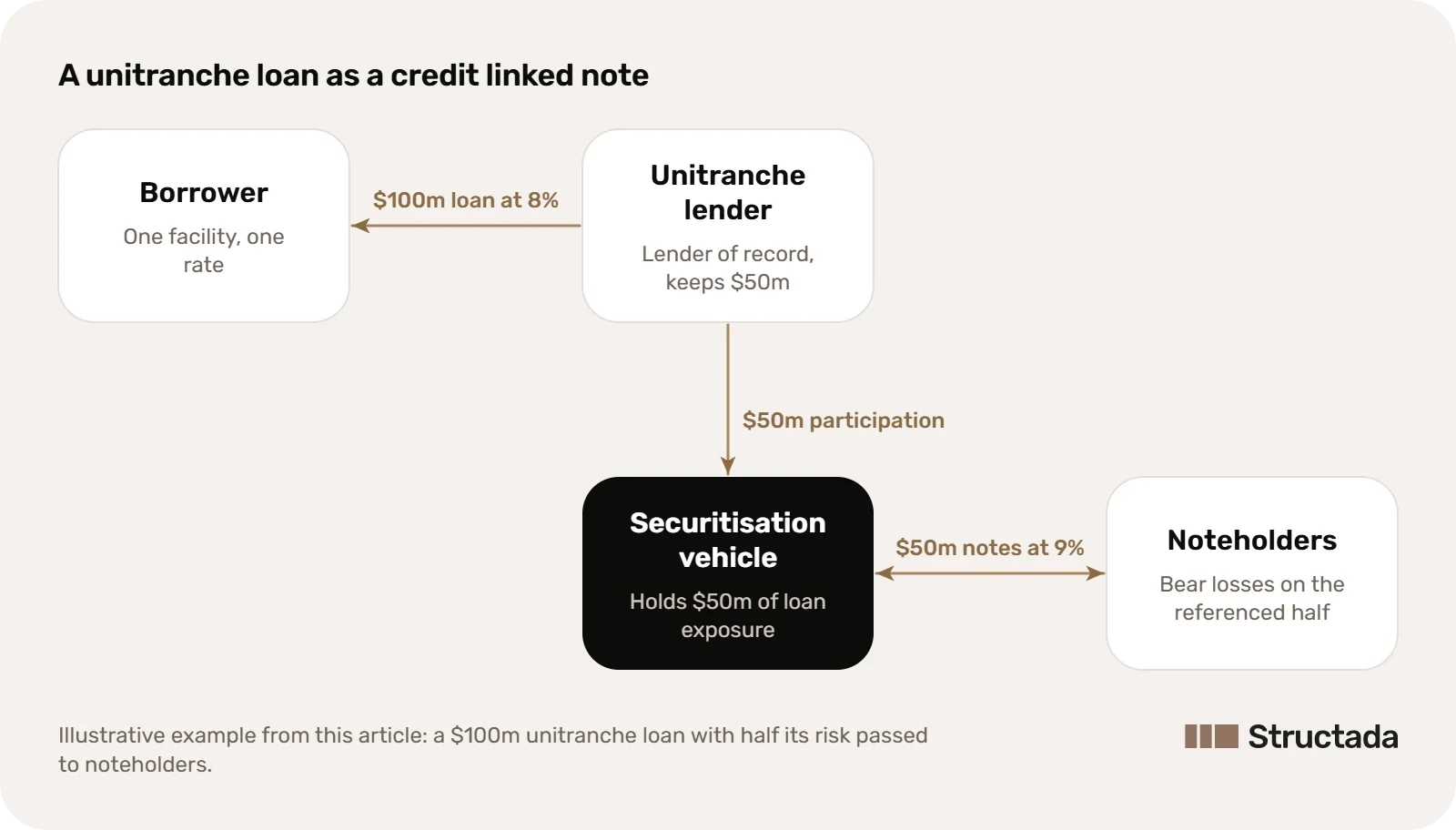
The structure begins with the loan itself. The lender originates the unitranche facility on its normal terms, and the borrower signs a single loan agreement with a single lender of record. Nothing in the borrower's documents needs to refer to the note.
The loan, or the economic exposure to it, then becomes the reference asset for the CLN. A securitisation vehicle issues notes to investors, and the proceeds fund the vehicle's acquisition of the loan or of a participation in it. Interest and principal paid by the borrower flow through the vehicle to noteholders, net of fees and costs. Continuing the illustration, the vehicle might issue $50 million of notes referencing half of the $100 million loan, paying investors a coupon of 9%.
Risk transfer follows from the terms of the note. If the borrower defaults, losses on the referenced portion are absorbed by noteholders, who may lose part or all of their principal according to the note conditions. In the example, the lender is protected against losses on the $50 million covered by the notes and keeps the economics and the risk of the remainder. How much of the loan to reference is a commercial decision: some lenders fund the whole facility through notes, others keep a slice to align their interests with investors.
The final step is making the notes investable. They need an ISIN, a paying agent and settlement through the international clearing systems, so that investors can hold them in the same accounts they use for any other bond.
Benefits for lenders, borrowers and investors
For the lender, the main benefit is capacity. Transferring the credit risk of a unitranche loan to noteholders reduces its exposure to a single borrower and frees its balance sheet to originate further loans. For a regulated lender, risk transfer may also support regulatory capital relief, though that depends on the rules that apply to it and on the structure meeting them, a subject our guide to synthetic risk transfer explores.
For the borrower, very little changes, and that is the point. It keeps a single facility, a single blended rate and a single set of covenants, and it continues to deal with the lender that underwrote it. The CLN sits behind the loan, invisible to the borrower's day-to-day relationship.
For investors, a CLN linked to a unitranche loan offers access to private credit yields in the form of a security rather than a loan. Hedge funds, pension funds, credit managers and wealth channel investors who cannot or do not wish to hold loans directly can hold a note through their custodian, with a risk profile that reflects the blended position of the underlying facility. The note format widens the pool of potential investors well beyond the lender's existing co-lending relationships.
Considerations and challenges
The structure is only as good as the credit analysis behind it. A unitranche loan carries both senior and subordinated risk in one instrument, so investors need a clear view of the borrower, its cash flows, its security package and the covenants that protect them. A note priced on optimistic assumptions will either fail to place or store up problems for the first difficult quarter.
Alignment of terms matters as much as credit quality. The coupon, interest periods, maturity, prepayment provisions and loss allocation of the note must mirror the loan closely. Where the borrower can prepay the loan without penalty, noteholders need to understand that their notes may be redeemed early. Where the loan can be amended or waived, the note conditions must set out who decides and how noteholders are consulted. Mismatches left unaddressed fall back on the lender, which defeats the purpose of the exercise.
Regulatory and documentary discipline is the third requirement. The notes must be offered in compliance with the rules of each jurisdiction where investors sit, usually on a private placement basis to professional investors, and the documentation must make the transfer of risk clear. Investor demand is the last variable and the hardest to control: appetite for single-name private credit exposure varies with market conditions, and the timetable should allow for that.
What this means for issuers
Structuring a unitranche loan as a credit linked note is a practical way for a specialist lender to keep offering borrowers the product they want without carrying every loan on its own balance sheet. The borrower experience stays simple, and the lender gains access to investors who would never have joined a bilateral loan but are comfortable holding a note in custody.
The work lies in the detail. Lenders that do this well design the loan with the note in mind from the outset, so that interest periods, prepayment terms and amendment rights translate cleanly into note conditions. Settling the vehicle, the reference terms and the settlement arrangements before the loan closes is far easier than retrofitting them afterwards, and it gives investors the clarity they need to price the risk with confidence. Our guide to how to issue a credit linked note sets out the steps.