- Synthetic risk transfer (SRT) lets a bank transfer the credit risk on a portfolio of loans to investors without selling the loans, usually to reduce the capital it must hold.
- The bank keeps the loans and its client relationships, and buys protection on a tranche of the portfolio, typically the first-loss or mezzanine slice, through a guarantee, credit default swap or credit linked note.
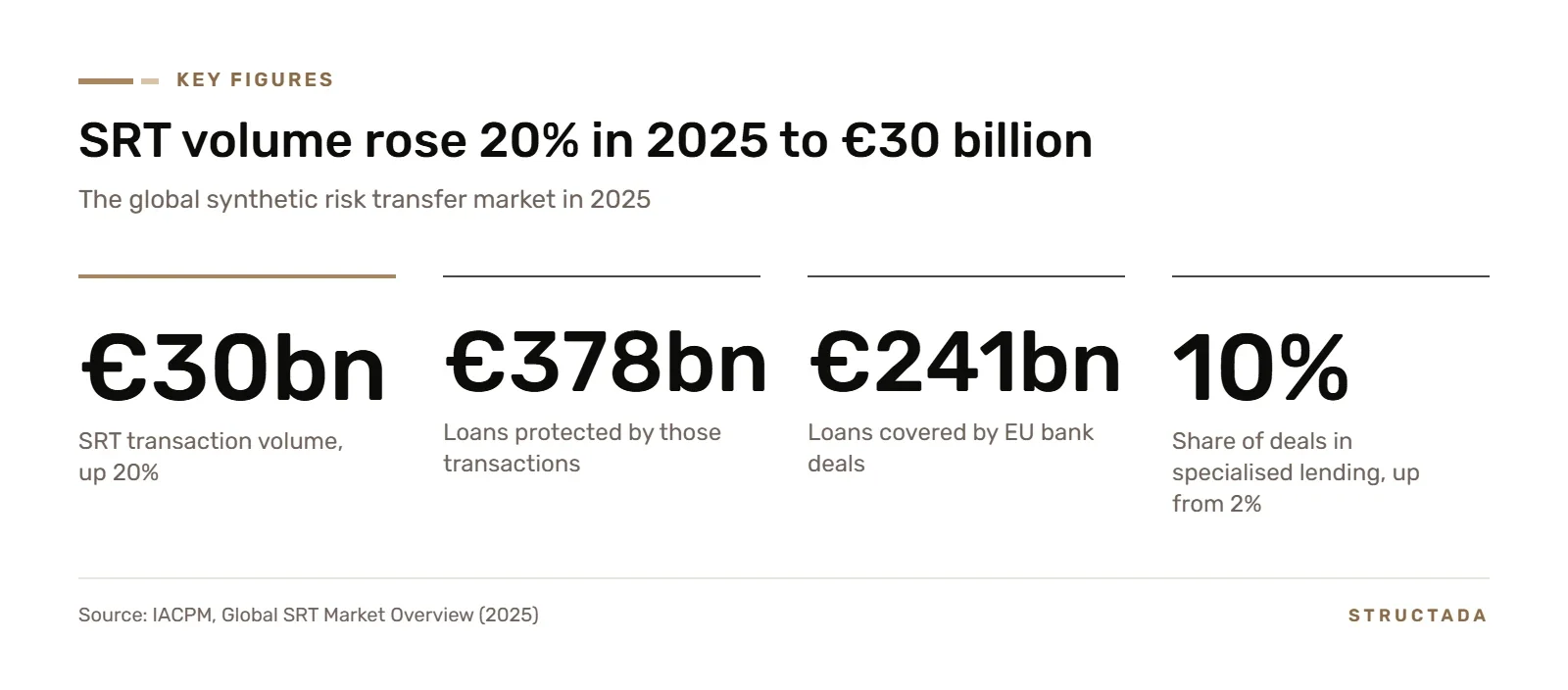
- The market is growing fast: SRT transaction volume rose 20% to €30 billion in 2025, protecting €378 billion of loans, according to the IACPM.
- Corporate and SME loans make up over 70% of reference portfolios, and EU banks are the largest issuers.
- Investors include hedge funds, private credit funds, pension funds, insurers and multilateral development banks, attracted by returns linked to bank loan books.
Consider a bank with a €2 billion portfolio of performing corporate loans. The clients are valuable and the bank has no wish to sell them. Yet regulators require it to hold capital against every one of those loans, and that capital is capacity the bank cannot use to lend elsewhere.
Synthetic risk transfer is how a growing number of banks resolve that tension. Instead of selling the loans, the bank pays investors to take a defined slice of the losses on the portfolio. If defaults rise, the investors absorb them. Because part of the risk has left the bank, regulators allow it to hold less capital. The borrowers see no change at all.
What began as a specialist tool for a handful of European banks has become one of the fastest-growing corners of structured credit, drawing in private credit funds, pension funds and insurers. Its mechanics also say a good deal about how tranched credit risk is packaged and sold more widely.
What is synthetic risk transfer?
Synthetic risk transfer, also called significant risk transfer or synthetic securitisation, is a transaction in which a bank buys credit protection on a tranche of a reference portfolio of loans that it keeps on its balance sheet. The protection seller agrees to cover losses on that tranche in return for a premium.
The transaction is "synthetic" because the loans themselves are never sold; only the credit risk moves. It is "significant" because, to obtain capital relief, the bank must show its regulator that it has transferred a meaningful share of the risk. Both words matter, and the second is where most of the structuring effort goes.
How synthetic risk transfer works
The bank first selects a reference portfolio, such as corporate, SME or mortgage loans, which stays on its balance sheet throughout. The risk on that portfolio is then divided into tranches: a first-loss or junior tranche, a mezzanine tranche and a large senior tranche, in the same way as the layers of a capital stack.
Investors provide protection on the tranche that carries most of the unexpected loss, usually the mezzanine or first-loss slice. The bank typically keeps the senior tranche, and often a small first-loss piece as well, which aligns its interests with those of the investors. In return, it pays a regular premium for the protection.
If loans in the portfolio default, losses on the protected tranche fall on the investors, either by reducing the principal of their notes or by triggering payments under a guarantee. Once the bank's regulator recognises the transfer, the bank's risk-weighted assets fall, and the capital it must hold falls with them.
The main SRT structures
According to Mayer Brown, SRT deals take four main forms, which differ in whether investors pay cash upfront and in who issues the instrument.
| Structure | How it works | Notes |
|---|---|---|
| Unfunded guarantee | A protection seller guarantees losses on the tranche | Simplest; often used with multilateral institutions; the seller's credit quality matters |
| Bank-issued credit linked note | The bank issues notes whose principal is reduced by losses on the portfolio | Funded, so no counterparty risk for the bank; adds securities disclosure |
| Funded bilateral trade | The investor posts collateral under a credit derivative | Funded protection without a public note |
| SPV-issued credit linked note | An SPV sells protection to the bank and issues notes to investors | Allows several investors and some secondary trading |
Funded structures, where investors pay cash upfront, remove the bank's exposure to the protection seller, since the money to cover losses is already in hand. That is why credit linked notes are so common in SRT, and why the market has developed alongside the wider note issuance infrastructure.
The size of the SRT market
The market has grown rapidly. The IACPM reports that transaction volume rose 20% in 2025 to €30 billion, protecting €378 billion of loans. EU banks were the most active issuers, with deals covering €241 billion of loans.
The composition of reference portfolios is broadening too. Corporate and SME loans still make up over 70% of the total, but specialised lending, such as project finance and commercial real estate, rose from 2% to 10% of deals, and retail finance, including residential mortgages, accounted for 13% of transactions. The direction is clear: more banks, more asset classes and a wider investor base.
Why banks use SRT
Capital relief is the main reason. Lower risk-weighted assets free capital that the bank can use to lend further or return to shareholders, and the cost of protection can be lower than the cost of issuing new equity.
The second reason is commercial. Because the loans stay on the books, clients see no change and the bank keeps the relationship, the fees and the cross-selling that come with it. A true sale would surrender all of that. SRT also gives risk managers a precise tool for reducing exposure to particular sectors or large borrowers without disturbing the client base.
Who invests in synthetic risk transfer
Hedge funds and specialist credit funds have historically been the largest buyers; Mayer Brown notes that hedge funds took almost 40% of distributed tranches between 2008 and 2023. Private credit funds have followed, attracted by exposure to diversified bank loan books that would be difficult to originate directly, and pension funds and large asset managers have returned to the market. Insurers tend to participate through unfunded protection, while multilateral development banks provide guarantees, especially for SME and emerging market portfolios.
The risks of SRT
Investors absorb losses on a tranche that sits close to the bottom of the capital structure, so credit risk is the obvious exposure. Less obvious is information asymmetry: the bank knows its borrowers far better than investors do, which is why portfolio selection, retention and alignment of interest receive so much attention in negotiation. Some portfolios are concentrated in particular sectors or large names, which magnifies the effect of a single default.
There is also regulatory risk. Capital relief depends on regulators accepting the transfer, and the rules continue to develop. Supervisors have raised questions about banks lending to SRT investors, a practice that can recycle risk back into the banking system it was meant to leave.
How SRT is regulated
In the EU and UK, SRT is governed by the Capital Requirements Regulation and the Securitisation Regulation, with guidance from the EBA and national supervisors. Simple, transparent and standardised (STS) treatment is available for some on-balance-sheet synthetic securitisations, giving lower capital charges. In the US, the market has grown more recently as banks and regulators have become more comfortable with credit linked note structures.
What this means for issuers
SRT is mainly a tool for regulated banks, but its growth matters well beyond them. It demonstrates a deep investor appetite for tranched exposure to loan portfolios through notes, it is drawing more private credit money into bank-originated risk, and it relies on the same building blocks, a reference portfolio, tranching and credit linked notes, that non-bank lenders use to fund their own books. Our guide to how securitisation works compares true sale and synthetic structures, and our article on CoCos explains another way banks manage capital.
For specialist lenders, the lesson is practical. Understanding how SRT is structured, priced and regulated helps in designing non-bank lender funding that investors recognise, and in speaking a language many of those investors already use every day.
Frequently Asked Questions
What does SRT stand for?
Synthetic risk transfer, also called significant risk transfer.
How does synthetic risk transfer work?
A bank keeps a portfolio of loans but buys protection on a tranche of it from investors, who absorb losses on that tranche in return for a premium.
Why do banks use SRT?
Mainly to reduce the capital they must hold against loans, while keeping the loans and client relationships.
How big is the SRT market?
Transaction volume reached €30 billion in 2025, protecting €378 billion of loans, according to the IACPM.
Who invests in SRT?
Hedge funds, private credit funds, pension funds, insurers, asset managers and multilateral development banks.
What is the role of credit linked notes in SRT?
Credit linked notes let investors provide funded protection: they pay cash upfront, and the notes' principal is reduced by losses on the reference portfolio.