- A Schuldschein, or Schuldscheindarlehen, is a German law loan documented by a certificate of indebtedness and arranged by a bank, which then distributes it to institutional investors.
- It sits between a bilateral loan and a bond: documented like a loan, but placed widely with investors such as savings banks, cooperative banks, insurers and asset managers.
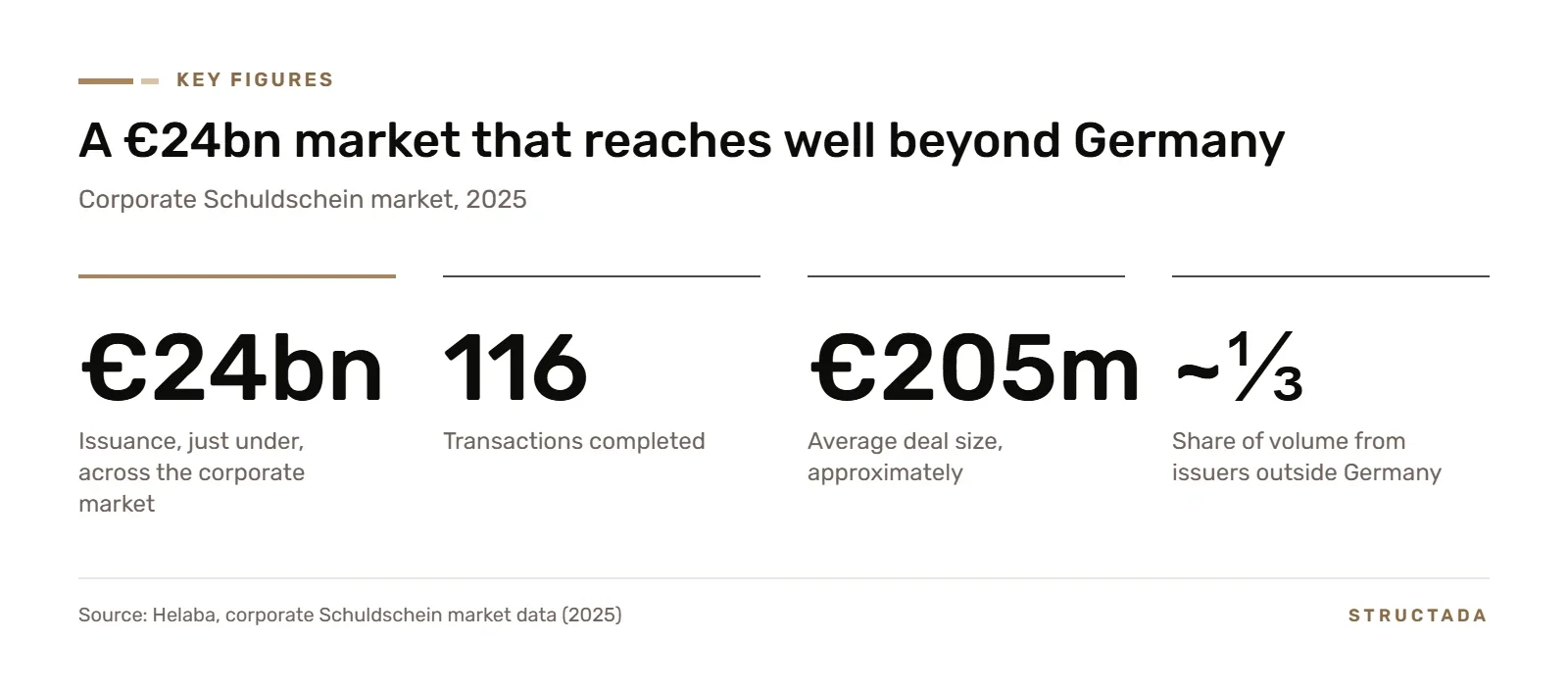
- The corporate Schuldschein market saw just under €24 billion of issuance across 116 deals in 2025, according to Helaba, with almost a third of volume coming from issuers outside Germany.
- Typical features include tranches of three, five, seven and ten years, fixed and floating rates, light documentation and no requirement for a credit rating.
- It suits established, mid-sized and larger companies that want to diversify away from banks without the cost and disclosure of a public bond.
For decades, Germany's Mittelstand companies have borrowed in a way that most of the world barely noticed. Rather than issue bonds, they signed a simple German law loan, arranged by a bank and sold in pieces to dozens of other banks and investors. The instrument is called a Schuldschein, and it has become one of Europe's main private placement markets.
Its reach is now international. Issuers from France, Austria, the Nordics, the US and Asia use it, and the corporate market saw just under €24 billion of issuance across 116 transactions in 2025, according to Helaba, one of its leading arrangers. Almost a third of that volume came from issuers outside Germany.
The Schuldschein's appeal lies in an unusual combination: the legal simplicity of a loan with the distribution of a bond. That combination also defines its limits, and both are worth understanding before choosing it over the alternatives.
What is a Schuldschein?
A Schuldscheindarlehen, usually shortened to Schuldschein or SSD, is a loan under German law. The word means "certificate of indebtedness". The borrower signs a loan agreement and issues a Schuldschein, a certificate that records the debt. The arranging bank lends the money and then transfers parts of the loan to other investors by assignment or contract transfer.
Legally, it is a loan rather than a security. It is not listed, needs no prospectus and is not cleared like a bond. Commercially, it behaves much like a privately placed bond: it is marketed to many investors, priced off a reference rate and often split into several tranches. That dual character is the source of most of its advantages.
How a Schuldschein works
A Schuldschein transaction follows a well-worn path, and its brevity is part of the attraction:
- The borrower mandates one or more arranging banks.
- The arranger prepares a short loan agreement, often based on the Loan Market Association's Schuldschein template, and an information memorandum.
- The arranger markets the loan to investors, usually over two to four weeks, with price guidance for each tranche.
- Final pricing is set and the loan is allocated.
- The arranger funds the loan and transfers investors' shares to them.
For the life of the loan the arranger usually acts as paying agent, collecting interest and principal from the borrower and passing them to investors. Transfers between investors happen by assignment through that agent, rather than through a clearing system.
Typical Schuldschein terms
Deals are often between €50 million and €500 million or more, and the average size in 2025 was around €205 million. Tenors of three, five, seven and ten years are standard, with longer tranches available on request. Interest can be fixed or floating, and many deals offer both, so that investors with different preferences can participate in a single transaction. Most issuance is in euros, with some in US dollars and other currencies.
A credit rating is not required. About one in five 2025 deals came from rated issuers, and the remainder relied on the arranger's credit work and the investors' own analysis. Documentation is short and covenants are limited compared with a syndicated bank facility. The investor base is drawn from savings banks, cooperative banks, insurers, pension funds and asset managers, many of them German and with long memories of the issuers they lend to.
Why issuers use the Schuldschein
The first reason is diversification. A Schuldschein brings a new group of investors beyond the issuer's relationship banks, which matters to a treasurer who wants to reduce reliance on a handful of lenders. It does so without the burdens of the bond market: no prospectus, no listing and usually no rating.
The second is flexibility. Several tranches, tenors and rate types can sit within one transaction, and deal sizes far smaller than a benchmark bond are routine. Information is shared only with investors in the deal, which suits private companies that would rather not publish detailed disclosure. For many investors, the loan form also brings accounting simplicity, since it can be carried at amortised cost rather than marked to market.
The drawbacks of a Schuldschein
The same features impose costs. Liquidity is limited: investors usually hold to maturity, and there is no active secondary market. Prepayment is often restricted, particularly for fixed-rate tranches, so the borrower has less freedom to refinance if rates fall or its circumstances change.
The investor base also brings expectations. Schuldschein investors look for a solid credit story, often investment grade or close to it, even where no rating is published. And for international issuers, German law and German market practice mean advisers familiar with both, which adds to the work on a first transaction.
Schuldschein vs other private placements
| Schuldschein | US private placement | Euro PP | Notes from an SPV | |
|---|---|---|---|---|
| Legal form | German law loan | Notes under a note purchase agreement | Bond or loan | Notes, often with an ISIN |
| Main investors | German and European banks, insurers | US insurers | French and European insurers and funds | Professional investors, family offices, wealth managers |
| Typical issuers | Established mid-sized and large companies | Investment-grade companies | Mid-sized European companies | Lenders, managers, asset owners |
| Rating | Not required | Often private rating | Not required | Not required |
| Clearing | Assignment through the paying agent | Direct | Varies | Euroclear and Clearstream |
Each of these routes reaches a different investor base on different terms. Our guides to private placements and types of US private placements cover the main alternatives.
Who the Schuldschein suits
The Schuldschein suits companies with an established track record, solid credit and a funding need of tens or hundreds of millions, which want to broaden their lender base without a public bond. It is less suited to young companies, specialist lenders or issuers seeking to fund a specific asset pool, where investors need to look through to the assets rather than rely on the company's balance sheet.
For those issuers, notes issued from a securitisation compartment may fit better. The notes can carry an ISIN, settle through Euroclear and Clearstream and be linked to a defined loan book, which allows investors to take risk on the assets rather than the whole company. A credit linked note is one common route.
What this means for issuers
The Schuldschein is a proven, flexible and relatively low-cost way for established companies to borrow from a wide group of European investors. Its strength is that it asks little of the issuer beyond a sound credit and a willingness to work with German documentation and an arranging bank.
The decision turns on fit. An issuer whose credit story rests on its own balance sheet will find the Schuldschein a natural complement to bank debt. An issuer whose story rests on a pool of assets, or whose investors expect a cleared security, will usually be better served by a US or Euro private placement or a note linked to those assets. Whether a rating is worth obtaining depends on the target investors, as our guide to credit ratings explains.
Frequently Asked Questions
What does Schuldschein mean?
It means "certificate of indebtedness" in German. The full term, Schuldscheindarlehen, means a loan documented by such a certificate.
Is a Schuldschein a bond?
No. Legally it is a loan under German law, although it is distributed to investors in a way similar to a privately placed bond.
Who invests in Schuldscheine?
Mainly German savings and cooperative banks, other European banks, insurers, pension funds and asset managers.
Can non-German companies issue a Schuldschein?
Yes. Almost a third of 2025 volume came from issuers outside Germany, with French companies the largest group.
Does a Schuldschein need a credit rating?
No. Most issuers are unrated, although investors expect a solid credit profile.
How big is the Schuldschein market?
The corporate market saw just under €24 billion of issuance across 116 transactions in 2025, according to Helaba.