

- Global Islamic finance assets reached $5.2 trillion in 2025 and are on track to pass $6 trillion by the end of 2026, a deep pool of demand for compliant issuers.
- A Shariah-compliant issue must avoid interest, excessive uncertainty and haram sectors, and tie returns to real assets and shared risk.
- Investors screen issuers on business activity, with haram income typically capped at 5% of revenue, and on balance-sheet ratios, typically around a third for debt and cash.
- Sukuk are the anchor instrument, with more than $1 trillion outstanding. Murabaha, Ijara and Wakala let specialty lenders and businesses raise Shariah-compliant credit.
- Every issue needs a Shariah supervisory board, which adds cost and time but gives investors the assurance they require.
- Shariah compliance widens an issuer's buyer base beyond Muslim investors, and Luxembourg compartments give GCC sponsors a route to international capital.
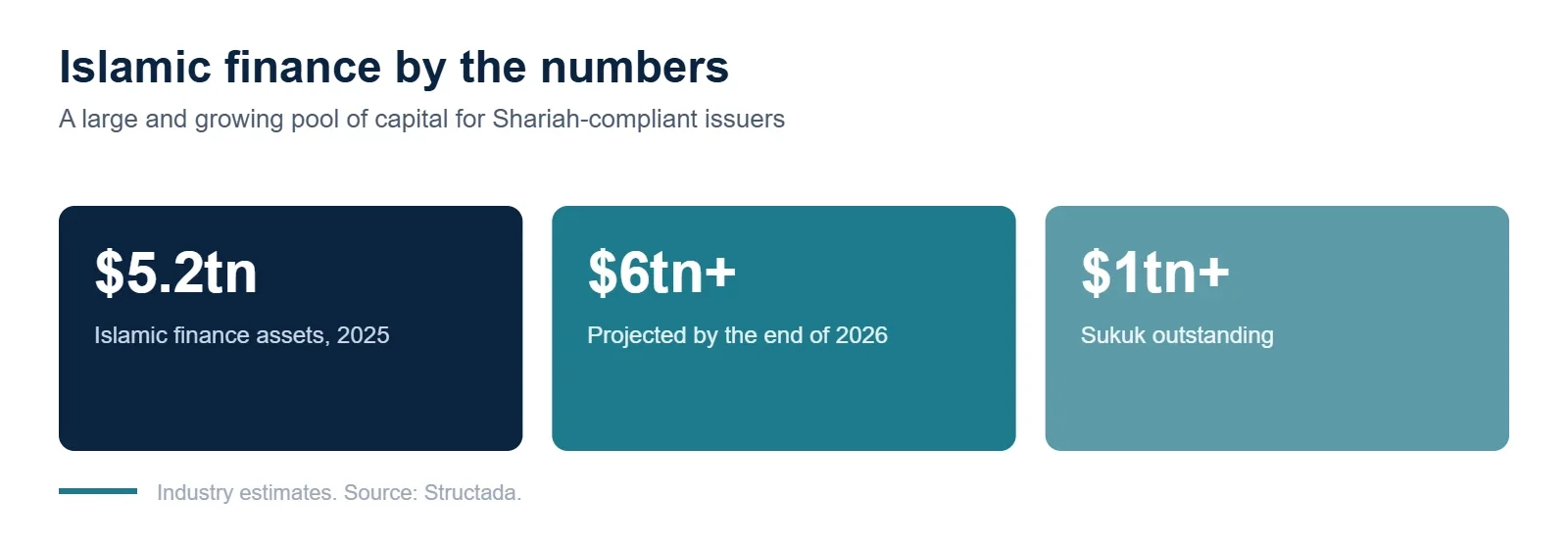
Global Islamic finance assets reached $5.2 trillion in 2025, up close to 15% on the year, and are on track to pass $6 trillion by the end of 2026, according to the AlHuda Centre of Islamic Banking and Economics. A market of that size has become a standing part of institutional capital allocation, and the UAE and wider GCC sit at its centre.
Shariah-compliant investing, often called halal investing, aligns financial activity with Islamic law (Shariah, also spelt Sharia). In practice, that means capital is deployed against real assets and real economic activity, on terms that are transparent and fair to both sides. For issuers raising capital in the Middle East, the principles matter twice over: once for compliance, and again for access to a pool of investor demand that keeps growing.
Global Islamic finance assets reached $5.2 trillion in 2025, up close to 15% on the year, and are on track to pass $6 trillion by the end of 2026, according to the AlHuda Centre of Islamic Banking and Economics. A market of that size has become a standing part of institutional capital allocation, and the UAE and wider GCC sit at its centre.
Shariah-compliant investing, often called halal investing, aligns financial activity with Islamic law (Shariah, also spelt Sharia). In practice, that means capital is deployed against real assets and real economic activity, on terms that are transparent and fair to both sides. For issuers raising capital in the Middle East, the principles matter twice over: once for compliance, and again for access to a pool of investor demand that keeps growing.
Shariah principles
Shariah draws on the Quran, the Hadith and centuries of Islamic jurisprudence. Applied to capital markets, five principles shape what an issuer can offer:
- No riba (interest). Lending at interest is prohibited. Returns come instead from profit-sharing, lease payments, trade mark-ups or cash flows tied to an asset.
- No gharar or maysir. Contracts must avoid excessive uncertainty and speculation, which rules out many conventional derivatives.
- No haram sectors. Alcohol, gambling, pork, conventional banking and insurance, and similar activities are screened out.
- Shared risk. Capital providers take part in both the upside and the downside. Mudarabah, a profit-sharing arrangement, and Musharakah, a joint venture, put this into practice.
- Real economic purpose. Finance should be backed by tangible assets or productive activity, with a preference for sectors such as healthcare, education, infrastructure and technology.
These principles decide which assets can be financed and how each issue has to be built.
Types of Shariah-compliant investments
Sukuk are the anchor of Islamic capital markets. Often called Islamic bonds, they give holders an ownership interest in an underlying asset or project, with returns drawn from what that asset earns, such as rent on real estate, rather than a fixed rate of interest. Global sukuk outstanding passed $1 trillion in 2025, according to the IIFM Sukuk Report 2026, much of it issued by GCC sovereigns and corporates.
Screening rules matter to debt issuers as much as to listed companies. Investors apply the same tests on business activity, leverage and interest income used by the Dow Jones Islamic Market Index and the FTSE Shariah indices, and Islamic funds monitor holdings continuously. An issuer whose business or balance sheet drifts out of compliance can lose its buyers.
Real estate sponsors are natural Shariah issuers, because the asset backing is tangible. Finance is raised through leasing (Ijara) or partnership (Musharakah) structures instead of interest-bearing debt.
Shariah-compliant credit is the newer frontier. Murabaha (a cost-plus sale), Ijara and Wakala (an agency arrangement) allow specialty lenders and businesses to raise finance against receivables and assets, at a return fixed in advance but grounded in a trade or an asset. Issued through a securitisation vehicle, these structures let an originator reach Shariah-sensitive investors with a private credit note.
Shariah screening and purification
Before they buy, investors screen an issuer on two levels. The first is business activity: income from haram sectors such as alcohol, tobacco, gambling, pork, weapons, adult entertainment and conventional banking or insurance must stay below a de minimis level. The second is the balance sheet. Thresholds vary between standard setters such as AAOIFI, MSCI, FTSE Russell and S&P Dow Jones, but typical limits look like this:
|
Screen |
Typical limit |
|---|---|
|
Non-compliant income |
Below 5% of total revenue |
|
Interest-bearing debt |
Below 30–33% of market capitalisation or total assets |
|
Cash and interest-bearing securities |
Below 30–33% of market capitalisation or total assets |
|
Receivables and cash combined |
Below around 50% of total assets |
Any small amount of non-compliant income that remains is dealt with through purification: investors give that portion of their returns to charity. For an issuer, these tests are the terms of entry. A structure that keeps the asset pool clean, avoids interest-bearing cash and reports clearly against each screen is one investors can buy and hold without reworking their own compliance.
Oversight and governance
Compliance is overseen by a Shariah supervisory board, a panel of qualified scholars who approve the structure, review the contracts and audit ongoing operations. Their fatwa, or formal opinion, tells investors that a product adheres to Shariah in substance and not only in name.
Standards bodies such as AAOIFI set common rules on accounting, governance and Shariah, and several GCC regulators have adopted them. For an issuer, the board is part of the cost and timetable of every deal. Its standing with investors matters as much as its approval, and the reputational stakes of getting compliance wrong are high.
A wider investor base
A Shariah-compliant issue reaches beyond Muslim investors, because its screening overlaps with ESG and socially responsible mandates:
- Ethical screening of companies and sectors.
- Avoidance of speculative, high-risk activity.
- An emphasis on transparency and real economic activity over financial engineering.
For an issuer, one structure can therefore appeal to Shariah-sensitive capital in the Gulf and to ethical and diversification buyers elsewhere. Sukuk in particular now draw cross-border institutional demand on the strength of the credit and the yield as much as the compliance.
The UAE and GCC context
The UAE has built one of the deepest Islamic finance ecosystems in the world, spanning Islamic banks, asset managers and three regulatory regimes: the Securities and Commodities Authority onshore, the Dubai Financial Services Authority in the DIFC and the Financial Services Regulatory Authority in ADGM. Sukuk from regional sovereigns, corporates and infrastructure projects provide scalable, liquid opportunities, and Shariah-structured real estate continues to draw family office and institutional capital.
The region's sponsors also look beyond their own markets. A Luxembourg securitisation vehicle can create Shariah-compliant compartments, each ring-fenced and supervised by its own Shariah board, which lets a GCC sponsor issue to international investors under an established European legal framework.
What it means for issuers
A Shariah-compliant structure opens a market approaching $6 trillion, with deep demand in the GCC and growing interest from ethical and international buyers. It also brings costs: a Shariah board, contracts built around the asset, and a longer structuring timetable.
The questions worth settling early are practical ones: which contract suits the underlying asset, who sits on the Shariah board, and which jurisdiction gives investors the protection they expect.
Frequently asked questions
What is Shariah-compliant investing?
Investing in line with Islamic law: no interest, no excessive uncertainty or speculation, no prohibited sectors, and returns tied to real assets and shared risk.
What is the difference between a sukuk and a bond?
A bond is a debt that pays interest. A sukuk gives holders an interest in an underlying asset or project, with returns drawn from what that asset earns.
Who decides whether an investment is Shariah-compliant?
A Shariah supervisory board of qualified scholars, which approves the structure and monitors compliance over its life.
Do Shariah-compliant issues only attract Muslim investors?
No. Ethical, ESG and diversification buyers also take part, which widens the pool for issuers.
Can private credit be Shariah-compliant?
Yes. Structures such as Murabaha, Ijara and Wakala let specialty lenders and businesses raise finance within Shariah principles, often issued through a securitisation vehicle.
What is halal investing?
Another name for Shariah-compliant investing: putting money only into assets and businesses permitted under Islamic law.
What screening criteria do Shariah investors apply?
A business-activity screen, with non-compliant income usually below 5% of revenue, and financial ratio screens, with debt and cash usually below about a third of market capitalisation or total assets.
What is purification in Islamic finance?
The practice of giving any small, unavoidable non-compliant income to charity, so the investor's return stays compliant.