

- Delivery versus payment (DvP) is a settlement mechanism that ensures securities are delivered if and only if payment is made, so neither side can be left having given value without receiving it.
- DvP exists to remove principal risk, the risk that a seller delivers securities and is not paid, or a buyer pays and does not receive the securities.
- The Bank for International Settlements set out three DvP models in 1992, distinguished by whether securities and cash settle trade by trade (gross) or in batches (net).
- Notes settled through Euroclear and Clearstream normally close on a DvP basis, while some private placements still settle free of payment, leaving one party exposed until both legs complete.
- Europe moves to T+1 settlement on 11 October 2027, and central banks are building DvP for tokenised securities, both of which make settlement design a live issue for issuers.
Every securities transaction involves two transfers: the securities move one way and the cash moves the other. If those two transfers are not tied together, one party must go first and trust the other to follow. In a market that settles millions of transactions a day between counterparties who may never have met, that trust is a source of risk the system cannot afford.
Delivery versus payment is the answer the market settled on. It links the two legs so that the securities are delivered if and only if payment is made. It underpins almost every bond, note and share settled through a clearing system, and it determines how safely an issuer's notes reach its investors on closing day.
This guide explains what delivery versus payment is, how the main DvP models work, how DvP differs from free of payment settlement, and why the subject matters to issuers of notes.
What is delivery versus payment?
Delivery versus payment is a settlement mechanism that makes the transfer of securities conditional on the transfer of cash, and vice versa. The Bank for International Settlements, in its 1992 report Delivery versus payment in securities settlement systems, described the objective in five words: delivery occurs if and only if payment occurs.
The risk it removes is principal risk. The BIS report defines it as the risk that the seller of a security delivers but does not receive payment, or that the buyer pays but does not receive delivery. Principal risk puts the full value of the transaction at stake: a buyer who pays for €10 million of notes and never receives them has lost €10 million, not the difference between two prices.
DvP has since become a basic expectation of market infrastructure. Regulatory standards for securities settlement systems require settlement to be designed so that the final settlement of one obligation occurs only if the linked obligation also settles, as the Reserve Bank of Australia's standard for settlement facilities illustrates.
How DvP settlement works
In practice, DvP depends on a settlement system that controls both the securities accounts and the cash accounts, or that can link the two with certainty. A clearing system such as Euroclear or Clearstream receives matching instructions from buyer and seller, checks that the seller holds the securities and that the buyer has the cash or credit to pay, and then moves both at the same moment.
If either leg cannot settle, neither does. The instruction stays pending, and the securities and cash remain where they were. Nobody is left with an unsecured claim against a counterparty for the value of the trade.
The cash leg can settle in central bank money, where payment passes across accounts at a central bank, or in commercial bank money, where it passes across accounts at a settlement bank. The 1992 BIS report noted that central bank accounts are one obvious solution, but they are not always available, particularly for cross-border settlement in many currencies. That is one reason the international central securities depositories hold cash accounts for their participants and settle DvP across their own books.
The three DvP models
The BIS report classified DvP systems into three models, according to whether securities and cash settle trade by trade (gross) or in batches (net).
| Model | Securities | Cash | Timing |
|---|---|---|---|
| Model 1 | Gross, trade by trade | Gross, trade by trade | Both legs settle together, in real time |
| Model 2 | Gross, trade by trade | Net, at end of cycle | Securities move during the cycle, cash at the end |
| Model 3 | Net, at end of cycle | Net, at end of cycle | Both legs settle in batches at the end of the cycle |
Model 1 offers the cleanest risk profile, since each transaction is final when it settles, but it needs more liquidity because every payment is made in full. Models 2 and 3 economise on liquidity by netting payments, at the cost of finality arriving later in the day. Modern systems often combine features, but the three models remain the reference point for regulators and practitioners.
DvP versus free of payment
The alternative to DvP is free of payment (FOP) settlement, in which securities move without a simultaneous cash transfer. FOP has legitimate uses, such as moving holdings between custodians or posting collateral, but it becomes a risk when used for a sale.
In a FOP sale, one party performs first. If the issuer delivers notes free of payment and then waits for subscription money to arrive by wire, it is exposed to the investor until the cash lands. If investors wire money first and wait for delivery, they are exposed to the issuer. Either way, the gap is principal risk of the kind DvP was designed to remove.
FOP closings remain common in smaller private placements, particularly where notes are issued outside a clearing system or where an investor's custodian is not set up to settle the instrument. Moving the same issue onto a DvP basis usually requires an ISIN, eligibility with Euroclear or Clearstream, and an agent able to run the closing through the clearing system.
DvP at the closing of a note issue
On the issue date of a note settled through the international central securities depositories, the notes and the subscription cash generally change hands on a DvP basis. The issuing and paying agent, or the manager of the issue, delivers the notes into the clearing system against payment from the investors' accounts, and the net proceeds are then paid to the issuer. Our guide to the role of a paying agent explains how that agent continues to handle payments for the life of the notes.
For the issuer, a DvP closing means investors can subscribe through their usual custodian, with the same protection they expect on any other bond. That matters most to private banks, wealth managers and family offices, whose custodians are reluctant to pay away cash without receiving the securities at the same time. An issue structured for DvP settlement through the ICSDs, with an XS ISIN and the documentation the clearing systems accept, is one those custodians can process without special arrangements. Our Euroclear-ready checklist sets out what that involves.
T+1 and settlement discipline
Settlement cycles are getting shorter. The United States moved to T+1 settlement in May 2024, and the EU, the UK and Switzerland are scheduled to follow on 11 October 2027, according to BNP Paribas and Arthur Cox.
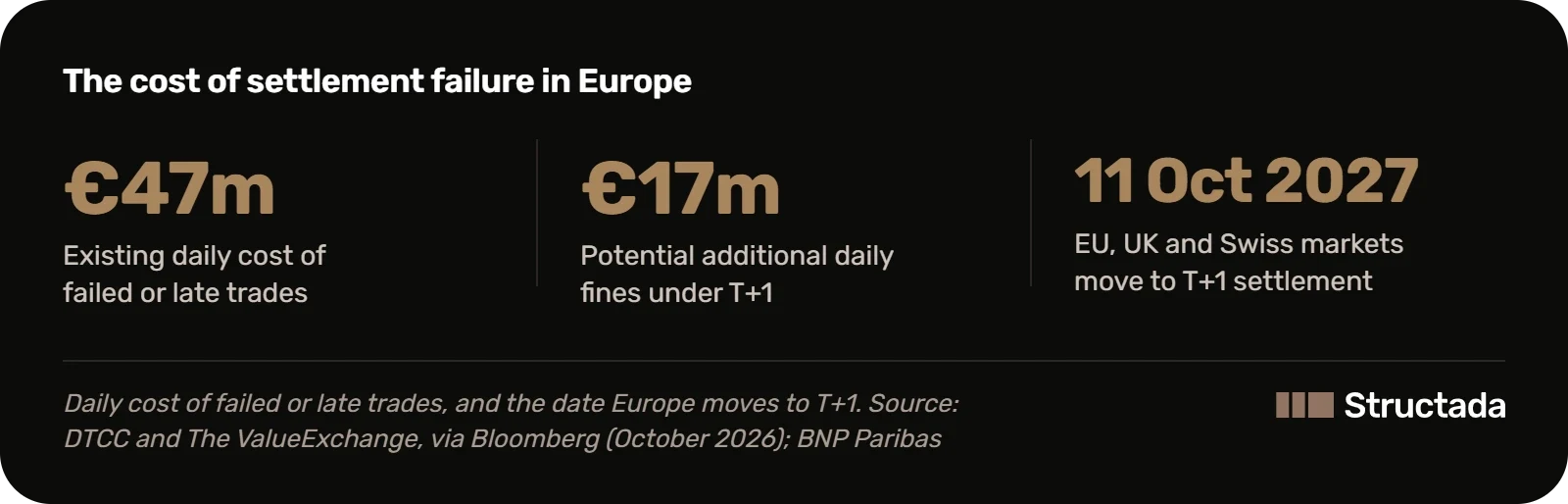
A shorter cycle leaves less time to match instructions and fix errors before a trade fails. Under the EU's Central Securities Depositories Regulation, participants responsible for failed or late settlement face daily cash penalties. A DTCC and ValueExchange study reported by Bloomberg in October 2026 put the existing cost of failed or late trades at €47 million a day, with the move to T+1 potentially adding €17 million a day in fines if the new regime applied today. DvP prevents a failed trade from becoming a loss of principal, but it cannot stop the trade failing.
DvP for tokenised securities
A tokenised bond can move across a distributed ledger in seconds, but DvP still requires the cash leg to move with it, and most ledgers have no safe settlement asset for that cash.
The Eurosystem's Pontes initiative is designed to fill that gap by allowing transactions in tokenised assets to settle in euro central bank money, with final settlement taking place in the TARGET infrastructure, according to the ABBL. Its first use cases include DvP settlement of tokenised securities, with an initial launch expected in the third quarter of 2026. A companion initiative, Appia, is intended to design an integrated ecosystem for tokenised assets, as the FIA reports. The principle remains the one set out in 1992: the technology may change, but delivery should still occur if and only if payment occurs.
What this means for issuers
Settlement method is easy to overlook when an issuer is focused on structure, pricing and documentation, but investors notice it immediately. A note that can be bought delivery versus payment through Euroclear or Clearstream fits the process every professional investor and custodian already runs; a note that requires investors to wire money first and trust delivery to follow asks them to accept a risk they avoid everywhere else.
The practical decisions sit early in the transaction: obtaining an ISIN, establishing eligibility with the clearing systems, appointing an issuing and paying agent and agreeing how the closing will run. Settled at the outset, they allow an issue to close on the same terms as any established bond.