

- A central securities depository (CSD) is the institution at the top of the chain that records who owns a security and settles transfers between its participants.
- Under the EU Central Securities Depositories Regulation of 2014, a CSD operates a settlement system and provides at least one of two other core services: the notary service or central maintenance.
- Domestic CSDs mainly serve their home market. The international CSDs, Euroclear Bank and Clearstream Banking Luxembourg, were set up to settle eurobonds and now handle most internationally traded debt.
- Investors rarely deal with a CSD directly. They hold through custodians, which hold through participant banks, which hold accounts at the CSD.
- For issuers, the choice of CSD decides which investors can easily hold the notes and how they will settle.
Ownership of a modern security is a set of book entries. A pension fund in Zurich, a private bank in Dubai and a family office in London may all hold the same note without any paper changing hands. Somewhere at the top of that chain sits one institution whose records are final: the central securities depository.
What is a central securities depository?
A central securities depository, or CSD, is a financial market infrastructure that records securities in book-entry form, keeps the top-tier accounts that show who holds them, and settles transfers between its participants. In the EU, the Central Securities Depositories Regulation of 2014 (CSDR) defines a CSD as an entity that operates a securities settlement system and provides at least one of two other core services.
The European Central Securities Depositories Association (ECSDA) describes the three core services as follows.
The notary service is the initial recording of a new issue in book-entry form, the first entry point of a security into the system. The central maintenance service is keeping the top-tier securities accounts, including safekeeping and processing corporate actions such as interest payments and redemptions. The settlement service is operating the system that transfers securities between participants, normally against payment.
How the holding chain works
Investors almost never hold accounts at a CSD. The CSD's participants are banks, brokers and custodians. Those participants hold securities for their own clients, who may in turn be custodians holding for end investors. Each layer keeps its own records, and the CSD's records sit at the top.
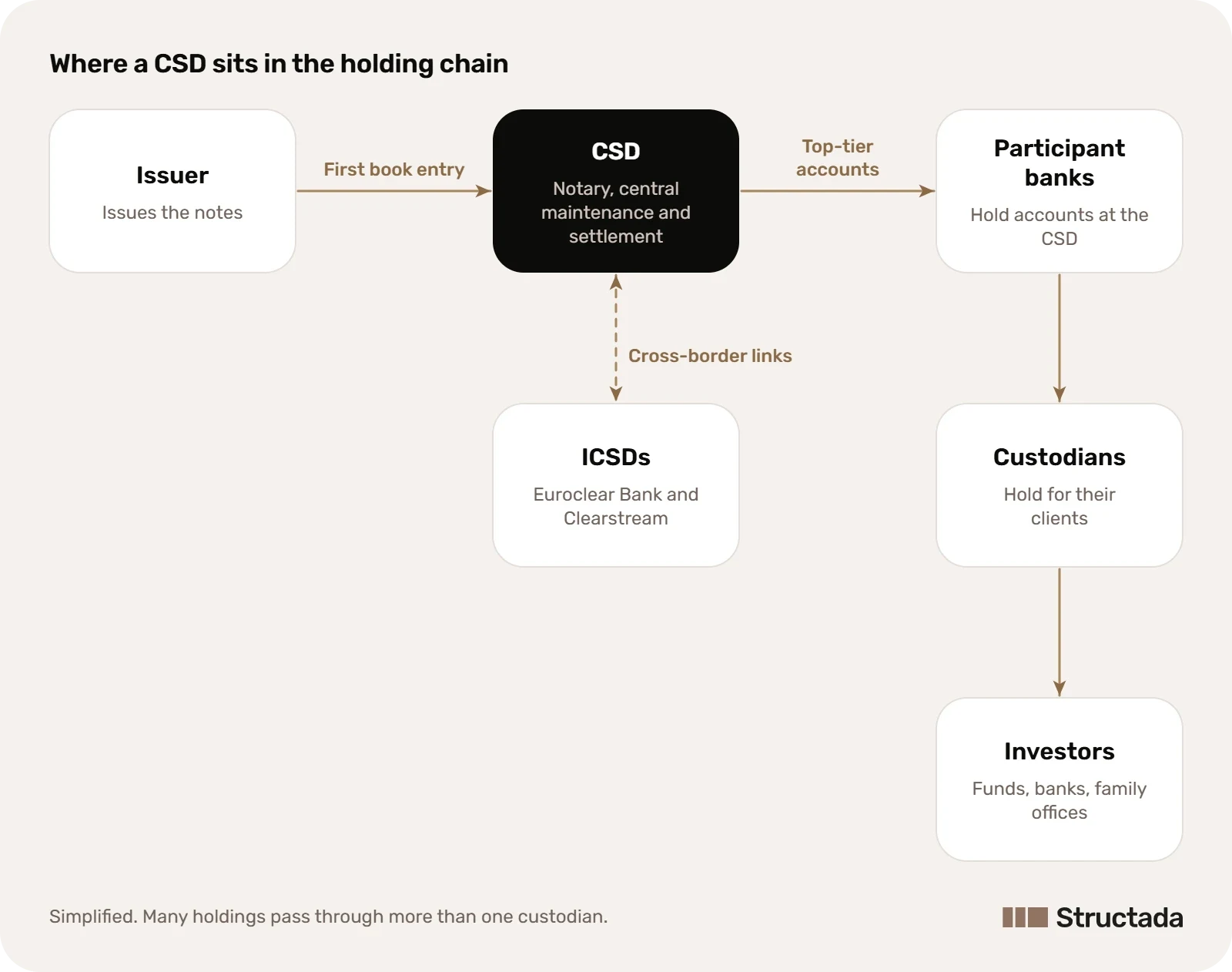
This tiered structure is why a security's eligibility at a particular CSD matters so much. A custodian that is a participant, directly or through another bank, can hold and settle the security without special arrangements. One that is not may find it hard to hold at all.
CSDs and ICSDs
Most CSDs are national. Clearstream Banking Frankfurt serves Germany, Euroclear France serves France, Euroclear UK & International operates CREST in the UK and Ireland, and the Depository Trust Company (DTC) is the main CSD in the United States.
The international CSDs, or ICSDs, were set up in the late 1960s and 1970s to settle eurobonds. ECSDA notes that they now handle most internationally traded instruments. In the EU there are two: Euroclear Bank in Brussels and Clearstream Banking in Luxembourg. Notes issued into them carry an XS ISIN and can be held by custodians across the world through the ICSDs' links to each other and to domestic markets.
T2S and settlement in central bank money
In the euro area, many CSDs settle through TARGET2-Securities (T2S), a Eurosystem platform that went live in June 2015. ECSDA describes it as delivering harmonised delivery versus payment settlement in central bank money. T2S is a settlement platform used by CSDs; it is not a CSD itself, and the CSDs keep their notary and account functions.
Why it matters to issuers
For an issuer, the CSD decides who can easily buy and hold the notes. Issuing into a domestic CSD suits a domestic investor base. Issuing into Euroclear and Clearstream suits international investors and the wealth channel, because private banks and family office custodians across Europe, the Middle East and Asia already hold accounts there. Our guide to clearing systems explains how settlement works once the notes are live.
The CSD also sets eligibility rules. Before admitting a security it reviews the documents and the features of the instrument, and an issuing and paying agent handles that process for the issuer.