

- XS securities are debt instruments issued directly into the two international central securities depositories, Euroclear Bank and Clearstream Banking Luxembourg, and identified by an ISIN beginning with "XS" rather than a country code.
- Euroclear Bank and Clearstream jointly act as the numbering agent for XS ISINs, which are normally built from the security's nine-digit common code.
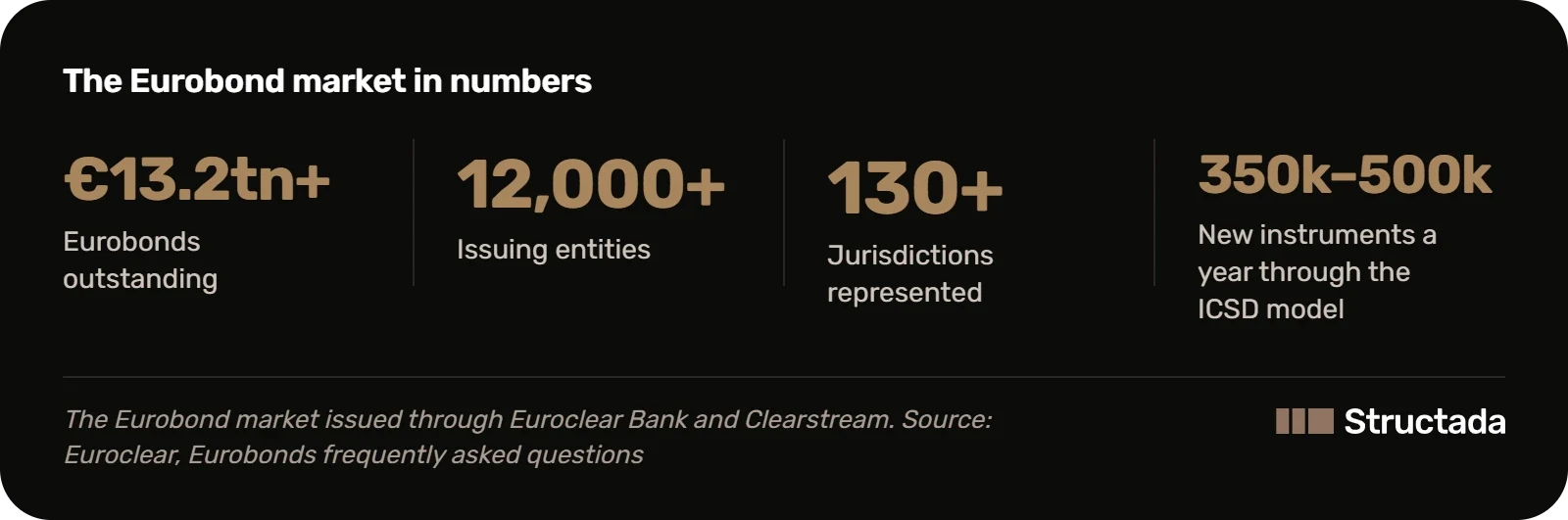
- The market behind the prefix is vast: Euroclear puts the Eurobond market at more than €13.2 trillion outstanding, from over 12,000 issuers in more than 130 jurisdictions.
- An XS ISIN signals that a security can be held and settled through almost any custodian in the world, which is why private placements, structured notes and credit linked notes use the format.
- Issuing an XS security requires an issuing and paying agent, a global note held by a common depositary or common safekeeper, and documentation the clearing systems will accept.
Most identifiers describe where a security comes from. The first two letters of an ISIN normally name a country: US for a Treasury, DE for a Bund, GB for a gilt. One prefix breaks the rule. A bond issued by a German carmaker, a Gulf sovereign or a Luxembourg securitisation vehicle may all carry the same two letters at the front of their identifier: XS.
Those two letters mark a security that belongs to no single national market. They tell a custodian, a broker or a portfolio manager that the instrument lives in the international settlement system run by Euroclear Bank and Clearstream, and that it can therefore be bought, held and settled by investors almost anywhere. For issuers who want to reach investors beyond their home market, that is a large part of what they are paying for.
This guide explains what XS securities are, how their ISINs are allocated, how an XS issue is put together and why the format matters to issuers of notes.
What are XS securities?
An XS security is a debt instrument issued directly into the international central securities depositories (ICSDs), Euroclear Bank in Brussels and Clearstream Banking in Luxembourg, rather than into a national depository. According to Euroclear, fixed income Eurobonds issued through this model are recognised by the XS prefix, while equity-type instruments carry the issuer's country code instead.
The term covers far more than plain bonds. Commercial paper, medium term notes, structured products, certificates and credit linked notes can all be issued in XS form. Governing law can be the issuer's own or another chosen law, and Euroclear says it supports more than 50 governing laws and around 100 currencies.
The scale is considerable. Euroclear puts the Eurobond market at more than €13.2 trillion outstanding, issued by over 12,000 entities in more than 130 jurisdictions, with between 350,000 and 500,000 new instruments a year passing through the ICSD model.
What the XS prefix means
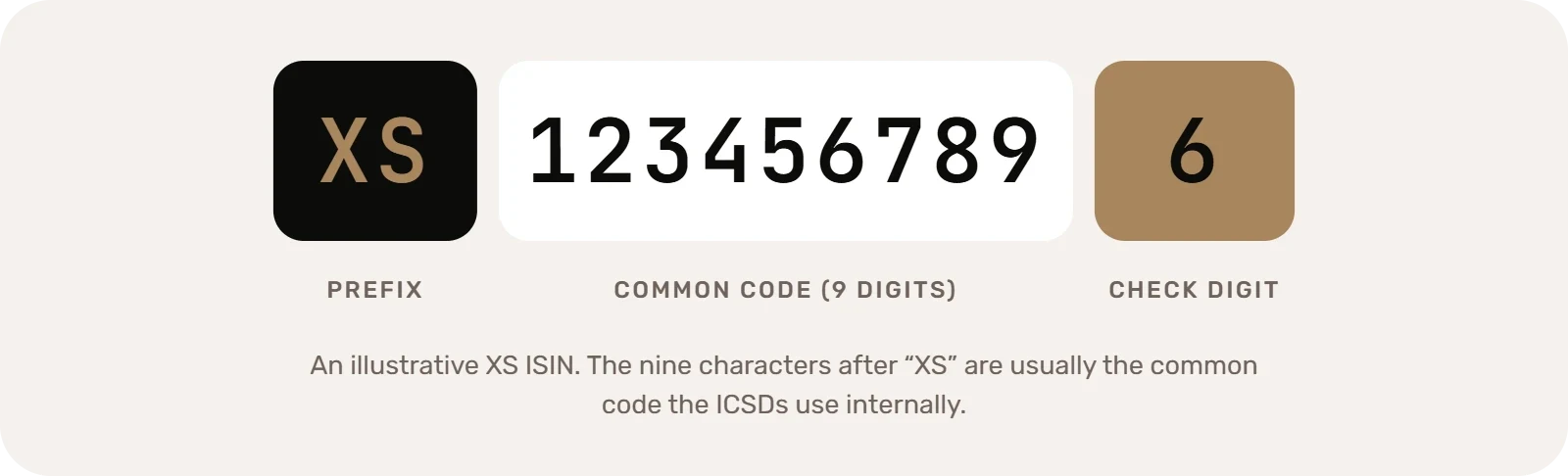
A standard ISIN has twelve characters: a two-letter prefix, a nine-character national security identifier and a check digit. For most securities the prefix is the country code under ISO 3166 and the middle section comes from that country's national numbering agency, as Cbonds notes.
XS is a convention rather than a country. It identifies securities whose home is the international market itself. In practice the nine characters after XS are usually the security's common code, the identifier the two ICSDs use internally, so an XS ISIN and its common code describe the same instrument in two formats. A CUSIP plays the equivalent role for securities settling in the US system.
Who allocates XS ISINs
National ISINs are allocated by a national numbering agency in each country. XS ISINs have a joint allocator. According to Clearstream, it acts jointly with Euroclear Bank as numbering agent for the XS ISINs of international debt securities issued in and deposited with the ICSDs.
For programme issuance the process is largely automated. Clearstream's European Pre-Issuance Messaging service, launched in 2002 with Euroclear Bank and DTCC, connects dealers, issuing and paying agents and the numbering agencies, and Clearstream says it can assign ISINs in less than five minutes for commercial paper, certificates of deposit and EMTNs issued under a programme. A one-off issue is usually requested by the issuing agent once the terms are settled.
How an XS issue works
An XS issue rests on three elements beyond the legal documents themselves.
The first is an issuing and paying agent. The agent requests the ISIN and common code, coordinates closing with the ICSDs and, for the life of the security, receives interest and principal from the issuer and passes them to the clearing systems for distribution to investors. Euroclear describes the role as central to both issuance and servicing, and our guide to the role of a paying agent explains it in more detail.
The second is the global note. XS securities are normally represented by a single global note rather than individual certificates. Under the classic global note structure, the note is held by a common depositary on behalf of both ICSDs. Under the new global note structure, introduced for bearer international debt in 2006, it is held by one of the ICSDs as common safekeeper and the ICSDs' own records determine the amount outstanding. The new global note matters to issuers whose investors include banks, because international bearer debt must be in that form to be eligible as Eurosystem collateral.
The third is acceptance by the clearing systems. Euroclear and Clearstream review the documentation and the security's features before admitting it. Our Euroclear-ready checklist sets out what that review looks for, and our guides to Euroclear, Clearstream and clearing systems explain how settlement works once the security is live.
XS securities and US investors
Many international issues are sold to US investors under Rule 144A as well as to investors elsewhere under Regulation S. Traditionally the 144A tranche settles through DTC with a US ISIN and CUSIP, while the Regulation S tranche settles in the ICSDs with an XS ISIN, so the same bond carries two identifiers and two sets of plumbing.
That split is under review. The Securities Issuance Consortium, a market initiative convened by Euroclear in 2021 with more than 200 participants from over 50 firms, is working to bring more 144A tranches into the XS structure and has promoted a unitary ISIN covering both tranches. According to the consortium, only 15% of 144A issues by European issuers and 3% by Asian issuers are currently set up within the XS structure.
Why the format matters to issuers
For a large sovereign or corporate, the XS format is simply how international bonds are issued. For smaller issuers, specialist lenders and securitisation vehicles, it does something more important: it makes a private instrument look, operationally, like any other bond in an investor's account.
Private banks, wealth managers and family offices hold their investments through custodians that are connected to Euroclear and Clearstream. A note with an XS ISIN can be booked, valued and reported by those custodians without special arrangements. A note without one, or a loan in its place, often cannot be held at all. That is why medium term notes, structured notes and credit linked notes issued by Luxembourg and Irish vehicles are almost always XS securities, and why many are also listed on venues such as Euronext Dublin or TISE.
What this means for issuers
An XS ISIN is a passport. It tells the global network of custodians and brokers that a security belongs in the international system and can travel freely within it. For issuers placing notes with professional and private wealth investors across several countries, it is usually the most important operational decision after the choice of vehicle.
The work behind it is specific: an issuing and paying agent appointed early, the right global note structure for the investor base, documentation that meets ICSD standards and, where US investors are involved, a view on whether a single XS structure can serve both tranches. Settled at the outset, those choices make every later step of the issue, from closing to coupon payments to secondary transfers, simpler.