

- An issuing and paying agent (IPA) is the bank or agent that brings a note into the clearing systems at issue and moves interest and principal to investors for the rest of its life.
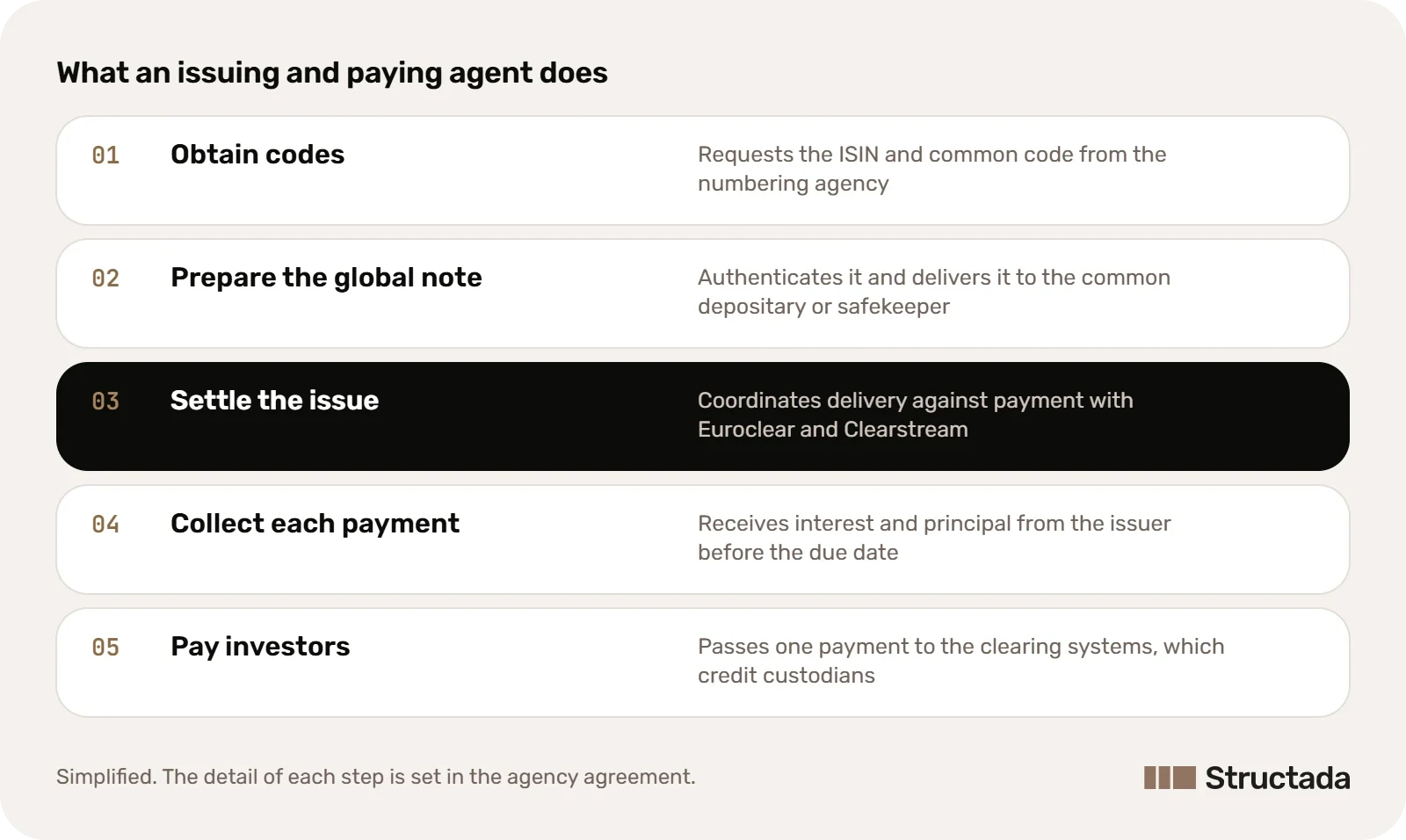
- At issuance the IPA obtains the ISIN and common code, prepares and authenticates the global note and coordinates settlement with Euroclear and Clearstream.
- After issuance it receives each payment from the issuer and passes it to the clearing systems, which credit their participants and, through them, the investors.
- The IPA acts for the issuer under an agency agreement. It does not represent noteholders, which is the job of a trustee where one is appointed.
- For programme issuers the IPA is a standing appointment, so new series can be issued quickly under the same documents.
Every note issued into Euroclear and Clearstream needs someone to bring it in and someone to pay it out. In most international issues the same institution does both. It is called the issuing and paying agent, usually shortened to IPA, and it is one of the few parties that stays involved from the day a note is created until the day it is repaid.
Issuers tend to meet the IPA late, once the term sheet is agreed and the lawyers are drafting. That is often too late. The IPA's requirements shape the timetable, the documents and how payments will reach investors, so it pays to understand the role early.
What is an issuing and paying agent?
An issuing and paying agent is a bank or specialist agent appointed by an issuer to issue its notes into the clearing systems and to make payments on them. The role combines two functions that are sometimes split: the issuing agent, which handles the creation and settlement of the notes, and the paying agent, which handles interest and principal.
The appointment is made under an agency agreement, known as an issue and paying agency agreement in a programme. It sets out what the agent will do, the fees it will charge and the protections it receives. Large issuers' EMTN programmes publish these agreements, and they follow a broadly standard form across the market.
What the IPA does at issuance
The issuing side of the role is about turning a signed deal into a security that custodians can hold.
The IPA requests the ISIN and common code from the numbering agency. For notes issued into the international central securities depositories this produces an XS ISIN. It prepares the global note that represents the whole issue, authenticates it and arranges for it to be delivered to the common depositary or common safekeeper. It then coordinates closing with Euroclear and Clearstream, so that the notes are credited to the buyers' accounts against payment on the settlement date.
None of this is visible to investors when it works. When it does not, the issue fails to settle. Our Euroclear-ready checklist sets out what the clearing systems look for before they will accept a new security.
What the IPA does after issuance
For the rest of the note's life the IPA is the conduit for every payment. The issuer pays interest and principal to the IPA, normally a business day before the due date and in same-day funds. The IPA passes a single payment to the clearing systems, which credit their participant banks, which in turn credit the investors' custodians. The IPA never needs to know who the end investors are, because the clearing systems and custodians keep those records.
The IPA also handles the administration that goes with payments: notices to noteholders, calculations where it also acts as calculation agent, partial redemptions, cancellations and the exchange of global notes where the documents require it. If a payment is missed, it is usually the first party to know.
Who the IPA acts for
The IPA is the issuer's agent. It owes its duties to the issuer under the agency agreement and does not represent the noteholders. That distinction matters most when something goes wrong. A trustee, where one is appointed, acts for noteholders and can enforce on their behalf. An IPA cannot.
Where there is no trustee, the coordinating agent is usually called the fiscal agent. Where there is a trustee, the same institution is usually called the principal paying agent. Our guide to fiscal agents and paying agents explains the difference.
IPAs in programmes and single issues
Programme issuers appoint an IPA once and use it for every series. Under a medium term note or commercial paper programme, a new series can be priced in the morning and issued within days, because the agency agreement, the form of global note and the settlement arrangements are already in place.
For a single issue, the IPA is appointed for that note alone. The work is the same, but the onboarding is not. The agent will need to complete know-your-customer checks on the issuer, review the documents and agree the payment timetable before it will accept the appointment, and that can take several weeks if left late.
How to choose and appoint an IPA
Issuers usually look at four things: the agent's direct links to Euroclear and Clearstream, its experience with the type of note being issued, how quickly it can complete onboarding, and its fees, which typically combine a set-up charge with an annual fee and per-payment charges.
The appointment should be one of the first workstreams, not the last. An IPA that is engaged at the term sheet stage can request codes, review the global note and confirm the closing mechanics while the legal documents are still being drafted. One appointed a week before closing becomes the critical path.
What this means for issuers
The IPA is the part of a note issue that investors never see and always rely on. It turns a legal document into a security that can be held and traded, and it makes sure that every coupon arrives on time for as long as the note is outstanding. Choosing an agent with the right connections and appointing it early removes much of the risk from closing and from the years that follow.