

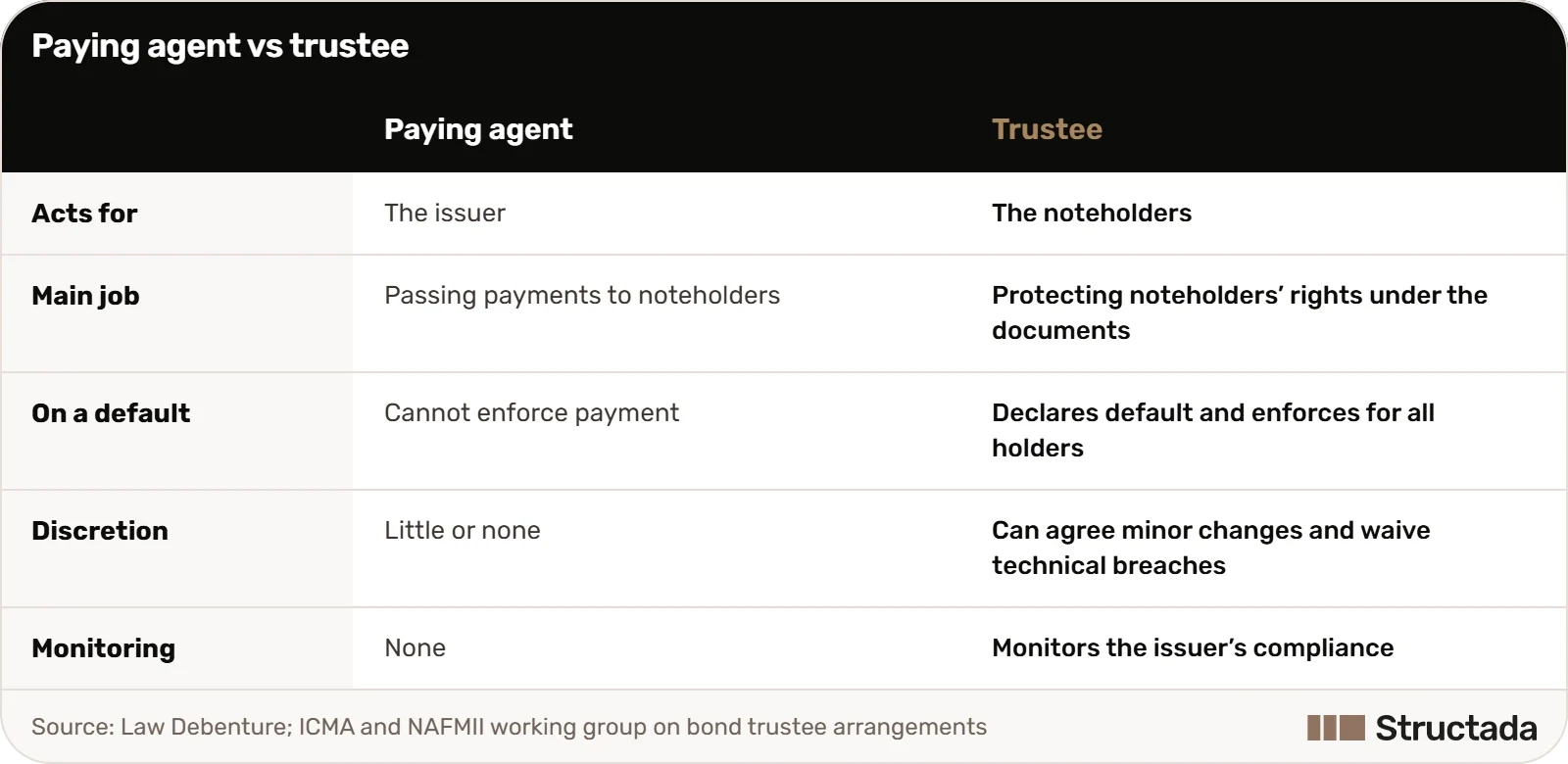
- A paying agent acts for the issuer and passes payments to noteholders. A trustee acts for the noteholders and protects their rights.
- A paying agent cannot enforce payment. A trustee can declare a default, enforce security and act for all noteholders at once.
- Trustees can also agree minor changes and waive technical breaches without a noteholder meeting, if holders are not materially prejudiced.
- Trust deeds usually stop individual holders from suing on their own unless the trustee fails to act, which prevents a race to court.
- Most secured, structured and listed corporate notes use a trustee. Simpler issues to a few investors sometimes rely on a fiscal agent alone.
A note issue has two kinds of party standing between the issuer and its investors. One moves the money. The other protects the investors' rights. The paying agent does the first and the trustee does the second, and confusing the two leads to wrong assumptions about who will act if something goes wrong.
What a paying agent does
A paying agent receives interest and principal from the issuer and passes it to noteholders, normally through Euroclear and Clearstream. It is appointed by the issuer under an agency agreement and acts as the issuer's agent. Its duties are administrative: making payments on time, publishing notices and keeping records.
What it cannot do is make the issuer pay. If the money does not arrive, the paying agent has nothing to pass on and no power to enforce. As Cbonds puts it, a paying agent "lacks the authority to enforce bond payment obligations."
What a trustee does
A trustee is appointed by the issuer but owes its main duty to the noteholders. It holds the issuer's promise to pay, and any security, on trust for all of them. The ICMA and NAFMII working group on trustee practice describes it as "not an agent of the issuer, but an independent institution which is appointed by the issuer and acts on behalf of the bondholders."
The trustee monitors compliance with the terms, decides whether an event of default has occurred, and if it has, accelerates the notes and enforces on behalf of all holders. Where notes are secured, a security trustee or collateral agent holds the security and enforces it.
Why the distinction matters on a default
Without a trustee, each noteholder must act for itself. Law Debenture points out that under a fiscal agency structure a single holder can trigger repayment over a minor default that a trustee could have waived, and that holders may scramble to start proceedings in different courts. With a trustee, enforcement is collective. Trust deeds usually prevent individual holders from suing unless the trustee has been asked to act and has failed to do so.
That collective approach protects investors from each other as well as from the issuer. It ensures recoveries are shared according to the documents, not according to who reached court first.
What else a trustee can do
Trustees also have discretion that makes notes easier to manage. They can agree changes to the documents that are not materially prejudicial to noteholders, and waive technical breaches, without calling a meeting. For issuers with many holders spread across custodians, avoiding a formal meeting for every minor amendment saves time and cost.
None of this means the trustee vouches for the issuer's credit. Its job is to act for investors under the documents, not to guarantee repayment.
Which issues use which
Every note has a paying agent. The question is whether it also has a trustee. Trustees are the norm for secured notes, structured products, securitisations and most listed corporate bonds; the ICMA working group cites data showing that around 95% of US issuers' bonds and around 90% of UK issuers' bonds used one in 2016 and 2017. Issues without a trustee rely on a fiscal agent, an arrangement most common among sovereigns and strong corporate issuers. Our guide to fiscal agents and paying agents explains that structure.
For notes issued by securitisation vehicles, including credit linked notes, the trustee or security agent is central: investors are relying on specific assets, and someone must hold and enforce the security over them for all holders.
Cost and appointment
Paying agency fees are modest and largely fixed. Trustee fees are higher and may rise if the trustee has to act on a default, since its costs of enforcement are usually paid ahead of noteholders. Issuers weigh that against what their investors expect. For a note sold to wealth managers and private banks, a trustee is often the difference between a security investors can hold and one they will pass on.
What this means for issuers
The paying agent makes the issue work day to day. The trustee makes it investable when things go wrong. Most secured and structured issues need both, and appointing them early lets the documents, security and settlement be built around how investors will actually be protected. The issuing and paying agent usually handles the first role; a separate, independent institution handles the second.