

- A paying agent receives interest and principal from the issuer and passes it to noteholders, usually through the clearing systems.
- A fiscal agent is the issuer's main agent in a bond issue that has no trustee. It pays investors and also handles the issue's administration.
- Where a trustee is appointed, the same coordinating role is usually called the principal paying agent.
- Both fiscal agents and paying agents act for the issuer and owe no duties to noteholders. Under a fiscal agency structure, each noteholder enforces its own rights.
- Fiscal agency is cheaper and simpler. Trustee structures give noteholders a single representative and are used in most corporate bond issues.
Read the front page of a bond prospectus and you will find a list of agents. Two titles cause more confusion than the rest: fiscal agent and paying agent. They overlap, they are often filled by the same bank, and the difference between them says a good deal about how the bond is structured and who protects the investors.
What is a paying agent?
A paying agent is the institution that receives interest and principal from the issuer and passes it to the people entitled to it. In an international note held through Euroclear and Clearstream, the paying agent makes a single payment to the clearing systems, which then credit their participants. Larger issues may have several paying agents in different countries, coordinated by one lead agent.
The paying agent's job is mechanical. It pays what the documents say should be paid, when they say it, to the accounts the clearing systems specify. It has no power to enforce payment if the issuer does not provide the money.
What is a fiscal agent?
A fiscal agent is the issuer's principal agent in a bond issue where no trustee has been appointed. It carries out the paying agent's functions and the wider administration of the issue: maintaining records, publishing notices, arranging meetings of noteholders and dealing with replacement or cancellation of notes. It is appointed under a fiscal agency agreement.
According to Cbonds, where the transaction does not involve a trustee, the fiscal agent takes on the coordinating role. Where there is a trustee, the same institution is usually called the principal paying agent. In practice, the title tells you whether a trustee sits in the structure.
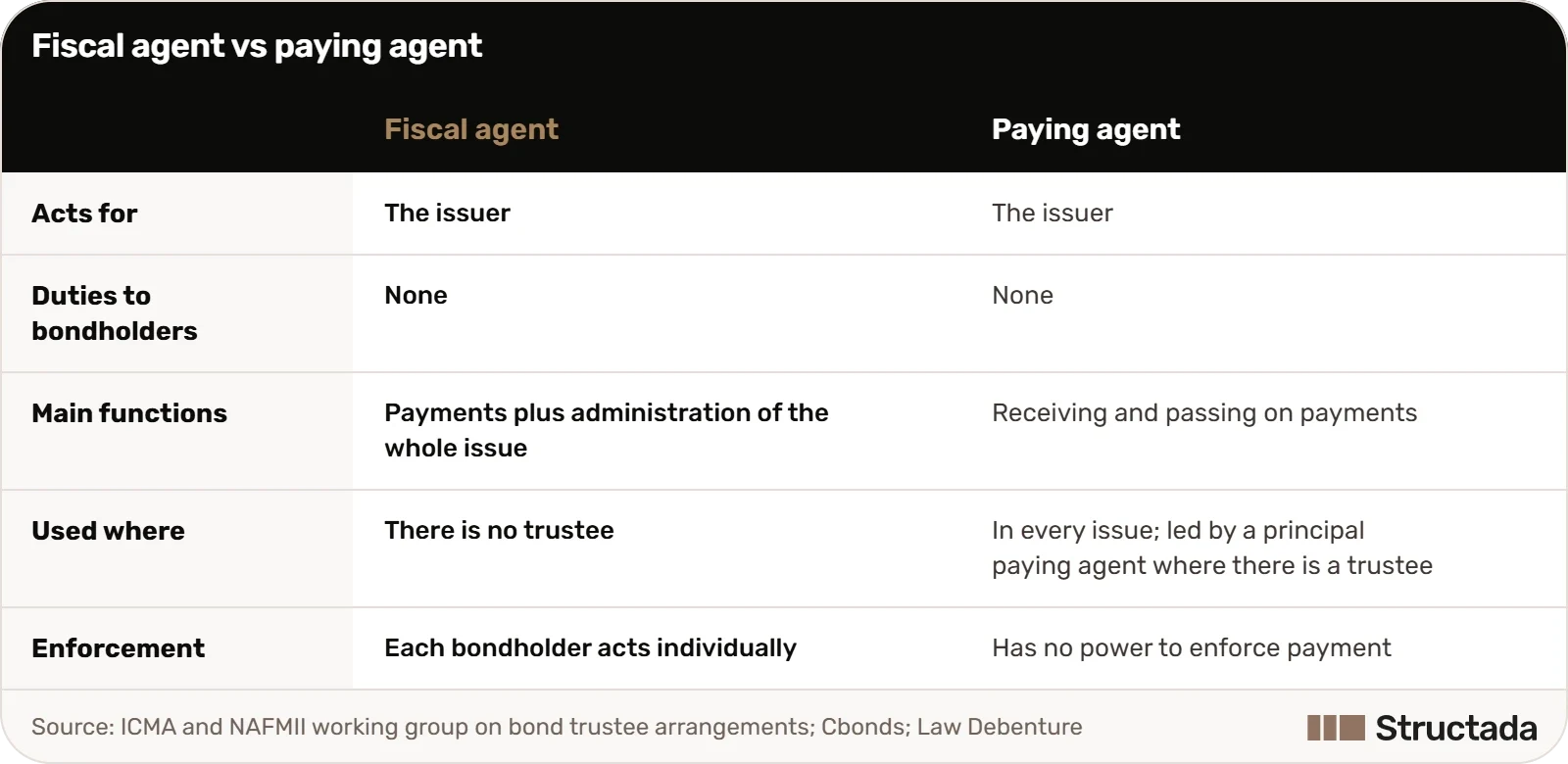
Who each one acts for
Both roles are agents of the issuer. The ICMA and NAFMII working group on bond trustee practice states that a fiscal agent "solely serves the issuer and bears no duty or obligation towards the noteholders." A paying agent is in the same position.
That matters when a payment is missed. Under a fiscal agency structure, there is no single party acting for the bondholders. Each holder must decide for itself whether to declare a default and take action, which can mean investors racing to sue in different courts. Law Debenture, a specialist trustee, also notes that funds held by a fiscal agent may be exposed to a liquidator, while a trustee can require payments to be made to it for all holders' benefit.
When a fiscal agent is used
Fiscal agency structures are most common where investors are comfortable relying on the issuer's standing and on their own ability to act: sovereigns, supranationals, some highly rated corporates and many short-term programmes. They are cheaper, because the fiscal agent usually charges little beyond its paying agency fees, and simpler, because there is no trust deed.
Trustee structures dominate elsewhere. The ICMA working group cites data showing that around 88% to 90% of UK issuers' bonds used a trustee in 2016 and 2017. Security, subordination, ratings and listing requirements all tend to push issuers towards a trustee, as does any structure where noteholders need someone to act for them collectively. Our comparison of paying agents and trustees covers that choice in more detail.
What this means for secured and structured notes
For secured notes, credit linked notes and notes issued by securitisation vehicles, investors usually expect more than a fiscal agent. The security over the assets is normally held by a trustee or a collateral agent for all noteholders, and enforcement runs through that party. The paying agent still makes the payments, but it sits inside a structure designed to protect investors as a group.
For a simple unsecured issue placed with a small number of professional investors, a fiscal agency structure can be enough. The question for the issuer is what its investors will need if something goes wrong, not only what is cheapest on the day.
What this means for issuers
Every note needs a paying agent. Whether it also needs a trustee, or whether a fiscal agent is enough, depends on the investors, the security and the ratings or listing requirements. Settling that early shapes the documents, the cost and how investors will view the notes. For the role that combines issuance and payment, see our guide to issuing and paying agents.