- Securitisation-as-a-service is a model in which a platform provides a ready-made issuing vehicle, documents, service providers and operations, so lenders, managers and asset owners can issue notes without building their own securitisation structure.
- Most platforms use a multi-compartment vehicle, often in Luxembourg, where each issuer's transaction sits in its own ring-fenced compartment.
- The issuer brings the assets and the investors; the platform supplies the vehicle, the base documents, the paying agent, clearing, administration and reporting.
- The main benefits are speed, lower and more predictable cost, and a structure that investors and custodians already recognise.
- Issuers should test a platform's ring-fencing, governance, fee transparency, operational quality and reporting before committing a transaction to it.
For most of the history of the market, a specialty lender that wanted to fund its loan book through notes had to build everything itself. It incorporated a vehicle, appointed directors, instructed lawyers, found a paying agent, opened accounts, obtained an ISIN and negotiated terms with every service provider in turn. The process took months, and the fixed cost was high enough to rule out smaller transactions altogether.
Securitisation-as-a-service changes that arithmetic. The infrastructure of a note issue is built once and shared, and each issuer pays to use it, much as companies now rent computing capacity rather than run their own data centres. The issuer concentrates on its assets and its investors; the platform supplies the vehicle, the documents and the operations.
The model has done more than lower costs. It has opened securitisation to issuers that would never have justified a standalone structure, and in doing so it has made the quality of the platform, rather than the ingenuity of each deal, the deciding factor in how well a transaction runs.
What is securitisation-as-a-service?
Securitisation-as-a-service describes any arrangement in which a third party provides the core infrastructure of a securitisation or note issue as a repeatable service. In practice that means an existing vehicle, usually a multi-compartment securitisation company; template documentation such as a base private placement memorandum and standard note terms; a pre-appointed team of directors, administrators, paying agent, auditors and lawyers; and settled processes for ISINs, clearing, payments and investor reporting, often supported by data and reporting technology.
The term is used loosely. Some providers sell technology to banks running their own securitisations. Others operate issuance platforms for asset managers and lenders, and others still offer what the market calls rent-a-compartment access to an existing vehicle. The common thread is that the issuer uses infrastructure someone else has built and maintains.
How securitisation-as-a-service works
A transaction on a platform follows a well-worn sequence:
- Onboarding: the issuer, and often the originator or asset manager, completes KYC and due diligence with the platform.
- Structuring: the parties agree the assets, the note terms, the target investors and any tranching.
- New compartment: the vehicle's board resolves to create a compartment for the transaction.
- Issue terms: a short supplement sets out the specific terms under the platform's base offering document.
- Issuance: the notes receive an ISIN and settle through Euroclear and Clearstream into investors' custody accounts.
- Ongoing service: the platform handles payments, accounts, audit and investor reporting for the life of the notes.
What makes this efficient is that most of the work in the first four steps has already been done for earlier compartments. The vehicle's constitutional documents, its service agreements and its relationships with the clearing systems are in place, so each new transaction requires only the terms specific to it. Once issued, the notes behave like any other clearable security, and the paying agent moves cash to investors through the same channels used for every other series.
Who uses securitisation platforms
The natural users are issuers whose assets are sound but whose transactions are too small or too frequent to justify a dedicated vehicle. Specialty and non-bank lenders use platforms to fund loan books through notes, often as a step towards larger facilities. Private credit and asset managers use them to package strategies for wealth and institutional investors, and asset owners use them to finance real estate, receivables, royalties and other cash-generating assets.
On the investor side of the market, wealth managers and private banks use platforms to create investable notes for clients, and family offices use them to hold co-investments or private transactions in a clearable form. For all of these, the attraction is the same: a security that sits in a custody account and can be processed like any other bond.
Build your own vehicle vs securitisation-as-a-service
| Build your own vehicle | Securitisation-as-a-service | |
|---|---|---|
| Time to first issue | Several months | Weeks |
| Set-up cost | High: incorporation, documents, onboarding | Low: a new compartment and issue terms |
| Running cost | All borne by the issuer | Shared across the platform |
| Control | Full control of board and providers | Platform governance, with issuer input on the transaction |
| Investor familiarity | Must be built from scratch | Platform and its documents already known to custodians |
| Best for | Large, frequent issuers wanting full control | First-time, smaller or repeat issuers wanting speed and lower cost |
A dedicated vehicle remains the better answer for a large issuer with steady volume and a need to control every appointment. For most others, the shared model wins on time and cost. Our comparison of securitisation SPVs and private funds sets out the wider choice of wrapper.
Why the model has grown
Several forces have converged. The growth of private credit has produced many more lenders and managers seeking to reach investors through notes rather than funds, and the wealth channel in particular prefers securities that can be held in an ordinary custody account. Notes issued by a securitisation vehicle also avoid most fund-level regulation, which makes them simpler to offer to professional investors across jurisdictions.
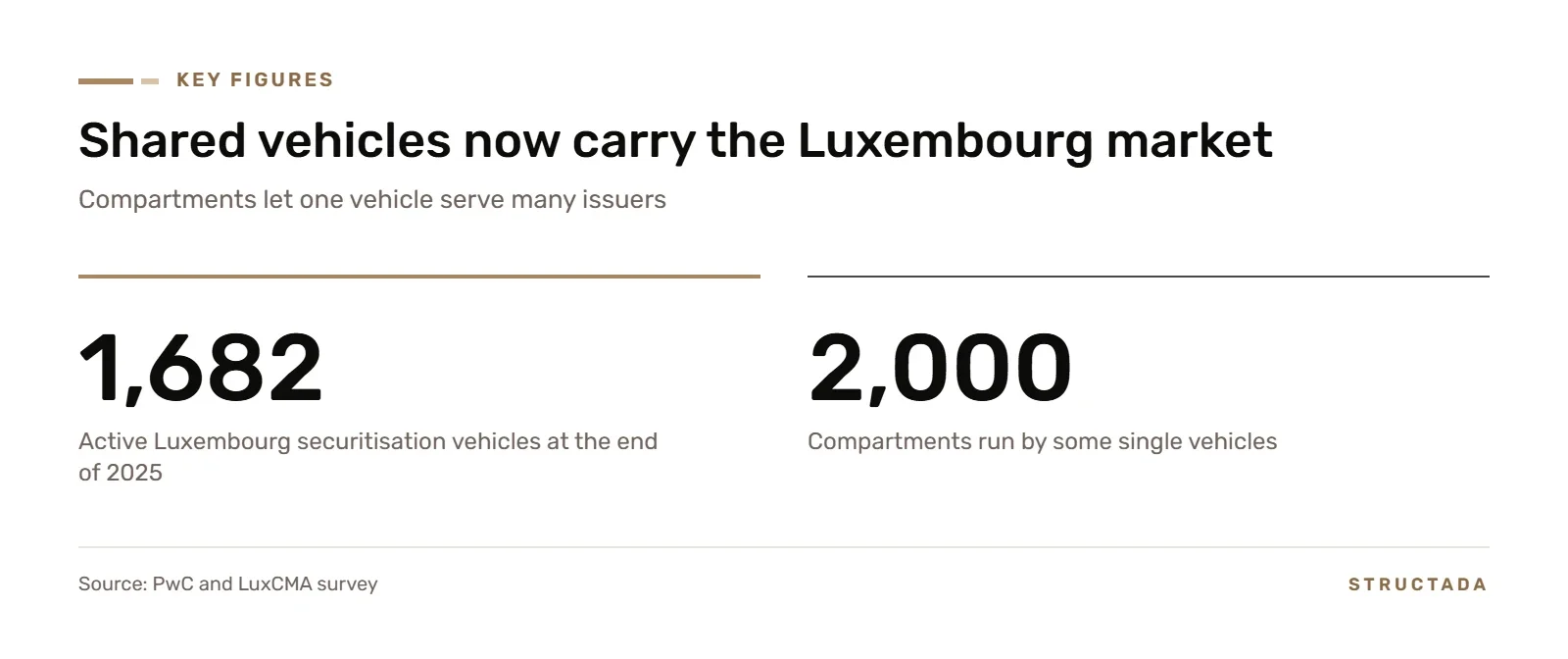
The legal infrastructure has made sharing possible. Luxembourg's securitisation law allows an unlimited number of ring-fenced compartments within a single vehicle. Luxembourg had 1,682 active securitisation vehicles at the end of 2025, and some run up to 2,000 compartments, according to the PwC and LuxCMA survey. Better data, onboarding and reporting tools have done the rest, making a platform with hundreds of compartments practical to run.
Choosing a securitisation platform
Platforms vary more than their marketing suggests, and the differences matter most when something goes wrong. Ring-fencing comes first: an issuer should understand how compartments are segregated, how assets and liabilities are attributed and what protects its investors from problems in another issuer's compartment. Governance follows closely. The composition and independence of the board, and how it manages conflicts between issuers sharing one vehicle, determine whether the structure will hold up under pressure.
Cost should be examined in full. Some platforms quote a fixed price for set-up and annual running costs; others charge item by item, which can make the true cost hard to see until the invoices arrive. Our guide to the hidden costs of CLN issuance explains what to ask. The quality of the service providers behind the platform, the speed and accuracy of its operations, the standard of investor reporting and its operational track record across past compartments all deserve the same scrutiny.
The model also has limits. The platform's board and policies govern the vehicle, so the issuer gives up some control. Unusual structures may not fit standard documents without negotiation. The issuer takes on a dependence on the platform's operations and reputation. And a platform provides infrastructure, not investors: placement usually remains the work of the issuer or its arranger.
What this means for issuers
Securitisation-as-a-service turns note issuance from a one-off engineering project into a repeatable process. For lenders, managers and asset owners seeking funding from professional investors, it can take months off the timetable and much of the cost out of a first issue, while giving investors a structure their custodians already recognise.
The choice of platform is the decision that counts. Ring-fencing, governance, transparent pricing and operational discipline determine whether the service delivers what it promises across the life of the notes, and those qualities are far easier to assess before the first compartment is created than after. Our guide on how to issue a credit linked note shows the steps involved.
Frequently Asked Questions
What is securitisation-as-a-service?
A model in which a platform provides an existing issuing vehicle, documents, service providers and operations, so issuers can issue notes without building their own securitisation structure.
How is it different from setting up my own SPV?
The issuer uses a compartment in an existing vehicle, with documents and providers already in place, rather than forming and running its own entity.
Is my transaction separate from other issuers on the platform?
On a Luxembourg platform, each transaction sits in its own compartment, ring-fenced by law, so investors' recourse is limited to that compartment's assets.
How long does it take to issue through a platform?
Typically weeks rather than months, depending on onboarding, the assets and the documents.
Who are the investors?
Usually professional investors, such as family offices, wealth managers, private banks and institutions, holding the notes through their custodians.
Does the platform find investors for me?
Not always. Some platforms help with distribution, but many provide only the infrastructure, leaving placement to the issuer or its arranger.