- A convertible loan is a loan that can, or must, convert into shares in the borrower, usually at the next funding round, rather than being repaid in cash.
- In the UK, these are commonly documented as convertible loan notes, which is why the abbreviation CLN can mean either a convertible loan note or a credit linked note depending on context.
- Investors are rewarded for taking early risk through a discount to the next round price, typically 10% to 20%, and often a valuation cap that limits the price at which they convert.
- Maturity is usually 12 to 24 months, with interest often accruing and converting rather than being paid in cash.
- Convertible loans suit early-stage and growth companies that need money quickly and want to delay setting a valuation, but they can create dilution surprises and repayment pressure if a funding round never comes.
Early-stage companies often face a timing problem. They need funding before their next equity round, but agreeing a valuation now would take time, cost legal fees and risk pricing the business at a low point. Conventional lending is rarely available, because there is little revenue to service debt and few assets to secure it.
The convertible loan exists to bridge that gap. An investor advances money today and, in place of repayment, the loan converts into shares when the company completes its next round, usually at a better price than new investors pay. The company receives cash quickly, and the investor is rewarded with equity on favourable terms for having taken the earlier risk.
The instrument looks simple, and its documents are short. Its consequences for the cap table, and for the company if the expected round never arrives, are less simple, and they are where most of the negotiation should be spent.
What is a convertible loan?
A convertible loan is a debt instrument that gives the lender the right, or the obligation, to convert the outstanding amount into shares in the borrower. Until conversion, it is a loan and ranks ahead of shareholders. On conversion, it becomes equity, and the lender becomes a shareholder.
Terminology varies by market. In the UK, convertible loans are usually documented as convertible loan notes or a convertible loan agreement. In the US, the equivalent is the convertible note, and many early-stage investors now use the SAFE, a simple agreement for future equity, which converts in a similar way but carries no debt claim. UK investors seeking SEIS or EIS tax reliefs generally cannot use a convertible loan and use an advance subscription agreement instead, as Goodwin notes.
One further point of terminology matters to anyone working across markets. In structured finance, CLN usually means a credit linked note, a quite different instrument that transfers credit risk on defined assets. Our guide to credit linked notes explains that meaning.
How a convertible loan works
The investor advances money to the company under a convertible loan agreement. Interest may accrue over the life of the loan, but it is usually rolled up and converted with the principal rather than paid in cash, which preserves the company's cash for the business.
Conversion is triggered by a qualifying round: a new equity financing above a minimum size set in the agreement. When that round closes, the loan converts automatically, at a discount to the round price or at the price implied by the valuation cap, whichever gives the investor more shares.
The agreement must also deal with outcomes other than a round. If the company is sold first, the investor typically chooses between repayment, often with a premium, and conversion at a price that lets it share in the sale proceeds. If no qualifying round happens by maturity, the investor may choose repayment or conversion at an agreed valuation. These fallback provisions receive less attention than the headline discount, yet they decide what happens when the plan goes wrong.
Key terms of a convertible loan
| Term | What it means | Typical market practice |
|---|---|---|
| Discount | Reduction to the next round price at conversion | Typically 10% to 20%, higher in difficult markets |
| Valuation cap | Maximum valuation used to set the conversion price | Negotiated deal by deal |
| Interest | Return on the loan before conversion | Often modest, accrued and converted |
| Maturity | Date by which the loan converts or is repaid | Typically 12 to 18 months, sometimes 24 or more |
| Qualifying financing | Size of round that triggers automatic conversion | Set as a minimum amount |
| Exit treatment | What happens on a sale before conversion | Repayment, often with a premium, or conversion |
| Security | Whether the loan is secured | Usually unsecured for early-stage companies |
A worked example of conversion
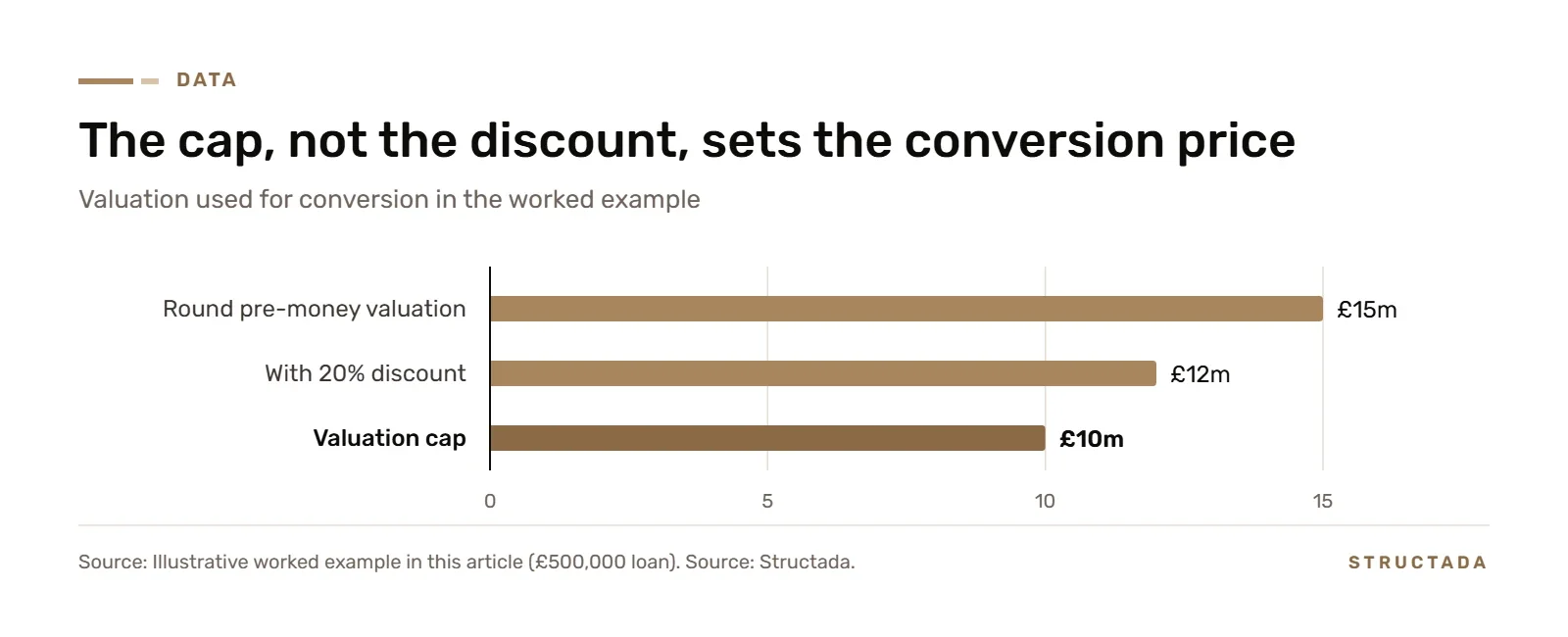
Consider an investor who lends £500,000 with a 20% discount and a £10 million valuation cap. Twelve months later, the company completes a round at a £15 million pre-money valuation. The discount alone would give a conversion valuation of £12 million, while the cap gives £10 million. The investor converts at the lower figure, £10 million, and so receives shares worth 1.5 times the round price per pound invested.
The example shows why the cap often matters more than the discount. Where the company has grown strongly between the loan and the round, the cap does most of the work, and founders who focused only on the discount can find the dilution larger than they expected.
Why companies and investors use convertible loans
For companies, the attraction is speed and economy. Documents are simpler, there is no need to agree a valuation now, and the legal work is lighter than a priced equity round. A convertible loan can fund the business to its next milestone, after which a round can be priced on stronger evidence, and terms can be adjusted for individual investors where that helps.
For investors, the instrument offers a balance of protection and upside. As lenders they rank ahead of shareholders before conversion, they convert at a better price than later investors, and they keep repayment rights if the company is sold early or no round happens.
Drawbacks and risks
The most common problem is dilution. Several convertible loans issued over time, each with a low cap, can convert together into a far larger share of the company than founders anticipated. Each loan looked modest when signed, and the combined effect appears only at the round.
Repayment risk is the second. If no round happens, the company may face a demand it cannot meet, which shifts negotiating power sharply to the lender at the worst moment. Until conversion, the loan also sits on the balance sheet as a liability, which can complicate other financing. In the UK, SEIS and EIS relief is generally unavailable, which narrows the pool of investors willing to use the instrument.
Convertible loans in growth and private credit
Convertible features are used well beyond start-ups. Growth lenders and private credit funds use them to combine a contractual return with equity upside, particularly where a borrower is growing quickly. A common alternative is a straight loan with warrants, which gives the lender a separate right to buy shares while the loan itself is repaid in cash. Bank capital instruments such as CoCos use a very different form of conversion, triggered by losses rather than funding rounds.
For established lenders and asset-rich businesses seeking larger amounts from professional investors, secured notes or credit linked notes issued from a securitisation compartment can provide funding without diluting shareholders at all. Where the alternative is a conventional facility, our guide to term loans sets out how they compare, and our guide to alternatives to setting up a fund covers other structuring routes.
What this means for issuers
A convertible loan is a fast, flexible bridge for companies that need funding before they are ready to set a valuation. It works best when a qualifying round is realistic within the loan's term, and when the cap and discount are set with the full cap table in view, including every other convertible already outstanding.
It is also equity finance in all but name, and it should be priced as such. Where the business has assets or cash flows capable of supporting debt, non-dilutive alternatives deserve a proper comparison before equity upside is given away.
Frequently Asked Questions
What is a convertible loan?
A loan that converts into shares in the borrower, usually at the next equity funding round, rather than being repaid in cash.
What is a convertible loan note?
The UK name for a convertible loan documented as a note or loan instrument.
What is a valuation cap?
The maximum company valuation used to calculate the conversion price, protecting early investors if the next round is priced high.
What discount do convertible loans usually carry?
Typically 10% to 20% to the next round price, sometimes more in difficult funding markets.
What happens if there is no funding round?
At maturity, the investor usually chooses between repayment and conversion at an agreed valuation, which can put pressure on the company.
Is a convertible loan the same as a SAFE?
No. A SAFE is not a loan and has no maturity or interest, although it converts into equity in a similar way.