- Sports finance is the funding of clubs, leagues, venue owners and their investors, usually secured on the predictable income that sport generates: transfer fees, media rights, sponsorship and ticketing.
- The most common structures are transfer receivables financing, media and sponsorship receivables financing, stadium and infrastructure loans, and acquisition finance for club owners.
- Private credit has become a major lender to sport as valuations have risen, transfer spending has hit records and banks have become more selective.
- Lenders focus on who ultimately pays, how enforceable the contracts are, and sporting risks such as relegation, alongside league and UEFA financial rules.
- Sport receivables can be packaged into notes issued from a ring-fenced vehicle, giving professional investors access and clubs a wider pool of funding.
A football club sells a player for €40 million, payable over four years. The buyer is a well-known club and the contract is registered with the league, so the money is as good as promised. The selling club, however, needs the cash now: to meet wages, to sign a replacement and to stay within its league's spending rules. It turns to a lender, who advances most of the fee today and collects the instalments as they fall due.
That transaction is sports finance in its most common form. Beneath the public spectacle of transfer windows and broadcasting deals sits a large and growing market in lending against the income sport produces, used by clubs, leagues, stadium owners and the investors who now own many of them.
What makes the market interesting to credit professionals is that its best assets often belong to someone other than the borrower. The value of a sports financing usually rests on the strength of the club, broadcaster or sponsor that owes the money.
What is sports finance?
Sports finance, sometimes called sport finance, covers the ways in which sports organisations and their owners obtain funding. Some of it looks like ordinary corporate lending: a revolving credit facility, a bond or a loan to buy a club. Much of it, however, is secured on specific, contracted income streams, which places it closer to asset-based and receivables finance than to conventional corporate credit.
The users are varied. Clubs finance working capital, transfers, wages and facilities. Leagues and competitions borrow against central media and sponsorship income. Stadium and venue owners fund construction, redevelopment and refinancing. Owners and investors finance the acquisition of clubs or stakes in them, and rights holders and event organisers monetise future media and sponsorship contracts.
The main types of sports finance
| Type | What it is secured on | Who pays |
|---|---|---|
| Transfer receivables financing | Instalments due from clubs that have bought players | The buying club |
| Media rights financing | Future payments under broadcasting contracts | The broadcaster or league |
| Sponsorship receivables financing | Sponsorship, naming-rights and kit-supply contracts | The sponsor |
| Stadium and infrastructure finance | The stadium and its revenues | Matchday, events and commercial income |
| Acquisition and holding company finance | Shares in the club and group cash flows | The owner's group |
| Working capital facilities | General club revenues | The club |
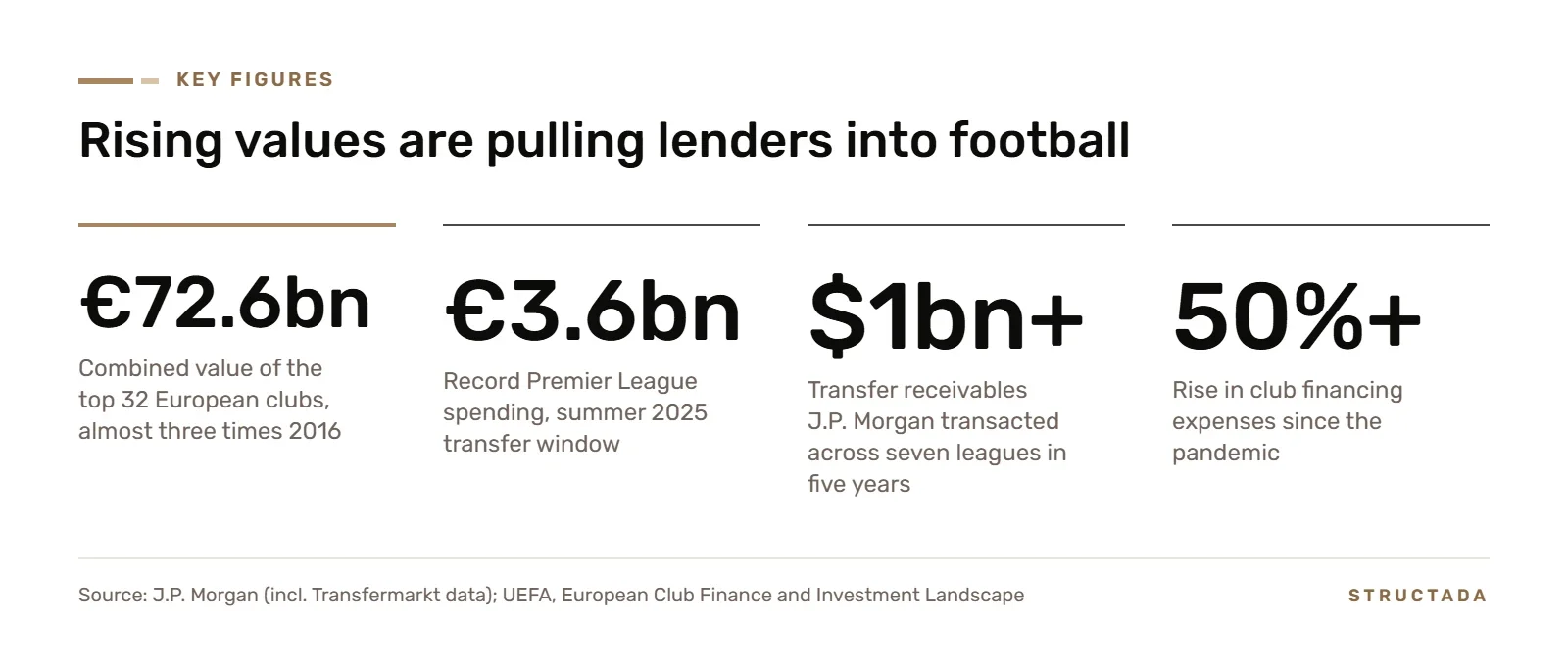
J.P. Morgan describes transfer, sponsorship and media receivables as the three main income streams clubs now turn into upfront funding, and reports having transacted over $1 billion of player transfer receivables across seven major leagues in five years.
How transfer receivables financing works
Transfer fees are rarely paid in one sum. A fee agreed in a busy window is typically settled in instalments over several years, which leaves the selling club holding a receivable from the buying club. Transfer receivables financing converts that receivable into cash.
The selling club assigns the receivable to a lender, or to a vehicle the lender funds. The lender advances cash at a discount to face value, with the discount reflecting the buying club's credit, the length of the payment schedule and the protections in the transfer contract. The buying club then pays the instalments as they fall due, either directly to the lender or through the selling club, and those payments repay the advance. League and governing body rules on transfer payments support enforcement if a buyer falls behind.
The principal credit is therefore usually the buying club rather than the seller. A receivable owed by a large, financially stable club is worth materially more than one owed by a club fighting relegation, and pricing reflects that difference directly.
Why private credit has moved into sport
Several forces have pulled private lenders into sport at the same time. Values have risen sharply: J.P. Morgan puts the combined value of the top 32 European clubs at €72.6 billion, almost three times the 2016 level. Transfer spending has reached new highs, with Premier League clubs spending a record €3.6 billion in the summer 2025 window, according to Transfermarkt data cited by J.P. Morgan. Each of those transfers creates instalment receivables that someone has to fund.
Financing needs have grown with them. UEFA's European Club Finance and Investment Landscape reports that club financing expenses have risen by more than 50% since the pandemic. Financial sustainability and profitability rules add a further incentive, encouraging clubs to manage cash carefully and to bring forward income they are already owed.
The supply side has shifted as well. Banks have become more cautious about concentrated, complex or lower-rated sports credits, leaving room for specialist lenders, as Prudential Private Capital notes. Private credit funds, insurers and other institutional investors now lend to sport directly or through notes and private placements.
How lenders assess sports credits
The first question is who pays. The creditworthiness of the buying club, broadcaster or sponsor matters more than the borrower's own accounts, and concentration on a single club, league or broadcaster is watched closely. The second is the contract itself: payment schedules, termination rights, set-off and whether the receivable can be assigned at all.
Sport also brings risks with no close equivalent in other receivables markets. Relegation, poor performance or failure to qualify for European competition can cut income or trigger clauses in media and sponsorship agreements. Lenders therefore look carefully at league rules, transfer payment protections and UEFA financial sustainability requirements, and at the identity, funding and stability of a club's owners, including sanctions and reputational checks.
Facilities usually come with covenants, reporting requirements and cash control over the income being financed. Our guide to loan covenants explains the terms borrowers should expect.
Structuring sports finance through notes
Sport receivables share the features that suit securitisation: identifiable contracts, scheduled payments and known payers. A club, league or lender can transfer a portfolio of transfer, media or sponsorship receivables into a ring-fenced vehicle, such as a compartment of a Luxembourg securitisation vehicle, which issues notes to professional investors.
This widens the pool of funding beyond a single bank or fund. A credit linked note can give investors exposure to a defined portfolio of receivables, with the notes carrying an ISIN and settling through Euroclear and Clearstream. Our article on securitised credit explains the wider principle of turning contracted income into securities.
What borrowers should weigh
Advancing future income has a price, and clubs should compare the cost of financing receivables with their other sources of funding. Assigned receivables and pledged media income are no longer available to support other borrowing, which narrows future flexibility. Any financing must also fit league and UEFA rules, including how the transaction is treated in sustainability calculations. Club debt attracts close attention from supporters, leagues and regulators alike, so disclosure and reputation deserve as much care as pricing.
What this means for issuers
Sports finance has become a mature, specialist market. For clubs and rights holders it offers a way to turn contracted future income into cash today, often at lower cost than unsecured borrowing. For lenders and investors it offers exposure to large, well-known payers under contracts with predictable schedules.
The quality of a sports financing rests on the same fundamentals as any receivables transaction: who pays, how enforceable the contracts are and what happens if results turn on the pitch. Issuers who assemble clean contract data, understand the regulatory framework and choose a structure that matches the receivables will find a deep and widening investor base.
Frequently Asked Questions
What is sports finance?
The funding of sports clubs, leagues, venue owners and investors, often secured on income such as transfer fees, media rights, sponsorship and ticketing.
What is transfer receivables financing?
A loan or sale in which a club receives cash today against instalments it is owed by another club for a player transfer.
Who lends to football clubs?
Banks, private credit funds, insurers and other institutional investors, either directly or through notes and private placements.
What are media rights financings?
Facilities that advance cash against future payments due under broadcasting contracts, usually from a broadcaster or a league's central distribution.
What are the risks in sports finance?
Counterparty risk on the paying club, broadcaster or sponsor, sporting risks such as relegation, contract enforceability, regulatory rules and concentration.
Can sport receivables be securitised?
Yes. Portfolios of transfer, media or sponsorship receivables can be transferred to a ring-fenced vehicle that issues notes to professional investors.