- AMC issuance turns a manager's strategy into a single security with an ISIN that private banks, wealth managers and family offices can buy through their custodian.
- An AMC can be issued by a bank, which adds the bank's credit risk, or by a securitisation vehicle, where investors are exposed to the assets held in a ring-fenced compartment.
- Issuance follows a clear path: define the strategy and investment rules, choose the issuer, onboard the manager, agree the terms, obtain an ISIN and clearing, then launch and rebalance.
- On an existing issuance platform, a liquid AMC can often launch in two to six weeks, with costs well below those of setting up a fund.
- Managers should look closely at issuer risk, rebalancing, liquidity, fees, distribution and reporting before choosing an issuer.
A manager with a credible strategy and a list of interested private banks often finds that the difficulty lies less in the investing than in the packaging. Private bank clients hold securities in custody accounts. They rarely subscribe to funds they have never heard of, and few managers want the cost and timetable of launching one simply to give them something to buy.
AMC issuance answers that problem. An actively managed certificate, or AMC, wraps a portfolio that a named manager runs at their discretion into a single security. Investors buy the certificate like any other note, the manager changes the holdings within agreed rules, and the certificate's value follows the portfolio.
The product itself is well understood, and our guide to actively managed certificates covers it in detail. The decisions that determine whether an AMC succeeds sit on the issuance side: who issues it, how it is built and the terms that govern how it runs.
What is AMC issuance?
AMC issuance is the process of creating and launching an actively managed certificate. It covers setting the strategy and investment rules, selecting an issuer, onboarding the manager, agreeing the terms, obtaining an ISIN and clearing eligibility, and bringing the certificate to investors.
The manager runs the strategy, but someone else issues the certificate. That separation is the heart of the structure. The issuer carries the legal obligation to investors, holds or references the portfolio and executes the manager's instructions, while the manager supplies the investment judgement. Choosing that issuer is therefore the first substantive decision in any AMC.
Bank-issued vs SPV-issued AMCs
There are two main types of AMC issuer, and they expose investors to different risks.
| Bank-issued AMC | SPV-issued AMC | |
|---|---|---|
| Issuer | An investment bank, under its structured products programme | A securitisation vehicle, often a compartment of a Luxembourg vehicle |
| Investors' credit exposure | The portfolio plus the bank's own credit risk | The assets held in a ring-fenced compartment |
| Typical underlying assets | Listed shares, bonds, ETFs and funds | Listed assets, and also loans and other private assets |
| Best suited to | Liquid strategies sold through the bank's own network | Managers wanting issuer independence or private assets in the portfolio |
Bank issuers dominate the Swiss and wider European market for liquid strategies. SPV issuers, particularly Luxembourg securitisation vehicles, are more common where the manager wants to avoid exposing investors to a single bank's balance sheet, or where the portfolio includes private credit or other assets a bank will not hold.
The AMC issuance process
Issuance follows a sequence that is broadly the same across issuers, although the time spent at each stage varies.
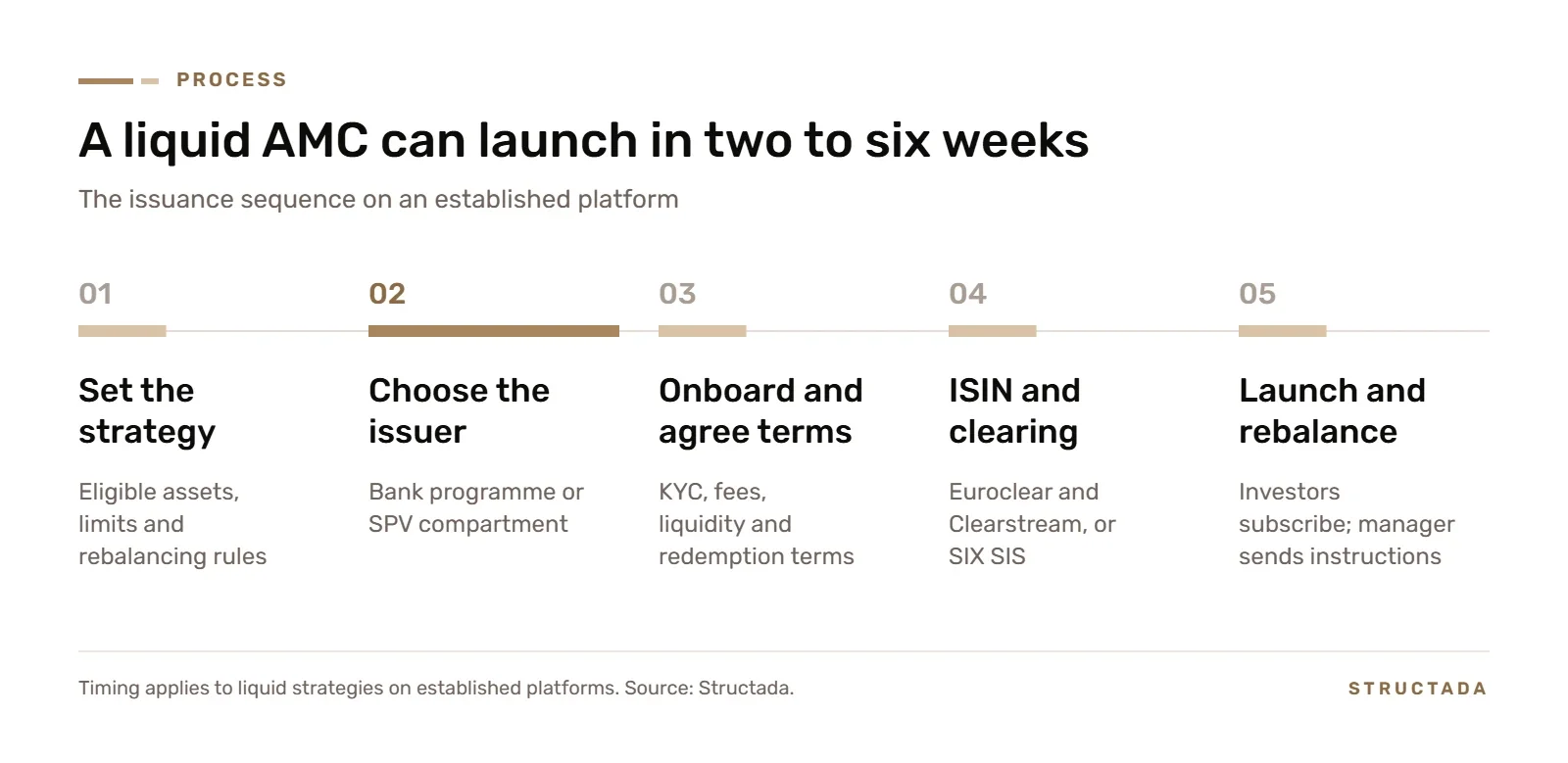
It begins with the strategy. The manager sets out the eligible assets, any limits on concentration or leverage, the rebalancing frequency and the target investors, and these rules become the certificate's investment guidelines. The choice of issuer and structure follows, driven by the assets, the investors' view of issuer risk, cost and the distribution plan. For an SPV issuer, a new compartment is created on an existing platform.
The issuer and its service providers then onboard the manager, running know-your-customer checks and confirming its regulatory status. Where the manager is not licensed for discretionary management, the structure may use an adviser role instead. The term sheet and final terms fix the currency, minimum investment, issue price, fees, rebalancing process, valuation, liquidity and redemption terms, and the maturity, which may be open-ended.
The issuer then obtains an ISIN and makes the certificate eligible in Euroclear and Clearstream, or SIX SIS for Swiss-focused products, through the relevant clearing system. Some AMCs are listed, for example on SIX or the Vienna MTF, so that investors who can only hold listed securities can buy them. At launch, investors subscribe through their custodian. Thereafter the manager sends rebalancing instructions, the issuer or its agent executes them, the certificate's value is published regularly and investors receive factsheets and portfolio reports.
How long AMC issuance takes
On an established bank or SPV platform with standard documents, a liquid AMC can often launch in two to six weeks, much of it spent on onboarding. AMCs holding private assets, or launched through a new standalone vehicle, take longer, because valuation, liquidity terms and the asset transfer mechanics all need more work. The practical lesson is that a manager who arrives with clear investment rules and complete onboarding documents shortens the timetable more than any other single factor.
AMC issuance costs
Costs vary by issuer and strategy, but they follow a familiar pattern. There is usually a set-up fee for structuring, documentation and the ISIN, and an annual issuer or platform fee, often a percentage of assets subject to a minimum. Custody, administration and calculation costs apply to the portfolio, and trading costs arise on each rebalancing. The manager's own fees, including any performance fee, are set by the manager and collected through the certificate.
Minimum fees deserve particular attention, because they can make a small AMC uneconomic. Even so, the comparison with a fund is usually favourable. There is no fund manager licence to obtain, no depositary to appoint for the AMC itself and no fund board to run, which is why AMCs are often considered among the alternatives to setting up a fund.
What managers should check before choosing an issuer
The first question is issuer risk: who the issuer is, and what investors are exposed to if it fails. The answer differs sharply between a bank programme and a ring-fenced compartment, and sophisticated buyers will ask it. Rebalancing comes next. How quickly instructions are executed, and at what cost, determines whether the certificate tracks the manager's intentions in practice.
Liquidity terms need to match the underlying assets, since a certificate offering frequent redemptions over illiquid holdings stores up trouble. Fees should be transparent, including platform and trading costs. Distribution matters as much as structure: a certificate is only useful if the target private banks and platforms will accept the issuer on their approved lists. Finally, reporting must give investors, their advisers and their compliance teams the information they need to keep holding the security.
AMCs and private assets
The newest growth area in AMC issuance is private markets. A securitisation compartment can hold loans, private credit positions or other assets that a bank issuer would not, while still giving investors a security with an ISIN that settles through the usual channels.
Valuation and liquidity terms carry more weight here, and they need to reflect the assets honestly. Where the portfolio is a defined pool of loans rather than an actively traded book, a credit linked note may be the better instrument, and our guide on how to issue a credit linked note covers that process.
What this means for issuers
AMC issuance gives a manager a fast, comparatively low-cost way to bring a strategy to private banks and wealth managers. The product decision is usually straightforward. The harder choices are the issuer, the structure behind it and the terms that govern rebalancing, liquidity and fees.
Those choices are difficult to change once investors are in. A certificate built on the wrong issuer, or with redemption terms that outpace its assets, will be hard to distribute and harder to run. Managers who settle the issuer and the terms before the first subscription produce a certificate that investors can buy with confidence and that the manager can operate without friction for years.
Frequently Asked Questions
What is AMC issuance?
The process of creating and launching an actively managed certificate: setting the strategy and rules, choosing an issuer, agreeing terms, obtaining an ISIN and clearing, and launching the certificate to investors.
Who can issue an AMC?
AMCs are issued by banks under their structured products programmes and by securitisation vehicles, often through dedicated compartments. The manager runs the strategy but is not usually the issuer.
How long does it take to issue an AMC?
On an existing platform, a liquid strategy can often launch in two to six weeks. Private-asset AMCs and new standalone structures take longer.
How much does it cost to issue an AMC?
Typical costs include a set-up fee, an annual issuer or platform fee, custody and administration costs and trading costs. Overall they are usually well below the cost of launching a fund.
What is the difference between a bank-issued and an SPV-issued AMC?
In a bank-issued AMC, investors take the bank's credit risk as well as the portfolio's. In an SPV-issued AMC, investors are exposed to the assets held in a ring-fenced compartment.
Can an AMC hold private assets?
Yes, particularly when issued by a securitisation vehicle. Liquidity and valuation terms need to match the assets.