- A tracker certificate is a structured product that follows the performance of an underlying index, basket or strategy, usually one for one, in a single security with an ISIN.
- Trackers are participation products with no capital protection, so investors gain and lose in line with the underlying, less fees.
- They range from simple index trackers to thematic baskets, rules-based dynamic trackers and actively managed certificates (AMCs).
- Compared with an ETF or fund, a tracker is faster and cheaper to launch, but it is a debt security, so investors carry the credit risk of whoever issues it.
- Trackers can be issued through a bank's programme or a securitisation compartment, and that choice decides whether investors are exposed to a bank's balance sheet or to the assets held.
An asset manager has a view on a theme: European defence, Gulf infrastructure, a basket of listed private credit managers. Its clients want the exposure, but no ETF matches it, and launching a fund would take months and a regulatory approval. In Switzerland and much of continental Europe, the usual answer is a tracker certificate.
Trackers are the plainest member of the structured products family. They do one thing, which is to follow an underlying, up and down, in a single security that any private bank or custodian can hold. That plainness is the source of their popularity, and it is why issuers use them to bring a strategy to market in weeks rather than quarters.
The questions worth asking sit underneath the simplicity: who issues the tracker, what stands behind it if that issuer fails, and how closely its terms deliver the exposure it promises.
What are tracker certificates?
A tracker, or tracker certificate, is a debt security whose value follows the performance of an underlying asset or group of assets. The underlying can be a stock market index, a basket of shares, bonds, commodities or currencies, or a strategy defined by rules or by a manager. Most trackers move one for one with the underlying, less a management fee.
Under the European and Swiss industry classification used by EUSIPA and the Swiss Structured Products Association, tracker certificates sit in the participation category, alongside bonus and outperformance certificates. Our guide to the types of structured products shows where they fit among the wider families. What sets participation products apart is the absence of capital protection: the investor takes the full upside and the full downside of the underlying.
How a tracker certificate works
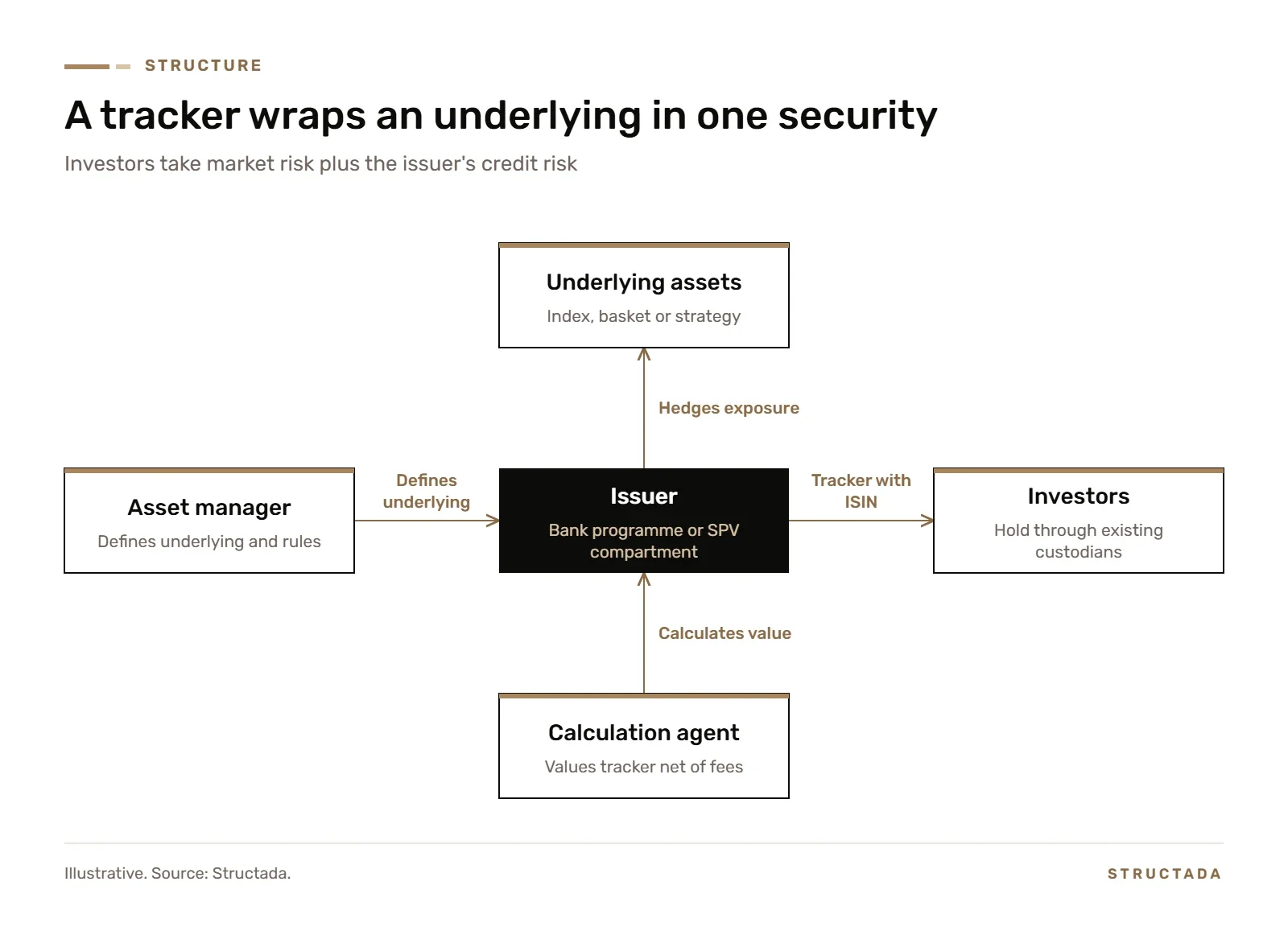
The issuer defines the underlying, creates the tracker under its issuance programme and hedges its exposure, usually by holding the underlying assets. A ratio sets the price of each unit, so that the security stays affordable: a tracker on an index standing at 5,000, with a ratio of 0.01, trades at 50. From then on the tracker's value follows the underlying for as long as it is held, net of the management fee. Investors exit by selling on an exchange or back to the issuer, which usually acts as market maker, or at maturity where the tracker has a fixed term.
Many have no fixed term at all. According to SIX, around two thirds of tracker certificates are issued as open-ended products, which the issuer can usually terminate on notice.
Two details deserve more attention than they usually receive. The first is dividends. A tracker on a performance index reflects reinvested dividends in the index level, while a tracker on a price index does not, and over several years the difference is material. The second is currency. A tracker on a foreign underlying carries exchange rate risk unless it is hedged, in which case it is often described as a quanto tracker, and the cost of that hedge is borne within the product.
Types of tracker certificate
The simplest form is the index tracker, which follows a published index such as a national or sector stock index and offers broad market exposure. Basket or thematic trackers follow a fixed selection of securities chosen to express an idea for which no index exists.
Dynamic or rules-based trackers go a step further, rebalancing a basket according to rules fixed at launch, which makes them a natural wrapper for systematic strategies. Bear trackers follow the inverse of an underlying and are used to benefit from, or hedge against, a fall.
At the far end sits the actively managed certificate. The line between a dynamic tracker and an AMC is discretion. A dynamic tracker follows rules written before the first unit is sold; an AMC lets a named manager change the holdings as markets move. Our article on AMC issuance covers that end of the market.
Tracker certificates vs ETFs, funds and AMCs
| Tracker certificate | ETF | Fund | AMC | |
|---|---|---|---|---|
| Legal form | Debt security of the issuer | Regulated fund | Regulated or private fund | Debt security of the issuer |
| Investor protection | Issuer credit risk, unless collateralised | Assets held separately | Assets held separately | Issuer credit risk, unless collateralised |
| Time to launch | Days to weeks | Months | Months | Weeks |
| Minimum viable size | Small | Large | Medium to large | Small |
| Who decides the holdings | Index or fixed rules | Index | Manager | Manager |
| Best for | Themes, baskets and niche exposure | Standard indices | Large, long-term strategies | Discretionary strategies |
The comparison explains the division of labour that has emerged. As Swiss data provider payoff.ch notes, ETFs have become the first choice for standard share indices, while certificates suit thematic and satellite exposures, where issuers can respond faster to new trends.
Bank-issued vs SPV-issued trackers
Most trackers are issued by banks. Investors in a bank-issued tracker therefore take two risks: the market risk of the underlying and the credit risk of the bank. In normal conditions the second is invisible. When a bank fails, it becomes the only risk that matters, because holders of its trackers rank as unsecured creditors whatever the underlying has done. Some markets offer collateral-secured certificates, in which the issuer posts collateral to reduce that exposure.
The alternative is to issue through a securitisation vehicle, often from a ring-fenced compartment of a Luxembourg securitisation vehicle. The compartment holds the underlying assets, so investors are exposed to those assets rather than to a bank's balance sheet. This route suits managers who want independence from any single bank, and those who want to wrap assets, such as private credit or unlisted positions, that a bank programme will not hold.
How issuers bring a tracker to market
The commercial work comes first: defining the underlying and the rules for rebalancing, dividends and corporate actions. The legal and operational work then follows a well-worn sequence.
- Choose the issuer: a bank programme or an SPV compartment.
- Appoint a calculation agent, a paying agent and, where relevant, an index provider.
- Set the currency, ratio, fee, market making and term.
- Obtain an ISIN and clearing eligibility.
- List the tracker where investors require it.
Each step matters to distribution. An ISIN and eligibility in Euroclear and Clearstream or SIX SIS, through a recognised clearing system, allow custodians to hold the tracker alongside any other security. A listing on SIX or the Vienna MTF opens the product to investors who may only hold listed securities. On an existing programme, a straightforward tracker can often be launched in days or weeks. Products sold to retail investors in the EU and UK also need a key information document.
The risks investors weigh
Issuer risk comes first. If the issuer fails, investors may lose some or all of their investment, regardless of the underlying's performance. Market risk follows close behind: with no capital protection, every loss in the underlying passes straight through to the holder.
The subtler risks lie in the terms. Management fees, bid-offer spreads and the treatment of dividends can make returns diverge from the underlying over time. Secondary liquidity usually depends on the issuer making a market, so an investor's ability to exit is only as good as that commitment. And unhedged trackers on foreign underlyings carry exchange rate risk that can outweigh the performance of the assets themselves.
What this means for issuers
Trackers are the most direct way to turn an index, basket or strategy into a single security that private banks, wealth managers and professional investors can buy through their existing custodians. They cost less and launch faster than a fund, and they work at sizes far too small for an ETF.
The decisions that shape the product are the underlying, the issuer and the terms. The choice between a bank programme and a securitisation compartment decides the credit exposure investors take. The fee, liquidity and dividend terms then decide how faithfully the tracker delivers what it promises. Issuers who settle both at the outset produce a product that survives due diligence.
Frequently Asked Questions
What is a tracker certificate?
A structured product that follows the performance of an underlying index, basket or strategy, usually one for one, in a single security with an ISIN.
What is the difference between a tracker and an ETF?
A tracker is a debt security of its issuer, so investors take issuer credit risk, while an ETF is a fund whose assets are held separately. Trackers launch faster and suit smaller, thematic exposures; ETFs dominate standard indices.
What is the difference between a tracker and an AMC?
A tracker follows an index or fixed rules. An actively managed certificate lets a named manager change the holdings at their discretion.
Do tracker certificates pay dividends?
Not directly. Trackers on performance indices reinvest dividends in the index level, while trackers on price indices do not reflect them.
Do tracker certificates have a maturity?
Many are open-ended, with no fixed maturity, while others have a set term. The issuer can usually terminate an open-ended tracker with notice.
Who can issue a tracker certificate?
Banks under their structured products programmes, and securitisation vehicles, often through dedicated compartments.