

- The 2022 reform of Luxembourg's securitisation law permits active management of debt portfolios under conditions, removed the previous borrowing restriction and opened up partnership structures.
- Luxembourg's Blockchain III Law implements the EU's DLT Pilot Regime, letting securitisation vehicles issue notes as digital securities, though most issuance still settles conventionally.
- Luxembourg-domiciled private debt fund assets passed €500 billion by the end of 2024, growing close to 25% in a year, while global private credit assets reached roughly $1.7 trillion.
- Institutional investors allocate to securitised credit more readily than a decade ago, helped by compartments that let one vehicle serve several investor groups.
- AML and KYC obligations, transfer pricing on related-party transactions and relative cost remain real considerations for managers, but none is a reason to avoid the jurisdiction.
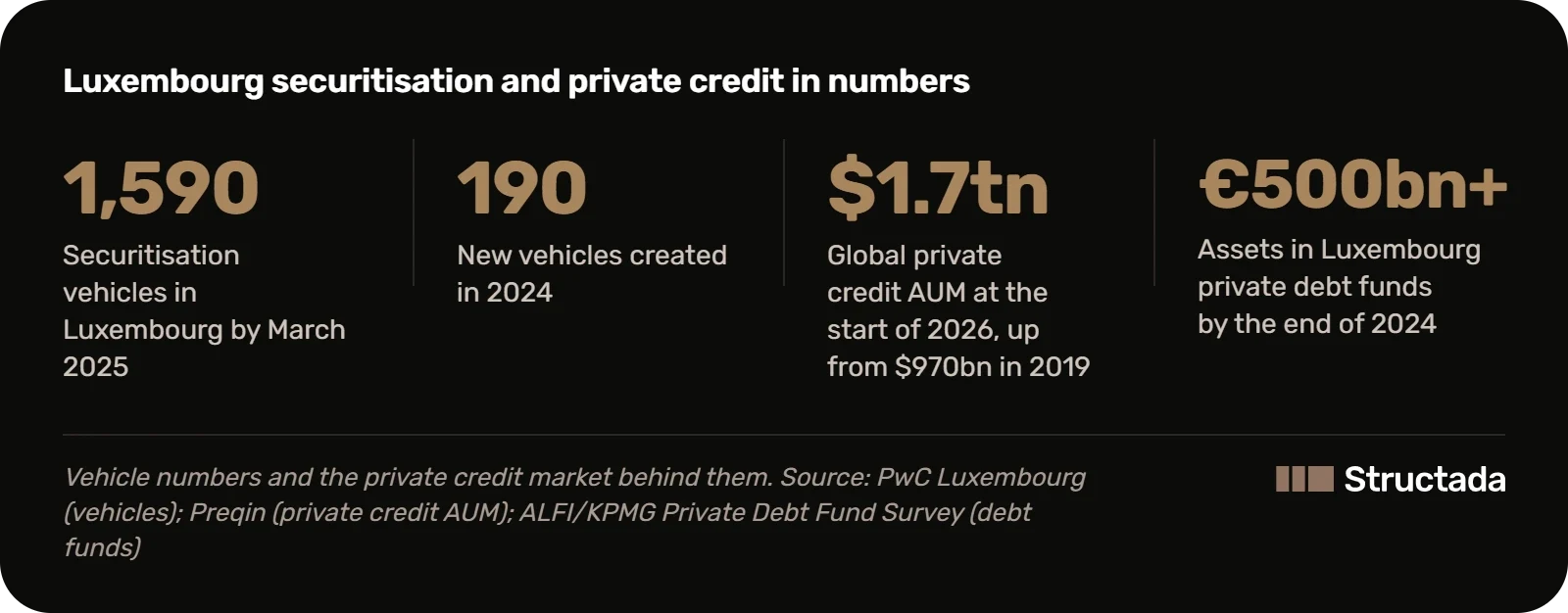
Luxembourg has spent two decades building the infrastructure that makes it Europe's centre for securitisation: a purpose-built legal framework, a deep service provider market, and tax and settlement arrangements that few jurisdictions can match. Around 1,590 securitisation vehicles were registered there by March 2025, with 190 created in 2024, according to PwC Luxembourg.
What has changed recently is what asset managers can build on that foundation. Several developments are reshaping Luxembourg securitisation trends at once: a reformed law that allows active management, legislation for digital issuance, the rapid growth of private credit, and a broader institutional appetite for securitised credit. Each opens a different opportunity for managers structuring private credit and alternative asset strategies, and each brings its own practical demands.
The 2022 reform of the securitisation law
The most consequential recent change came from the 2022 modernisation of the Law of 22 March 2004 on Securitisation. Before the reform, a securitisation vehicle's portfolio had to be managed passively, which ruled out any strategy that depended on ongoing trading or rebalancing of the underlying exposures.
The amended law permits active management, under conditions, for vehicles financing debt securities, financial instruments or receivables that are not issued to the public, and that management can be delegated to a third party. It removed the previous borrowing restriction, so a vehicle can now incur debt to finance the acquisition of its assets, which matters directly for strategies that rely on leverage. It broadened the scope of eligible collateral and clarified how security interests attach to a vehicle's assets, giving investors more certainty over enforcement. And it made partnership structures available, including the common limited partnership and the special limited partnership, both offering tax-transparent treatment and no longer requiring incorporation before a notary.
For asset managers, this reform turned the Luxembourg vehicle from a static, buy-and-hold wrapper into something closer to a managed strategy. A CLO manager, a private credit fund running an actively traded loan book, or a manager rebalancing a receivables pool as it turns over can now operate within a structure that would have been unworkable before 2022. Our guide to the Luxembourg securitisation law covers the framework in full.
Tokenisation and digital securities
Luxembourg has also moved early on the tokenisation of financial instruments. It implemented the EU's DLT Pilot Regime through domestic legislation generally referred to as the Blockchain III Law, which builds on two earlier laws recognising distributed ledger technology as a valid means of holding and transferring securities. In practice, a securitisation vehicle can issue notes as digital securities recorded and transferred on a distributed ledger, rather than through the traditional chain of custodians and registrars.
The appeal for managers is largely operational. A tokenised note can settle faster, involve fewer intermediaries and give investors and administrators a shared, verifiable record of who holds what. Interest in tokenised private credit is growing, and Luxembourg's early regulatory clarity is a large part of why managers exploring digital issuance look there first. It remains an early-stage part of the market, however, and most issuance still settles conventionally through Euroclear and Clearstream.
Private credit and the growth of debt funds
Private credit has been the largest single driver of new securitisation activity in Luxembourg over the past few years. Global private credit assets under management reached roughly $1.7 trillion at the start of 2026, according to Preqin, up from around $970 billion in 2019, and a meaningful share of that growth has been structured or serviced through Luxembourg vehicles. The domestic industry has grown alongside it: assets across Luxembourg-domiciled private debt funds and sub-funds passed €500 billion by the end of 2024, according to the ALFI/KPMG Private Debt Fund Survey, having grown by close to 25% in the preceding twelve months.
The link to securitisation follows from the asset class itself. Private credit strategies generate loans and receivables that need financing, warehousing or risk transfer, and securitisation serves all three. Direct lenders use Luxembourg vehicles to fund loan portfolios ahead of a later securitisation or sale. Managers use credit linked notes to pass defined slices of credit risk to investors without disturbing the underlying borrower relationship, an approach that sits alongside the traditional private credit fund. And the same compartments that support one strategy let a manager run several funding lines from a single vehicle. As private credit continues to take share from bank lending, the structures built to service it are likely to keep growing.
Institutional investor appetite for securitised credit
Pension funds, insurers, sovereign wealth funds and large asset managers have become considerably more comfortable allocating to securitised credit than they were a decade ago. Several forces are at work: a prolonged search for yield when traditional fixed income has not always delivered it, growing familiarity with how these structures work after years of use in private credit, and the operational comfort of notes settling through Euroclear and Clearstream alongside the rest of an institution's fixed income holdings.
Compartmentalisation is a specific advantage here. A single vehicle can issue different series of notes, or use a master-feeder arrangement, to bring in several investor groups without a separate legal entity for each. For a manager working with several institutions at once, that keeps documentation standardised and the legal cost of adding an investor low, which makes it easier to accommodate an institution that wants more scale than a bilateral facility could provide.
Challenges and considerations for managers
None of this growth comes without friction. Luxembourg's AML and KYC standards are well established and internationally recognised, which helps with onboarding, but they must be applied properly to every investor and counterparty, and the burden grows with the number of parties. Transfer pricing needs equal care: where a vehicle transacts with related parties, whether an originator, a manager or an affiliated servicer, pricing must be set and documented on an arm's-length basis to satisfy both the Luxembourg tax authorities and those of investors' home jurisdictions.
Cost is the third consideration. Luxembourg remains competitively priced against London, Dublin and New York, but it is not the cheapest option for every structure. For a smaller or simpler transaction, a manager should weigh the cost of Luxembourg's service providers, compartments and administration against what a simpler structure elsewhere might achieve, a comparison our guide to Luxembourg securitisation costs explores. Managers who plan for these issues at the outset rarely find them a serious obstacle later.
What this means for issuers
Taken together, these trends point in one direction. Luxembourg's securitisation regime has become more flexible, more digitally capable and more deeply embedded in how private credit is funded, while the institutional investor base willing to hold its notes has grown. For a manager deciding where to structure a new strategy, that combination is difficult to match elsewhere in Europe.
The opportunity, though, belongs to managers who use the new freedoms deliberately. Active management and leverage widen what a vehicle can do, and they also widen what its documentation must govern: eligibility criteria, management limits, borrowing terms and the rights of each class of noteholder. The managers who benefit most build the structure around the strategy from the start, with sound documentation and proper due diligence, rather than stretching an old buy-and-hold template to fit a new kind of portfolio.