- Credit linked notes (CLNs) typically offer investors a fixed return in the region of 8–12% per annum, anchored to identified underlying assets rather than a blind-pool commitment.
- A CLN can be linked to a specific loan pool or portfolio, settled through international clearing systems and structured around an investor's maturity and risk preferences.
- For growing businesses with cash-generating assets, CLNs provide non-dilutive funding that can be cheaper than venture debt and shaped to mirror actual repayment cash flows.
- Issuing through a jurisdiction such as Luxembourg, with settlement through Euroclear and Clearstream, lets a business reach professional investors well beyond a single lending relationship.
- The structure suits lending, trade finance, renewable energy and contractual revenue businesses, where the assets behind the notes can be clearly defined and reported on.
Two pressures are meeting in the private credit market. Professional investors want contractual income backed by assets they can see, without the long lock-ups and opaque deployment of a traditional fund. Growing businesses with real, cash-generating assets want to fund their next stage without surrendering equity at a poor valuation or accepting the terms of venture debt.
The credit linked note sits where those two needs meet. Once used mainly by banks to manage their own credit exposure, CLNs are now a practical funding tool for specialist lenders, trade finance houses and other asset-rich businesses, and a familiar holding for family offices, private banks and wealth managers.
Understanding why growing businesses use credit linked notes means looking at both sides of the transaction, because a note only works when the business's assets and the investor's requirements fit together.
What is a credit linked note?
A credit linked note is a structured debt security whose payments depend on the credit performance of a defined underlying asset or portfolio, such as a pool of consumer loans, trade receivables, real estate debt or contractual revenues. Investors receive regular coupons and the return of principal at maturity, provided no credit event occurs on the reference assets.
The notes are issued by a securitisation vehicle, often a compartment of a Luxembourg securitisation vehicle, and carry an ISIN so they can be held and settled like any other bond. That combination of identified assets and standard settlement is what makes the instrument useful to both sides.
Why professional investors buy credit linked notes
The first reason is predictable yield. CLNs typically offer a fixed return in the region of 8–12% per annum, paid as regular coupons, with capital returned at maturity provided no credit event occurs. Where listed bonds often pay less than inflation and equities carry growing volatility, contractual income of that kind is attractive to allocators building a stable portfolio.
The second is visibility. A CLN is anchored to real underlying assets, and investors know what they are exposed to. Governance arrangements, including servicer reporting, trustee oversight and periodic portfolio data, allow those assets to be monitored. For allocators taking a first step into private credit, a defined downside, visible collateral and a contractual income stream are a comfortable combination.
The third is flexibility. Professional investors have grown wary of commitments that lock up capital for years against an uncertain deployment schedule. A CLN can be linked to a specific loan pool, portfolio or business, structured to be booked and transferred through international clearing systems, and shaped around an investor's maturity preferences and risk appetite. That lets an investor size exposure to a niche credit strategy precisely, without committing to a large blind fund.
Finally, CLNs reach investors through familiar channels. Historically they were the preserve of banks and large institutions. Through specialist arrangers, they are now available to professional investors via private banks, brokers, family offices and investment platforms, settled through existing custodians and booked alongside traditional holdings. Our guide to how credit linked notes reach investors describes those routes in more detail.
Why growing businesses issue credit linked notes
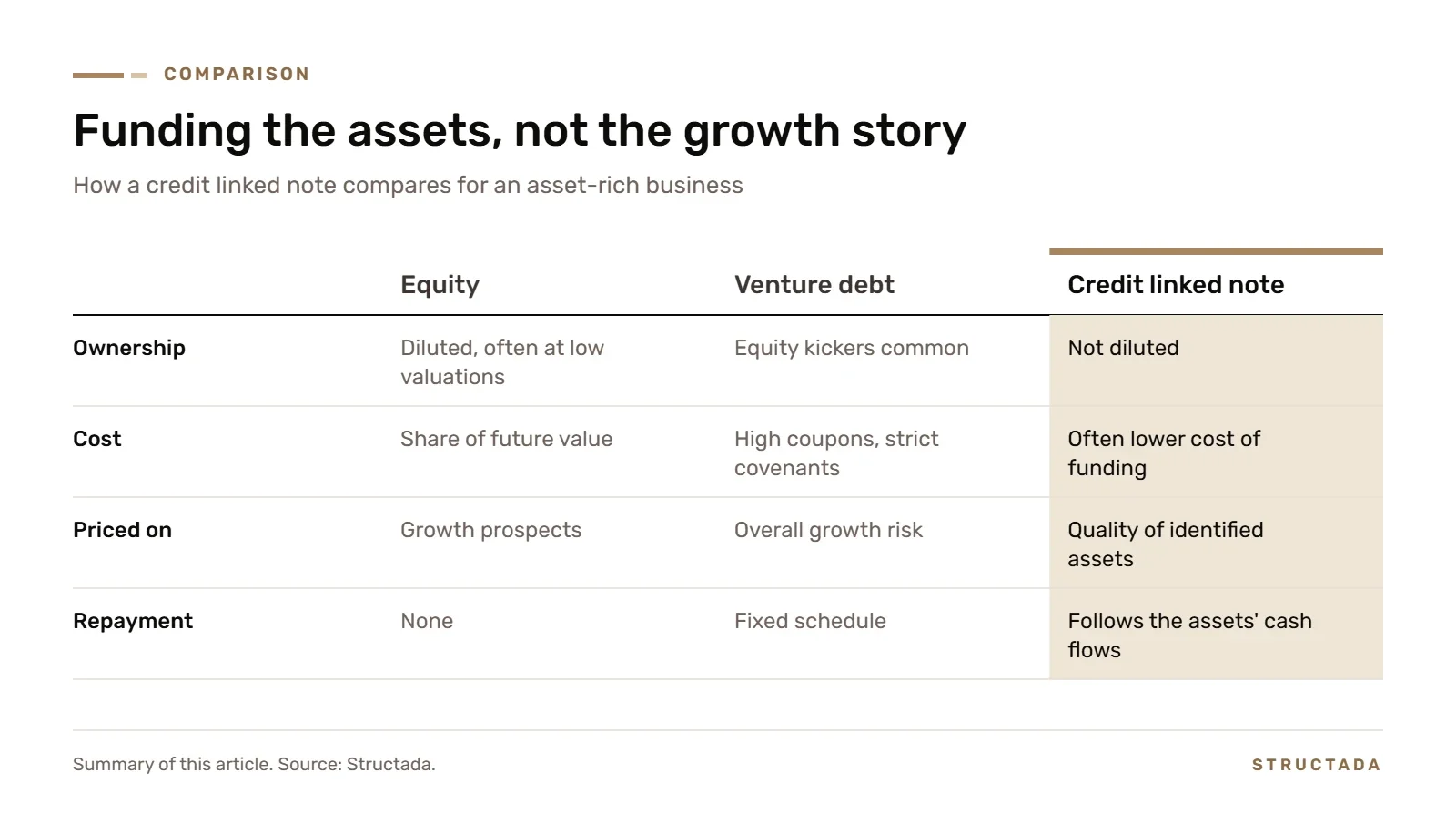
From the outside, a CLN can look like a purely investor-facing product. For a business with predictable, cash-generating assets, it is equally a corporate finance tool, and it competes directly with equity and conventional debt.
The most obvious advantage is that it is non-dilutive. Founders are increasingly reluctant to give away equity at depressed valuations, and funding the business's assets through notes protects ownership and long-term control. The notes are serviced from the assets they are linked to, so the funding scales with the loan book or receivables pool rather than with the shareholder register.
Cost is the second consideration. Venture debt has become a blunt instrument, with high coupons, equity kickers and strict covenants. A CLN can often be structured at a lower cost of funding, because investors are pricing the credit quality of identified assets rather than the business's overall growth risk. The comparison with conventional bilateral lending turns on the same point: the note looks through to the assets.
The third advantage is fit. A CLN can mirror the business's actual repayment profile, whether that is receivables collections, loan repayments or subscription revenues. Coupons and amortisation follow the cash the assets generate, which makes the structure far more adaptable than a standard lending product with a fixed repayment schedule that bears little relation to the underlying book.
Reaching a global investor base
A bilateral lender, however supportive, is one balance sheet with its own limits and appetite. Issuing a CLN through Luxembourg or a similar jurisdiction gives a business access to a much wider pool. Through settlement infrastructure such as Euroclear and Clearstream, notes can be purchased by professional investors worldwide and held in the custody accounts they already use.
That reach brings resilience. A business funded by many noteholders depends less on any single relationship, and each new series can be offered to the investors already familiar with the issuer's assets and reporting. Over time, a regular programme of notes builds a track record that makes later issues quicker to place.
Which businesses suit credit linked notes?
The structure works best where the assets behind the notes are predictable, contractual and capable of clear reporting. Specialist lenders with consumer, SME or property loan books are natural issuers, as are trade finance businesses with short-dated receivables. Renewable energy projects with long-term offtake contracts and businesses with contractual subscription or lease revenues can also fit, provided the cash flows can be identified, ring-fenced and monitored.
Businesses without such assets, or whose value lies mainly in future growth, are generally better served by equity. The discipline of a CLN rewards issuers that can show investors exactly what stands behind each note, and how it has performed. Our guide for non-bank lenders looks at that case specifically.
What this means for issuers
For a growing business with a book of cash-generating assets, a credit linked note can fund the next stage of growth on terms that equity and venture debt struggle to match: no dilution, pricing tied to asset quality and repayment that follows the cash the assets produce. For investors, the same note offers contractual, asset-backed yield in a form they can hold through their existing custodians.
The businesses that benefit most treat the note as an ongoing funding channel rather than a single transaction. They invest early in clean data, consistent reporting and a vehicle that can issue repeatedly, because the second and third series are where the structure pays for itself. Our guide to how to issue a credit linked note sets out the steps from term sheet to settlement.
Frequently Asked Questions
What is a credit linked note?
A debt security whose payments depend on a defined credit exposure, such as a loan or pool of receivables. Our complete guide to credit linked notes explains the structure in full.
Why do growing businesses issue credit linked notes?
To fund specific assets without giving up equity, at a cost tied to those assets, from a wider pool of investors than a single lender can provide.
Who invests in credit linked notes?
Professional investors, including family offices, private banks, wealth managers and institutions.
What returns do credit linked notes offer?
CLNs typically offer investors a fixed return in the region of 8–12% per annum, depending on the underlying assets and the structure.
Is a credit linked note the same as a loan note?
Both are debt. A loan note is usually a bilateral, unlisted instrument, while a credit linked note is a security issued through a securitisation vehicle, with an ISIN, linked to a defined credit exposure.
What kinds of businesses suit credit linked notes?
Businesses with predictable, cash-generating assets, such as specialist lenders, trade finance houses, renewable energy projects and contractual revenue businesses.