

- The Vienna MTF is the multilateral trading facility run by Wiener Börse, used widely to list bonds, notes and private placements.
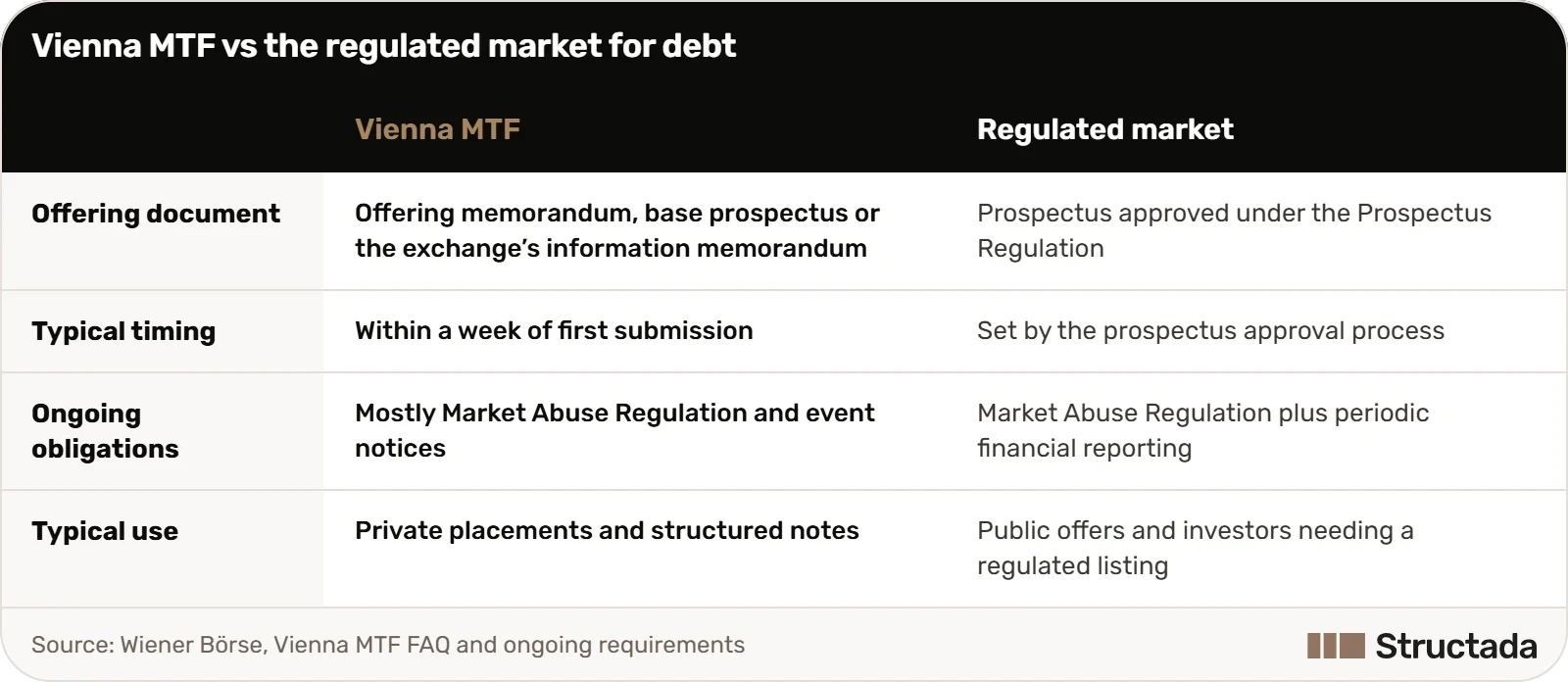
- A prospectus approved under the EU Prospectus Regulation is not required. An offering memorandum, base prospectus or the exchange's information memorandum template is enough.
- Wiener Börse says a listing can typically be achieved within a week of first submission, and no listing agent is required.
- Ongoing obligations are mostly limited to the Market Abuse Regulation and notifying the exchange of key events. Ongoing financial statements are not required.
- The regulated market suits issuers that need a regulated listing, but it requires an approved prospectus and full periodic reporting.
Listing a note is rarely about trading. Almost all bond trading happens over the counter, and Wiener Börse says as much about its own markets. Issuers list because investors need it: some funds and insurers can only hold listed securities, many custodians and wealth platforms prefer them, and in some cases a listing unlocks a withholding tax exemption. The question is where to list with the least cost and friction, and the Vienna MTF has become one of the more popular answers.
What is the Vienna MTF?
The Vienna MTF is a multilateral trading facility operated by Wiener Börse, the Vienna Stock Exchange. It sits alongside the exchange's regulated market, known as the Official Market. Its forerunner, the Third Market, was set up in 1992; the exchange itself dates back to 1771. Our guide to a Vienna Stock Exchange listing covers the exchange more broadly.
Because it is an MTF rather than a regulated market, the listing rules are set by the exchange's own rulebook rather than by the EU Prospectus Regulation and Transparency Directive. That is where most of the savings in time and cost come from.
What documents are needed?
A prospectus approved under the Prospectus Regulation is not required. Wiener Börse accepts an offering memorandum or base prospectus where the issuer already has one. Where it does not, the exchange provides an information memorandum template that sets out the minimum disclosure. For notes issued under a programme, the programme document is listed and later series are added against it.
The issuer must also provide the terms and conditions of the notes, the ISIN, and the usual corporate authorisations. For notes issued by a securitisation vehicle, the vehicle's constitutional documents and the compartment's terms normally form part of the package.
Who can apply, and how long does it take?
Wiener Börse states that no listing agent is required to list on the Vienna MTF. The application can be made by the issuer or by a bank, law firm or adviser acting for it.
On timing, the exchange says a listing can typically be achieved within a week of first submission. It aims to reply to the first review within two days and to later reviews within one. If the final documents arrive by 11am Central European Time, approval can be granted the same day, and trading can begin two trading days later.
Ongoing obligations
This is the main difference from the regulated market. Wiener Börse describes the Vienna MTF's ongoing requirements as mostly limited to the Market Abuse Regulation. The issuer must tell the exchange if the issuer changes, if its name changes, if repayment of principal is at risk, if a coupon is missed or postponed, and if notes are redeemed early. Ongoing financial statements are not required.
Notes are delisted automatically at maturity. The exchange charges an annual fee for each listed ISIN, payable up front for the life of the listing and capped at 20 years, with a proportional refund if notes are redeemed early. There is no fee for listing an issuance programme itself.
Vienna MTF or regulated market?
The regulated market suits issuers that need a regulated listing, for example because certain investors' rules require it or because the notes will be offered to the public. It brings a prospectus approved by the relevant authority and periodic reporting under the Transparency Directive.
For notes placed privately with professional investors, a regulated listing usually adds cost without adding much for the buyer. The Vienna MTF gives a recognised listing, an exchange page with the note's details and a stable venue for the life of the note, with obligations sized for privately placed debt. Wiener Börse also states that Irish and English issuers can benefit from withholding tax exemptions on bonds listed there. Issuers should confirm their own position with tax advisers. Alternatives with a similar purpose include Euronext Dublin's Global Exchange Market and TISE.
What this means for issuers
For a privately placed note, a listing is a practical tool, not a marketing exercise. The Vienna MTF offers a quick route, light ongoing obligations and no need for a listing agent or regulated prospectus. The work is in preparing a clean information memorandum, aligning it with the note's terms and building the listing into the closing timetable rather than adding it afterwards.